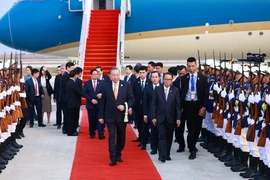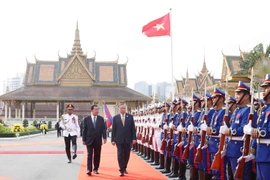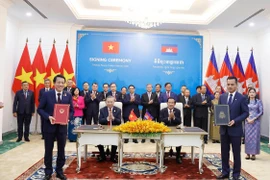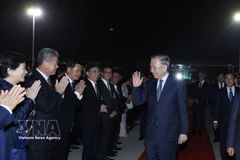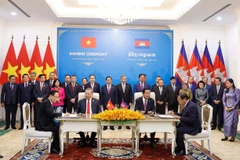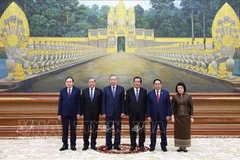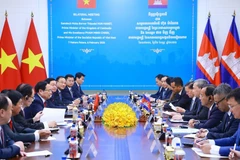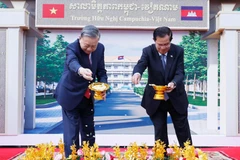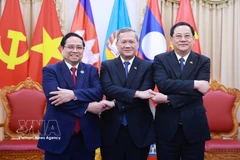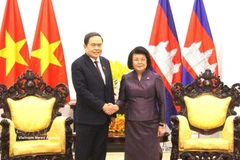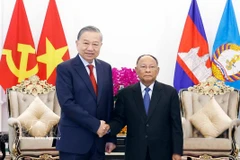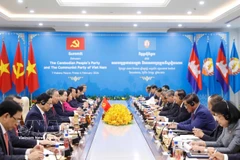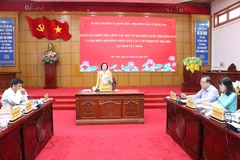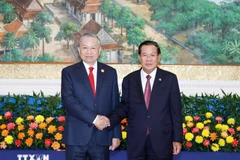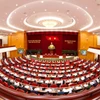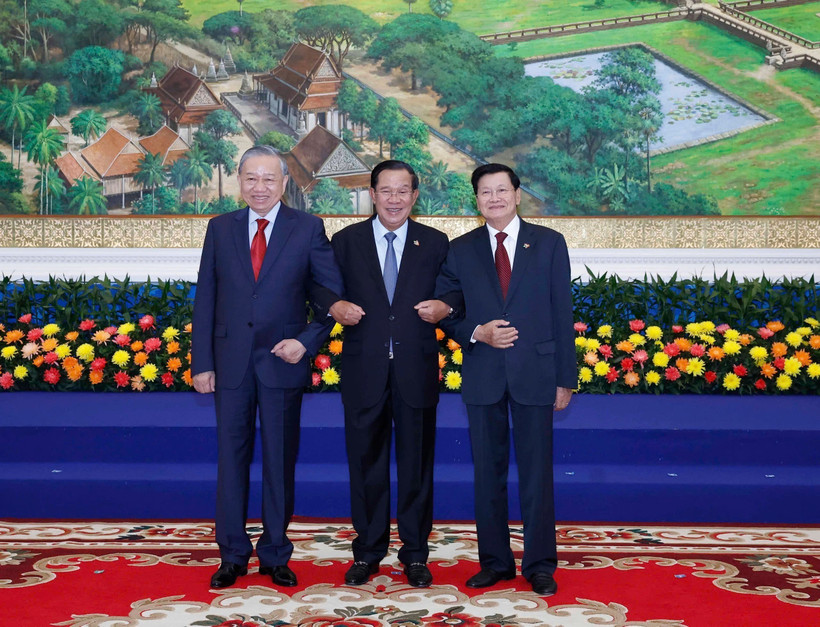
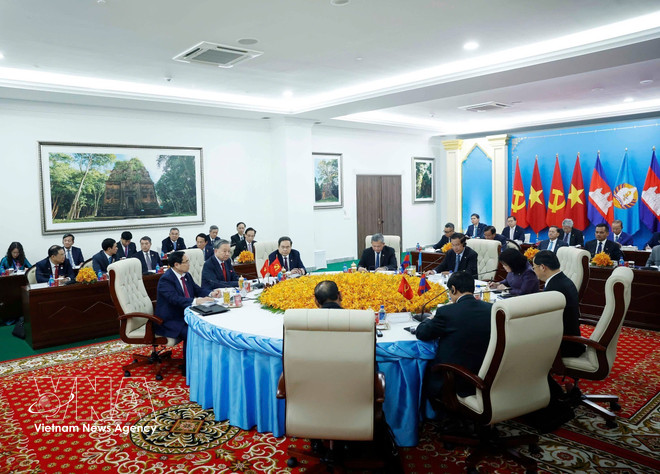
Phnom Penh (VNA) – General Secretary of the Communist Party of Vietnam (CPV) To Lam, President of the Cambodian People’s Party (CPP) Hun Sen and General Secretary of the Lao People’s Revolutionary Party (LPRP) Thongloun Sisoulith co-chaired a meeting of the chiefs of the three Parties at the CPP headquarters in Phnom Penh on February 6.
Also attending the meeting were the Prime Ministers of Vietnam, Cambodia and Laos; the Chairman of the Vietnamese National Assembly; and the President of the Cambodian National Assembly.
Held in a warm and friendly atmosphere, the leaders noted that the meeting took place as the CPV and the LPRP had successfully concluded their national congresses, while the CPP was effectively implementing its political platform for the 2023–2028 period, providing an important foundation for strengthening strategic exchanges, consolidating political trust and agreeing on major orientations for trilateral cooperation in a new stage of development.
General Secretary To Lam briefed the participants on Vietnam’s situation and the important and strategic outcomes of the 14th National Congress of the CPV, stressing that the congress reaffirmed the country's foreign policy of independence, self-reliance, multilateralisation and diversification of external relations, with priority given to the friendly neighbourliness and special traditional ties with Laos and Cambodia, as well as proactive and active contributions to peace, stability and cooperation in the region and the world.
 |
The Party chief underscored Vietnam’s consistent policy of attaching great importance to consolidating and developing the special solidarity and comprehensive cooperation among the three countries.
CPP President Hun Sen and LPRP General Secretary Thongloun Sisoulith thanked General Secretary To Lam for sharing Vietnam’s socio-economic achievements and the success of the 14th National Congress of the CPV. They lauded the CPV’s comprehensive reform policy, strategic mindset and leadership capacity in the new development period, expressing their confidence that under the CPV's sound leadership headed by General Secretary To Lam, Vietnam will successfully implement the congress’s resolution, becoming a developing country with modern industry and upper-middle income by 2030 and a developed socialist nation with high income by 2045.
Reviewing the past year, the three leaders agreed that the trilateral cooperation reaped positive achievements and has been strengthened and developed across all fields. Political and diplomatic relations remained the core pillar, while defence and security cooperation played a key role, with notable outcomes including the joint meeting of the defence ministers and a trilateral search-and-rescue exercise in Laos.
Economic, trade and investment cooperation recorded positive progress, they said, noting the strong economic growth of Vietnam, Cambodia and Laos at 8.02%, 6.3% and 4.2% in 2025, respectively. Meanwhile, they also highlighted growing people-to-people exchanges, locality-to-locality collaboration and effectiveness of communications on friendship and solidarity among the three countries. Vietnam, Laos and Cambodia held a youth festival in Quang Ngai province of Vietnam in 2025.
Against the backdrop of complex and rapidly evolving developments in the regional and world situation, the leaders agreed to further enhance solidarity, maintain regular consultation and strengthen coordination to safeguard legitimate interests of each country and preserve a peaceful and stable environment for development.
They agreed to continue maintaining the mechanism of regular meetings among the chiefs of the three Parties, governments, parliaments, ministers of public security, ministers of defence and ministers of foreign affairs and many other trilateral mechanisms; uphold the principle of not allowing any individual or organisation to use the territory of one country to harm others’ security; and strengthen border management and combat transnational crimes.
On economic, trade and investment cooperation, the three sides agreed to further deepen economic linkages in a more substantive, effective and sustainable manner, creating breakthroughs in closer connectivity in the fields of economy, infrastructure and participation in supply chains. This will be pursued by leveraging the complementary strengths of the three economies, particularly in the areas of institutions, finance, transport infrastructure, logistics, energy, telecommunications and tourism, while building production–consumption linkage chains.
They agreed to effectively implement signed agreements and cooperation frameworks, improve policies to facilitate trade, especially cross-border trade, ease the circulation of goods, services and investment among the three countries, and encourage and support businesses to expand investment in such areas as innovation, digital transformation, renewable energy, agriculture, high technology, processing industries, green development, digital economy and tourism.
To support one another in improving the quality of human resources to meet the requirements of a new development phase, the three Party chiefs reaffirmed their commitments to strengthening long-term education and training cooperation, viewing education and training as an important bridge linking younger generations and fostering understanding, trust and enduring friendship among the youth of the three countries.
They agreed to create the most favourable conditions possible, including renewing government scholarship programmes, granting scholarships and tuition exemptions or reductions for students from the two other countries studying in the remaining nation, considering this a key measure to strengthen education, training and human resource development cooperation.
They also agreed to enhance linkages and expand exchanges among lecturers and students of leading universities in the three countries, while coordinating the training of high-quality human resources to make practical contributions to each country’s sustainable development.
The Party leaders agreed to further promote practical and effective exchange and cooperation activities, step up information, education and mass mobilisation efforts among all strata of society, particularly young people, on the tradition of solidarity, special friendship and comprehensive cooperation among the three countries, and continue to bring into play the core role of mass organisations, friendship associations and border localities.
At the meeting, the three sides also exchanged views on international and regional issues of mutual concern.
The meeting of the leaders of the CPV, CPP and LPRP achieved very positive outcomes, covering all areas of cooperation among the three Parties and countries, and once again affirming that relations among the three Parties, countries and their people are of strategic and long-term significance.
At the end of the meeting, the leaders agreed to hold the fifth meeting of the heads of the three Parties in Laos in 2027./.