Party leader welcomes Hungarian President

The two leaders agreed to enhance political trust and connections between their countries and ruling parties, expand high-level and sectoral exchanges, and strengthen cooperation in trade, investment, science, technology, innovation, and education.

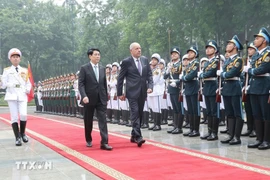
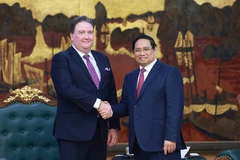
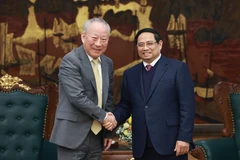
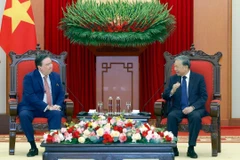
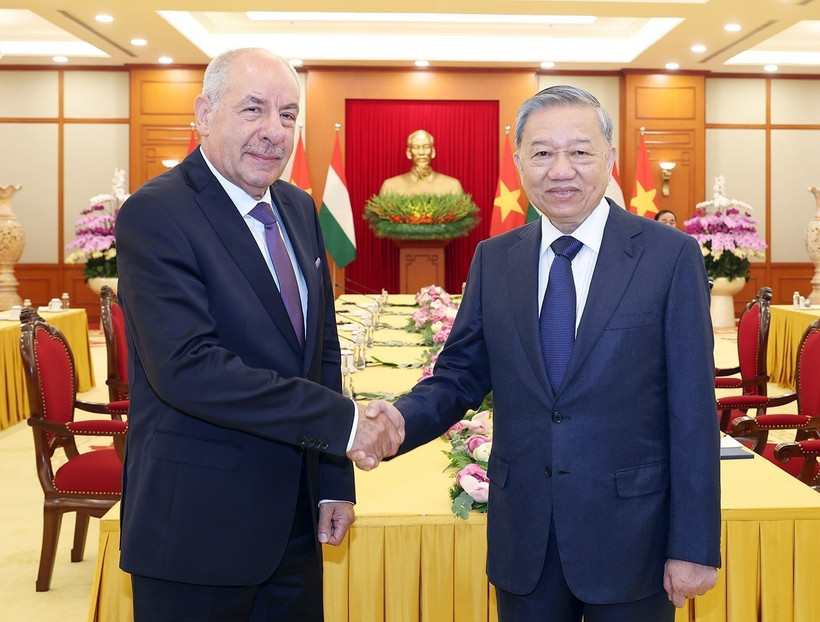
Party General Secretary To Lam (R) receives Hungarian President Sulyok Tamás in Hanoi on May 28. (Photo: VNA)

Hanoi (VNA) - Party General Secretary To Lam hosted a reception in Hanoi on May 28 for Hungarian President Sulyok Tamás who is paying an official visit to Vietnam from May 27-29.

General Secretary Lam welcomed President Sulyok’s visit, which coincides with the 75th anniversary of diplomatic relations between Vietnam and Hungary (1950–2025), injecting fresh momentum into bilateral ties.

The Party chief expressed gratitude for Hungary’s support during Vietnam’s past struggle for national liberation and reunification, as well as in its ongoing development. He underlined the special bond between the two nations and reaffirmed that Vietnam regards Hungary as a top priority partner in Central and Eastern Europe. Vietnam, he added, is ready to serve as a bridge between Hungary and Southeast Asia and sees Hungary as a vital gateway for enhancing ties with Central and Eastern Europe and the EU.

Praising Hungary’s achievements in socio-economic development and European integration, the Party chief noted the country’s growing prestige in the region. He also outlined Vietnam’s development vision, aiming to become a developing country with modern industry and upper-middle-income by 2030 and a high-income developed nation by 2045.

The General Secretary hailed the fruitful outcomes of President Sulyok’s talks with President Luong Cuong and the positive progress in bilateral relations.

He discussed key directions and measures for deepening bilateral traditional friendship, including leveraging existing mechanisms like the Joint Economic Committee, capitalising on the EU-Vietnam Free Trade Agreement (EVFTA) and the upcoming EU-Vietnam Investment Protection Agreement (EVIPA), and convening the Joint Committee on Science and Technology Cooperation at an early date.
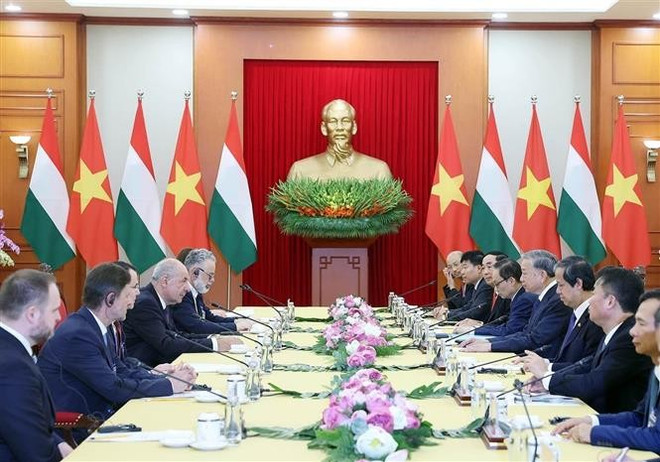
vna-potal-tong-bi-thu-to-lam-tiep-tong-thong-hungary-8059617.jpg
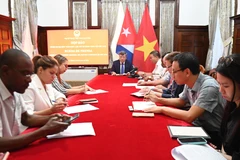
An overview of the reception (Photo: VNA)

He called for greater cooperation in innovation and suggested Hungary help train Vietnamese nuclear energy specialists.

Both sides agreed to boost cooperation in education, agriculture, pharmaceuticals, labour, culture, and locality-to-locality exchanges. They also agreed to jointly mark the 75th anniversary of diplomatic ties throughout this year.

President Sulyok recalled his student days alongside Vietnamese friends and following Vietnam’s struggle for independence, confident in its eventual victory. He congratulated Vietnam on its remarkable reform achievements, which have raised its capacity and international standing, and voiced his belief that Vietnam will continue to achieve more successes and advance to a new development era.

President Sulyok reaffirmed that Hungary attaches great importance to the longstanding friendship with Vietnam and sees Vietnam as a key partner in Southeast Asia.

He highlighted that cooperation between Hungary’s ruling Fidesz Party and the Communist Party of Vietnam is a vital channel for strengthening bilateral ties. The Hungarian President expressed his delight at the recent progress in relations between the two countries, especially since the establishment of their comprehensive partnership in 2018.

The two leaders agreed to enhance political trust and connections between their countries and ruling parties, expand high-level and sectoral exchanges, and strengthen cooperation in trade, investment, science, technology, innovation, and education.

They emphasised the need to make defence-security a new pillar of cooperation and to increase people-to-people exchanges to deepen mutual understanding.

President Sulyok also recognised the Vietnamese community and students in Hungary as an important force contributing to the host country’s socio-economic development.

The two sides committed to continued close coordination and mutual support at multilateral forums, particularly the UN and ASEAN–EU framework, and reiterated support for peaceful settlement of disputes in line with international law to help maintain peace, stability, and security in the region and globally./.
VNA

See more

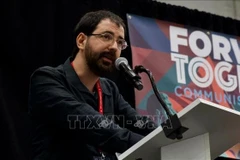
Assaf Talgam, a historian and a journalist of Zo HaDerekh, the official newspaper of the Communist Party of Israel. (Photo: VNA)

CPV's leadership - central factor shaping Vietnam’s enduring stability, impressive achievements: Israeli historian

Talgam said that from a comparative and historical perspective, the CPV’s leadership has been the central factor underpinning the country’s enduring political stability and impressive development trajectory. In a world marked by rapid and unpredictable changes, few political organisations have been able to maintain continuity of leadership while simultaneously adapting their governance approach as effectively as the CPV.

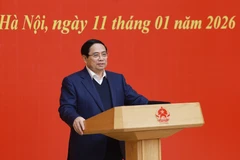
Prime Minister Pham Minh Chinh presents Certificates of merit from the Government’s Party Committee to individuals with outstanding achievements. (Photo: VNA)

Prime Minister outlines five specific strategies for Government’s Party Committee

PM Chinh noted that the Government’s Party Committee exercised comprehensive leadership over the Government's operations, proactively and effectively responded to emerging issues, with a particular focus on socio-economic development. As a result, 2025 witnessed high economic growth, sustained macroeconomic stability and ensured major balances.

Politburo member, Standing member of the Party Central Committee’s Secretariat Tran Cam Tu attends the rehearsal. (Photo: VNA)

Security forces stage rehearsal for 14th National Party Congress

The People’s Public Security forces have been praised for their core role in closely working with the army and relevant ministries and agencies, with success in thwarting hostile plots at an early stage, drastically combating fake news and disinformation surrounding the 14th National Party Congress.

Senior Lieutenant General Le Quoc Hung (L), member of the Communist Party of Vietnam (CPV) Central Committee and Deputy Minister of Public Security, and General Vilay Lakhamfong, Politburo member and permanent member of the Secretariat of the Lao People’s Revolutionary Party (LPRP) Central Committee. (Photo: VNA)

Deputy Minister of Public Security congratulates Lao officials following succesful 12th National Party Congress

Deputy Minister of Public Security Senior Lieutenant General Le Quoc Hungconveyed the warmest congratulations of the Central Public Security Party Committee, the Ministry of Public Security leadership, and the Vietnamese People’s Public Security Forces to Lakhamfong and other Lao public security leaders on the congress’s success and their election to key leadership positions for the new term.

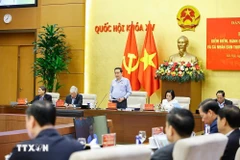
A session of the National Assembly Standing Committee. (Photo: VNA)

NA Standing Committee's key work agenda for 2026 approved

A major focus will be preparations for the election of deputies to the 16th NA and to People’s Councils at all levels for the 2026–2031 term. The NASC will coordinate with the National Election Council, the Government, the Vietnam Fatherland Front Central Committee, and relevant agencies and organisations to continue implementing the election plan, organise oversight of the electoral process, and carry out its duties and powers as prescribed.

Party General Secretary To Lam receives US Ambassador Marc Evans Knapper in Hanoi on January 9, 2026. (Photo: VNA)

Party leader receives outgoing US Ambassador

Vietnam always values its relationship with the US and looks forward to continuing close cooperation with the US government to deepen bilateral relations based on mutual respect for each other’s independence, sovereignty, territorial integrity, and political institutions, contributing positively to peace, stability, cooperation, and development regionally and globally.