The 32-km-long Pha Din pass with its highest peak at 1,648 metresabove sea level is the gateway to the northwestern mountainous provinceof Dien Bien. Sixty years ago, Pha Din pass was the place from whichsoldiers pulled the artilleries up the mountain to the Dien Bien Phubattlefield. A report by radio The Voice of Vietnam (VOV).
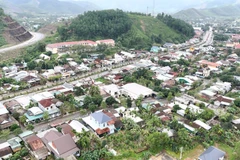
The terrain of the Pha Din pass now is not as difficult as before thoughthere are still eight sharp zigzag bends along the road. Work has beendone to lower the altitude of the pass and to widen the road, making iteasier to go through it. Pha Din pass becomes picturesque with greenscenery dotted with bamboo houses of the Thai ethnic minority people.
Sixty years ago, the pass was part of the pipeline supplyingammunitions and food to the Dien Bien Phu battlefield. Everyday,thousands of people, including young volunteers, militia and workers,carried ammunition and rice up the mountain through the pass.
It was also the place where ground forces and artillerymen marched through to Dien Bien Phu.
Musiccomposer Hoang Van, who composed the song “Artillery pulling chant”,still remembers the marches through Pha Din pass 60 years ago, saying:"Before entering Muong Thanh field, we had to go through a long zigzagpass, soldiers moved through on foot while transporters pushed bicyclescarrying supplies to the front."
The supply line began in late1953. The pass was dozens of kilometres and winding while French planescontinuously bombarded, he said. "At that time, we had to be careful toavoid enemy bombings. After that, we had to pull artillery up themountain. All these experiences inspired me to compose the song'Artillery pulling chant'.”.
Pha Din pass was the mostdifficult section in the long journey of moving the artilleries. AfterPha Din pass, soldiers had to pull their weapons over many slopes,abysses and high peaks to move toward Him Lam, Doc Lap and A1 hills andultimately French commander De Castries' bunker. The Dien Bien soldiers’efforts to haul their weaponry are unimaginable.
“As we hauledour ammunitions, dozens of people were arranged at each end of theartileries. At one end, some people pulled the cannons and at the other,some people pushed it. We used a winch and put a roller inside to pullthe artilleries," Van said.
It is now about dozens ofkilometres from Pha Din pass to Dien Bien city. During the Dien Bien Phucampaign, the length of the road was not calculated by kilometres butby the hardship that the soldiers suffered.
There were differentroads for transporting supplies to carry artilleries to the battlefield.Some roads were used for just a few hours for artilleries to go throughand then hidden by the forest as if they had never existed.
Therewas a special section of the road that was 15 km long and built within20 hours running the distance from Na Nham forest to Ngheu hamlet. Onthat road, Vietnamese soldiers manually pulled 2.4-tonne artilleries,75-mm canons and 120-mm mortars through difficult mountains, deepabysses and enemy bombings to join the opening battle of the Dien BienPhu campaign on March 13, 1954.
Pham Duc Cu, a formerartilleryman at Dien Bien Phu, recalled: “Our condition was very harsh.When we were 15 to 18 km from Dien Bien Phu, we had to pull theartilleries with our hands. It was the most difficult section of theroad. The Dien Bien artillerymen must have been made of bronze bodiesand iron feet. We will never forget the winding roads and slopes in BayToi, U Mau, Suoi Ngua and Voi Phuc, where we pulled 2.4-tonneartilleries to their positions in the battlefield”.
A monumentto the memory of hero To Vinh Dien, who used himself to save anartillery piece from sliding down to abyss, and his artillery platoonwas erected 20 km from Dien Bien. The monument reminds youngergenerations of Vietnam’s glorious history and the heroic soldiers ofDien Bien Phu.-VNA
The terrain of the Pha Din pass now is not as difficult as before thoughthere are still eight sharp zigzag bends along the road. Work has beendone to lower the altitude of the pass and to widen the road, making iteasier to go through it. Pha Din pass becomes picturesque with greenscenery dotted with bamboo houses of the Thai ethnic minority people.
Sixty years ago, the pass was part of the pipeline supplyingammunitions and food to the Dien Bien Phu battlefield. Everyday,thousands of people, including young volunteers, militia and workers,carried ammunition and rice up the mountain through the pass.
It was also the place where ground forces and artillerymen marched through to Dien Bien Phu.
Musiccomposer Hoang Van, who composed the song “Artillery pulling chant”,still remembers the marches through Pha Din pass 60 years ago, saying:"Before entering Muong Thanh field, we had to go through a long zigzagpass, soldiers moved through on foot while transporters pushed bicyclescarrying supplies to the front."
The supply line began in late1953. The pass was dozens of kilometres and winding while French planescontinuously bombarded, he said. "At that time, we had to be careful toavoid enemy bombings. After that, we had to pull artillery up themountain. All these experiences inspired me to compose the song'Artillery pulling chant'.”.
Pha Din pass was the mostdifficult section in the long journey of moving the artilleries. AfterPha Din pass, soldiers had to pull their weapons over many slopes,abysses and high peaks to move toward Him Lam, Doc Lap and A1 hills andultimately French commander De Castries' bunker. The Dien Bien soldiers’efforts to haul their weaponry are unimaginable.
“As we hauledour ammunitions, dozens of people were arranged at each end of theartileries. At one end, some people pulled the cannons and at the other,some people pushed it. We used a winch and put a roller inside to pullthe artilleries," Van said.
It is now about dozens ofkilometres from Pha Din pass to Dien Bien city. During the Dien Bien Phucampaign, the length of the road was not calculated by kilometres butby the hardship that the soldiers suffered.
There were differentroads for transporting supplies to carry artilleries to the battlefield.Some roads were used for just a few hours for artilleries to go throughand then hidden by the forest as if they had never existed.
Therewas a special section of the road that was 15 km long and built within20 hours running the distance from Na Nham forest to Ngheu hamlet. Onthat road, Vietnamese soldiers manually pulled 2.4-tonne artilleries,75-mm canons and 120-mm mortars through difficult mountains, deepabysses and enemy bombings to join the opening battle of the Dien BienPhu campaign on March 13, 1954.
Pham Duc Cu, a formerartilleryman at Dien Bien Phu, recalled: “Our condition was very harsh.When we were 15 to 18 km from Dien Bien Phu, we had to pull theartilleries with our hands. It was the most difficult section of theroad. The Dien Bien artillerymen must have been made of bronze bodiesand iron feet. We will never forget the winding roads and slopes in BayToi, U Mau, Suoi Ngua and Voi Phuc, where we pulled 2.4-tonneartilleries to their positions in the battlefield”.
A monumentto the memory of hero To Vinh Dien, who used himself to save anartillery piece from sliding down to abyss, and his artillery platoonwas erected 20 km from Dien Bien. The monument reminds youngergenerations of Vietnam’s glorious history and the heroic soldiers ofDien Bien Phu.-VNA