PM chairs national conference on drug prevention, control programme to 2030

Prime Minister Pham Minh Chinh on October 9 chaired a nationwide teleconference to launch the National Target Programme on Drug Prevention and Control to 2030, with connections to 34 provinces and cities and 3,321 communes, wards, and special zones.

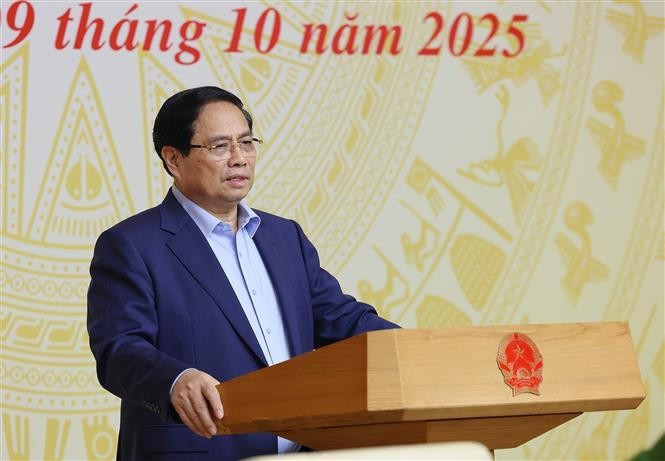
Prime Minister Pham Minh Chinh on October 9 chairs a nationwide teleconference to launch the National Target Programme on Drug Prevention and Control to 2030. (Photo: VNA)

Hanoi (VNA) – Prime Minister Pham Minh Chinh on October 9 chaired a nationwide teleconference to launch the National Target Programme on Drug Prevention and Control to 2030, with connections to 34 provinces and cities and 3,321 communes, wards, and special zones.

Addressing the conference, the PM said the event holds important significance in strengthening political commitment, ensuring unified awareness, and setting out clear responsibilities for each stakeholder under the principle of “six clarities” — the clarity of personnel, tasks, timeline, responsibility, authority, and results.

PM Chinh stressed that the Party and the State have always attached special importance to drug prevention and control, issuing and implementing many strategic programmes that have produced positive outcomes. However, he noted that drug-related crimes remain complex, with trafficking and transport continuing to rise despite strict penalties. Statistics from the Ministry of Public Security show increases in the number of cases, offenders, and seized narcotics, with Vietnam facing the risk of becoming a transit hub for drug trafficking. The issue of drugs infiltrating schools and the growing number of young addicts is particularly alarming, he said.
vna-potal-thu-tuong-chu-tri-hoi-nghi-trien-khai-chuong-trinh-muc-tieu-quoc-gia-phong-chong-ma-tuy-den-nam-2030-8326527.jpg
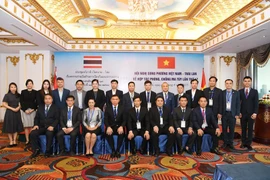
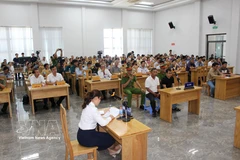
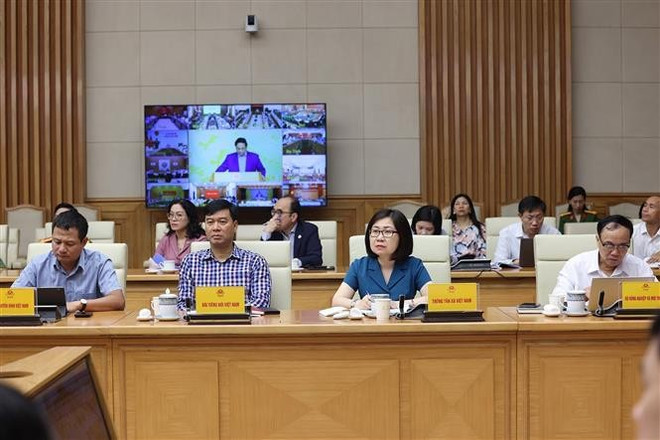
Delegates at the conference. (Photo: VNA)

According to the PM, drug prevention and control must not rely solely on the police but require the joint efforts of the entire political system and society, including ministries, agencies, local authorities, the Vietnam Fatherland Front, and mass organisations, especially at the grassroots level.

He emphasised the need for solutions to eradicate areas with complex drug-related issues, particularly drug abuse in schools, and to effectively implement the approach of “three reductions” — reducing supply, reducing demand, and reducing harm.

The government has submitted to the National Assembly the National Target Programme on Drug Prevention and Control to 2030 for approval.

According to PM Chinh, the effective implementation of this programme is crucial to reversing the growing threat of drugs, protecting people’s health and safety, and creating momentum for comprehensive and sustainable progress in national drug control efforts.

He also cited Party General Secretary To Lam’s recent direction calling for the building of “drug-free provinces and cities,” describing it as a demanding but meaningful goal that would bring far-reaching social impact if achieved.

The programme, approved by the government in March and outlined with specific tasks and measures by the Ministry of Public Security in September, aims to mobilise the collective strength of the political system and society in the fight against drugs, with a focus on grassroots-level prevention. By 2030, it targets at least 50% of communes and wards nationwide to be drug-free, and 100% of illegal drug cultivation and retail sites to be eliminated.

The total funding for the programme amounts to over 22,450 billion VND (851.73 million USD), sourced from the central and local budgets, as well as other legal sources./.
VNA

See more

Prime Minister Pham Minh Chinh talks to people receiving medical services at the Yen Khuong health station in Thanh Hoa province on November 9. (Photo: VNA)

PM visits residents, armed forces in Thanh Hoa's border commune

In Yen Khuong commune, the PM called for greater attention to school health, nutrition for children and the elderly, and the development of a civil-military medical cooperation model, not only to serve local residents but also to support people living across the border in Laos.

Party General Secretary To Lam (front, fourth from left) and officials mark the start of construction on the Na Ngoi Primary and Junior Secondary Boarding School in Na Ngoi commune, Nghe An province, on October 11, 2025. (Photo: VNA)

Work starts on inter-level boarding schools in border areas

The simultaneous beginning of construction on 72 schools, with the participation of leaders of the Government, ministries, sectors, and localities, is meant to reflect the strong determination and close coordination across the entire political system in caring for students in border areas.

Co.opmart Hue staff pack relief goods to ensure they reach those in need as quickly as possible. (Photo courtesy of Saigon Co.op)

Saigon Co.op rushes to deliver essential goods to storm-hit areas

The Saigon Union of Trading Cooperatives (Saigon Co.op) has urgently deployed an emergency support package, sending tens of tonnes of essential goods and relief teams to provinces hit by by recent historic storms and floods across central and northern Vietnam.

Local residents take the donated breeding cows home. (Photo: VNA)

Breeding cows presented to poor households along Vietnam–Cambodia border

Accordingly, leaders of the Border Guard High Command and Tay Ninh province of Vietnam, and Svay Teap district in Svay Rieng province of Cambodia presented 20 breeding cows, valued at 20 million VND (760 USD) each, to 20 households - 10 in Long Thuan commune (Tay Ninh) and 10 in Monorom commune of Svay Teap district.

Tuyen Quang province's tax officer assist people in carrying out tax payment procedures. (Photo: Nhandan.vn)

Tuyen Quang works hard to maximise state revenue in 2025

Tuyen Quang’s state budget revenue was estimated at more than 5.55 trillion VND (210.8 million USD) in the first 10 months of 2025, reaching 91% of the target assigned by the Prime Minister and 62.5% of the plan set by the provincial People’s Committee.

A ceremony in response to Vietnam Law Day held in Khuong Mai secondary school in Hanoi (Photo: nhandan.vn)

Vietnam Law Day to be observed in Hanoi

A national-scale ceremony marking Vietnam Law Day (November 9) is scheduled for November 7 afternoon in Hanoi, offering a chance for every citizen to uphold the spirit of respecting the Constitution and law, fostering a culture of legal compliance for the goal of wealthy people and a strong, democratic, equitable, and civilised nation.

The success of the Russian October Revolution had a profound impact on revolutionary movements around the world, including in Vietnam. Under the light of Marxism–Leninism and the October Revolution, Nguyen Ai Quoc found in it a “miraculous handbook,” the path to national salvation for the Vietnamese people. In the photo: The people of Hanoi seized the Residential Palace of the Tonkin Governor – the headquarters of the French-backed administration in northern Vietnam, marking the success of the August Revolution in Vietnam on August 19, 1945. (Photo: VNA Archives)

Russian October Revolution opens a window into Vietnam

On the eve of the 108th anniversary of the October Revolution, through a bilingual presentation by lecturer Hong Hoa and documentary footage, the question of how a revolution that took place in faraway Russia in 1917 could help an Asian nation like Vietnam achieve independence and freedom in 1945 was vividly explained to students born a century after the event.