PM inspects construction progress of Gia Binh International Airport

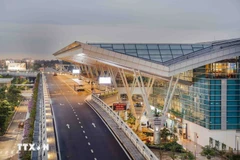
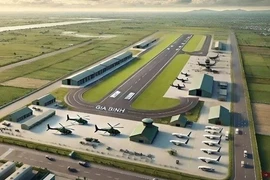
Gia Binh International Airport is expected to become one of the world’s top 10 five-star airports, serving 30 million passengers and handling 1.6 million tonnes of cargo annually by 2030.

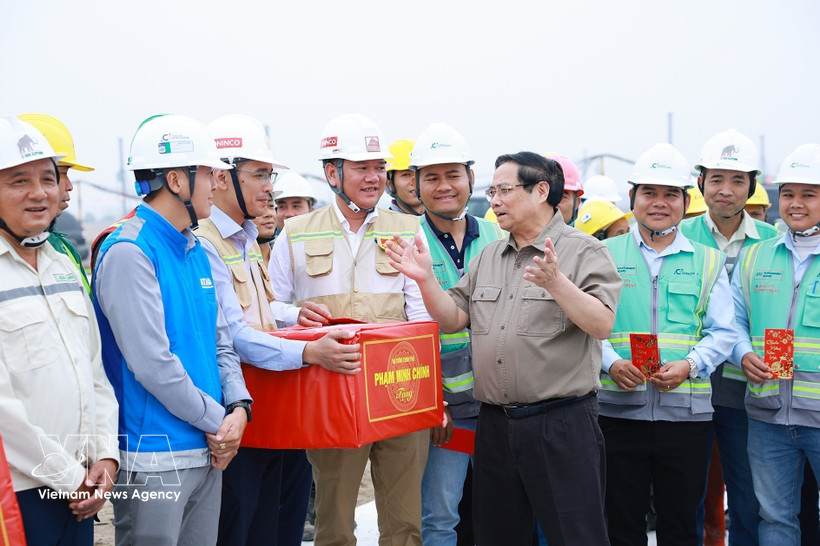
Prime Minister Pham Minh Chinh encourages workers at Gia Binh International Airport construction site (Photo: VNA)

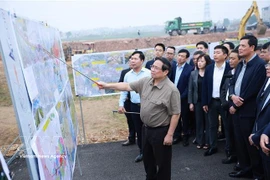
Bac Ninh (VNA) - Prime Minister Pham Minh Chinh on March 7 inspected the progress of the Gia Binh International Airport project in the northern province of Bac Ninh and a road connecting the airport with Hanoi capital city.

The airport project is being developed in the communes of Gia Binh, Luong Tai, Nhan Thang and Lam Thao, covering a total land area of approximately 1,885 hectares. It has a total investment of about 196.3 trillion VND (7.48 billion USD), including more than 141.2 trillion VND for the first phase.

According to the master plan, it aims to become one of the world’s top 10 five-star airports. By 2030, it is expected to serve 30 million passengers and handle 1.6 million tonnes of cargo annually. By 2050, the capacity is projected to reach 50 million passengers and 2.5 million tonnes of cargo per year. In the immediate term, key facilities are scheduled for completion during the 2025–2027 period to serve the APEC Economic Leaders’ Week in 2027.

Visiting and presenting gifts to construction teams at the construction sites of the VIP terminal and the air traffic control tower of Gia Binh International Airport, PM Chinh commended the efforts of the Ministry of Public Security, relevant ministries and agencies, Bac Ninh province, as well as investors and contractors in implementing the project.

So far, land clearance has been carried out for more than 1,259 hectares, equivalent to nearly 67% of the required area. Several key components of the project, including the VIP terminal, taxiways, the air traffic control tower and internal road systems, are being implemented with encouraging progress.
vnanet-phamminhchinh2.jpg
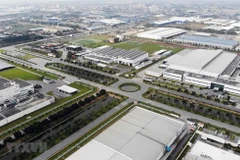
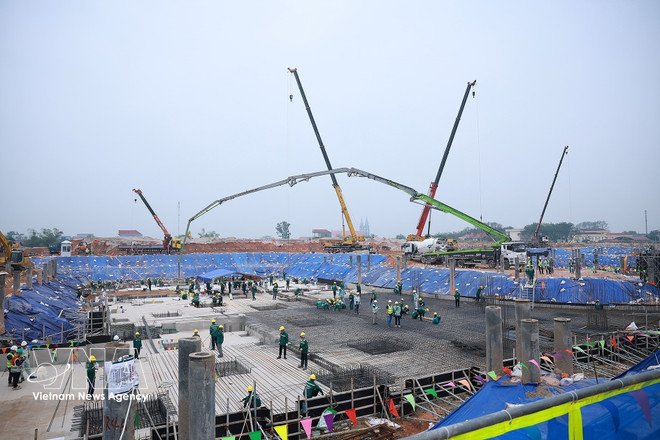
The construction site of Gia Binh International Airport (Photo: VNA)

The PM requested investors and contractors to further accelerate construction while ensuring the highest standards of quality and technical requirements. He also stressed the importance of synchronously planning the surrounding area to develop an aviation economic ecosystem, including logistics and airport-related services.

On the same day, PM Chinh inspected the construction of the resettlement area serving Gia Binh International Airport. The project covers more than 341 hectares and is expected to accommodate nearly 52,000 residents, with a total investment of over 21 trillion VND. He directed that the resettlement area be built as a modern, green, clean and well-planned urban space with complete infrastructure, including roads, electricity, water supply, telecommunications networks, as well as schools, healthcare facilities, cultural institutions and public green spaces, ensuring better living conditions for relocated residents.

He also examined the construction on the road linking the airport with Hanoi. The road is over 41 kilometers long with a total investment of approximately 83 trillion VND. Designed to modern expressway standards, the road will connect with key transport corridors such as the Ha Noi – Lang Son Expressway, the Ha Noi – Thai Nguyen Expressway and Hanoi's Ring Road 3.

Concluding the working session with ministries and local authorities, the Government leader stressed that Gia Binh International Airport should be developed as a dual-use facility, serving both socio-economic development and national defence and security purposes. He also emphasised the goal of building the airport as a smart, modern and civilised aviation hub, integrated with an international-standard airport city and aviation economic ecosystem.

According to the Prime Minister, the development of the airport and its associated infrastructure will open up new development space for Bac Ninh, Hanoi and neighbouring localities such as Hai Phong and Quang Ninh, while strengthening regional connectivity in the Red River Delta and expanding international trade links.

He requested ministries, sectors and localities to urgently implement assigned tasks, strengthen coordination in planning, land clearance and infrastructure development, and ensure that the projects are completed on schedule, initially to serve the APEC Economic Leaders’ Week in 2027 and, in the long term, to become a new growth driver for the region./.
VNA

See more

Illustrative image (Photo: VNA)

Australia announces import conditions for Vietnamese pomelos

Australia’s formal publication provides an important legal basis, marking the completion of the review, assessment and agreement on technical requirements for fresh Vietnamese pomelos. This represents a significant step forward in market access, creating favourable conditions for relevant agencies, localities and businesses to prepare for export activities in the coming time.

Containers of fresh Vietnamese durian for export are subject to a full-chain traceability system. (Photo: VNA)

First “green lane” durian shipment exported to China

​Under the “green lane” process, quality control begins at the cultivation stage, including soil sampling and monitoring, and continues through harvesting and processing, with traceability labels attached to trees and applied to fruit at the time of picking. It also allows plant quarantine procedures and the issuance of certificates of origin (C/O) directly in the localities where the orchards are located.

Delegates at the Vietnam Expo 2026 (Photo: VNA)

Vietnam pushes for deeper auto supply chain ties with RoK

The RoK stood as Vietnam’s largest foreign investor with more than 95.2 billion USD in registered capital as of February 2026, or about 18% of all foreign cash flowing in, with thousands of active projects. In January-February alone, the RoK led the pack with nearly 2 billion USD in pledges, grabbing a whopping 32.7% of total registered capital and showing no signs of slowing down.

More than 600 tourism firms, 15 countries and territories, and 34 provinces and cities are promoting destinations and introducing tourism products at the fair (Photo: VNA)

Digital transformation key to elevating Vietnam’s tourism: official

Speaking at the opening of the Vietnam International Travel Mart (VITM) 2026 in Hanoi on April 10, Deputy Minister of Culture, Sports and Tourism Ho An Phong noted that despite challenges in 2025, Vietnam largely fulfilled its socio-economic development goals. Tourism remained a bright spot, recording 21.5 million foreign arrivals and 135.5 million domestic visitors, with total revenue exceeding 1 quadrillion VND (37.9 billion USD).

A drone sprays fertiliser over rice fields. (Photo: VNA)

Low-altitude economy emerges as new growth driver for Vietnam

The UAV technology is particularly effective in addressing challenges faced by ground infrastructure, especially in densely populated urban areas and remote regions. Smart aerial devices also enable real-time data collection, improving governance, decision-making and digital transformation across industries.

Passengers at Cat Bi Airport in Hai Phong city (Photo: VNA)

Aviation sector ensures fuel supply for April 30–May 1 peak

Aviation fuel suppliers are actively negotiating and diversifying supply sources both domestically and internationally, while strengthening coordination, storage and distribution capacity to meet immediate demand. These efforts aim to support airlines in optimising operations and maintaining stable flight schedules.

A session at the Vietnam–Australia Green Transition Forum 2026. (Photo: VNA)

Green transition offers opportunities for stronger Vietnam–Australia cooperation

Under the theme "Accelerating decarbonisation in agriculture and manufacturing – Unlocking trade and investment opportunities", the forum gathered nearly 200 researchers, experts and businesses involved in policy development, investment, research and innovation. Participants exchanged insights and explored ways to translate the cooperation potential between Vietnam and Australia into practical business opportunities.