PM urges Can Tho to act as regional locomotive in all areas

It was also the PM's first voter engagement in Can Tho since the administrative merger of former Can Tho city with Hau Giang and Soc Trang provinces.

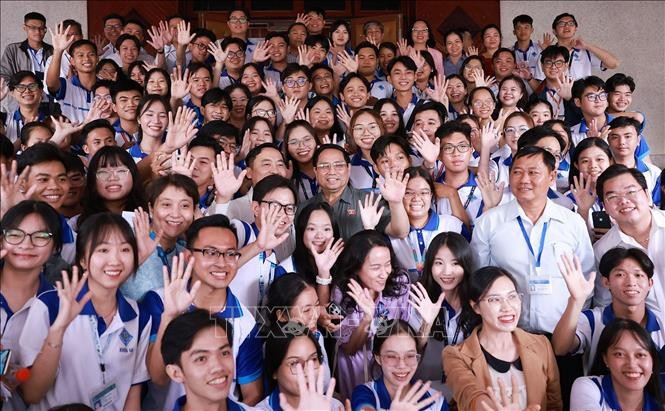
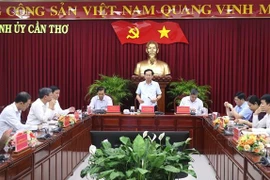
Prime Minister Pham Minh Chinh, NA deputies of Can Tho, and students of Can Tho University at the meeting (Photo: VNA)

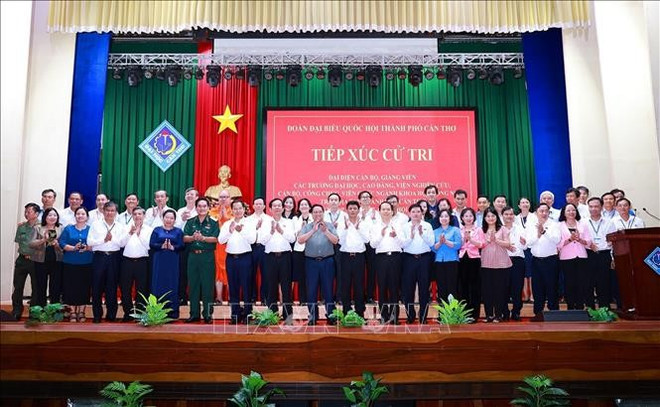
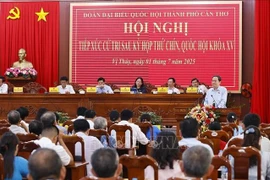
Can Tho (VNA) - Prime Minister Pham Minh Chinh and the delegation of National Assembly (NA) deputies of Can Tho city on July 13 held a meeting with local voters, including lecturers, researchers, civil servants and staff from universities, colleges and scientific institutions across the city.

This marked the third voter meeting of the city’s delegation of NA deputies following the 9th session of the 15th NA, and notably, the first thematic session focusing on science and technology.

It was also the PM's first voter engagement in Can Tho since the administrative merger of former Can Tho city with Hau Giang and Soc Trang provinces.

The meeting drew over 1,000 participants, including academics, postgraduate students, civil servants, and technology professionals. Delegates briefed constituents on the outcomes of the 9th NA session, which concluded after 35 days of rigorous discussion. The session saw the adoption of 34 laws, 14 legal resolutions and reviews of six draft bills. Significantly, the legislature passed a resolution amending several articles of the 2013 Constitution.

The NA also approved shortening the current legislative term and local council tenures (2021–2026) and confirmed that the general election for the next term will take place on Sunday, March 15, 2026.

Currently, the Can Tho NA deputy delegation has 21 members, including PM Chinh and NA Chairman Tran Thanh Man.
uuidf632a1a0-6f1c-40e1-9b35-b912dc865912code001library1type1mode1loctruecaptrue.jpg
Prime Minister Pham Minh Chinh and delegates at the meeting (Photo: VNA)

The delegation reported on local implementation of national policies related to science, technology, innovation, and digital transformation, particularly the rollout of Resolution 57-NQ/TW of the Politburo dated December 22, 2024.

At the meeting, voters raised various concerns, including issues related to scientific funding, commercialisation of research, digital skills development, and the need to retain talent within the national science and technology ecosystem. The PM and senior officials responded to these concerns, outlining measures to remove financial bottlenecks, reform research grant mechanisms, and boost private and social sector participation in innovation.

PM Chinh underscored the importance of increasing science and technology spending, from 3% of the state budget this year to 5% next year, along with tax incentives, preferential credit, visa facilitation, and housing policies for overseas Vietnamese experts.

He noted that priority will be given to developing high-quality human resources for emerging sectors such as semiconductors and AI, protecting intellectual property, and creating favourable conditions for collaboration between the "four pillars" of scientific research - government, academia, business, and the public.

The PM highlighted recent national achievements, including sustained political stability, social security, and economic growth. Vietnam’s GDP is projected to top ASEAN and rank among the world’s fastest-growing economies.

The Government’s push to eliminate substandard housing, particularly for policy-beneficiary households, is also expected to reach its targets ahead of schedule.

He also pointed to the smooth operations of the new two-tier local government model.

Praising Can Tho’s growing contributions to national development, the Government leader called for the city to lead in all key areas, particularly in science, technology, innovation, and digital transformation.

He urged the city to revive the stalled Can Tho Oncology Hospital project, accelerate the 1-million-hectare high-quality, low-emission rice programme for the Mekong Delta, and support digital education initiatives like “Digital Literacy for All”.

He encouraged Can Tho University to form digital transformation support teams to assist local communities and take the lead in human capital development for the semiconductor industry and the digital economy./.
VNA

See more

Vietnamese Ambassador to Brazil and Guyana Bui Van Nghi speaks at the event. (Photo courtesy of the Vietnamese Embassy in Brazil)

Vietnam highlights diplomatic gains, growing ties with Brazil, Guyana

On the occasion of the 50th anniversary of Vietnam – Guyana diplomatic ties, Ambassador Bui Van Nghi described the milestone as an opportunity for both sides to deepen political trust, broaden cooperation in potential areas, and make positive contributions to peace, cooperation and sustainable development in the regions and beyond.

Prime Minister Pham Minh Chinh addresses the third National Forum on Digital Economy and Digital Society in Hanoi on December 20. (Photo: VNA)

Digital economy as driver, digital society as foundation of growth: PM

The forum, themed “Developing an inclusive and comprehensive digital economy and digital society to achieve double-digit GDP growth in the 2026–2030 period,” brought together leaders of ministries and localities, technology enterprises, research institutions, experts and representatives of international organisations in Vietnam.

Deputy Minister of Foreign Affairs Le Thi Thu Hang (R) and Benoit Guidée, Director of the Asia–Oceania Department at the French Ministry for Europe and Foreign Affairs meet in Hanooi on December 19. (Photo: VNA)

Deputy FM meets French official

Deputy Minister of Foreign Affairs Le Thi Thu Hang stressed that Vietnam attaches great importance to its relationship with France, the first European Union country with which Vietnam has established a Comprehensive Strategic Partnership, noting that the two sides enjoy a solid foundation and significant potential for further cooperation.

Politburo member and permanent member of the Party Central Committee’s Secretariat Tran Cam Tu speaks at the event in Hanoi on December 19 (Photo: VNA)

Senior Party official reviews preparations for 14th National Party Congress

Politburo member and permanent member of the Party Central Committee’s Secretariat Tran Cam Tu expressed his belief that relevant agencies will continue to make efforts to basically complete organisation- and service-related preparations by December 31, ensuring readiness for the final rehearsals ahead of the opening of the 14th National Party Congress.

Prime Minister Pham Minh Chinh addressing the conference of the the Ministry of Industry and Trade on December 19 (Photo: VNA)

PM urges industry, trade sector to pioneer in six key areas

Prime Minister Pham Minh Chinh stressed that to make a substantive contribution to national development, the industry and trade sector must also achieve double-digit growth, generate new jobs, strengthen traditional growth drivers such as export and consumption, and accelerate emerging engines of growth, including the green, digital, circular, knowledge-based and sharing economies.

State President Luong Cuong (middle) presents congratulatory flowers to the two promoted officers (Photo: VNA)

Two military officers promoted to rank of Senior Lieutenant General

Lieutenant General Do Xuan Tung, Vice Director of the General Department of Politics of the Vietnam People’s Army (VPA), and Lieutenant General Do Van Banh, Political Commissar of the National Defence Academy were promoted to the rank of Senior Lieutenant General at a ceremony in Hanoi on December 19.

Lao Prime Minister Sonexay Siphandone (R) hosts a reception for Prosecutor General of the Supreme People’s Procuracy of Vietnam Nguyen Huy Tien. (Photo: VNA)

Vietnam–Laos step up cooperation in procuracy sector

They highly valued the effective and substantive cooperation results achieved by the Supreme People’s Procuracies of Vietnam and Laos in recent years, and called on both sides to continue enhancing coordination, stepping up exchanges of delegations at all levels, sharing professional and technical experience, and maintaining and expanding training and capacity-building programmes for officials.