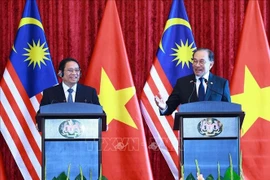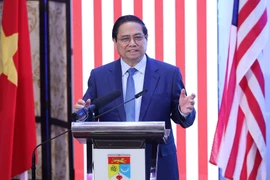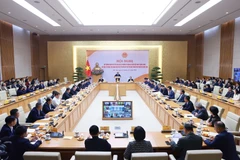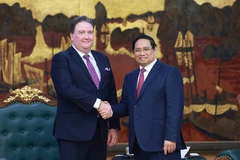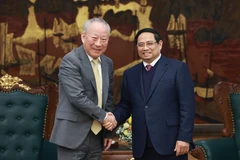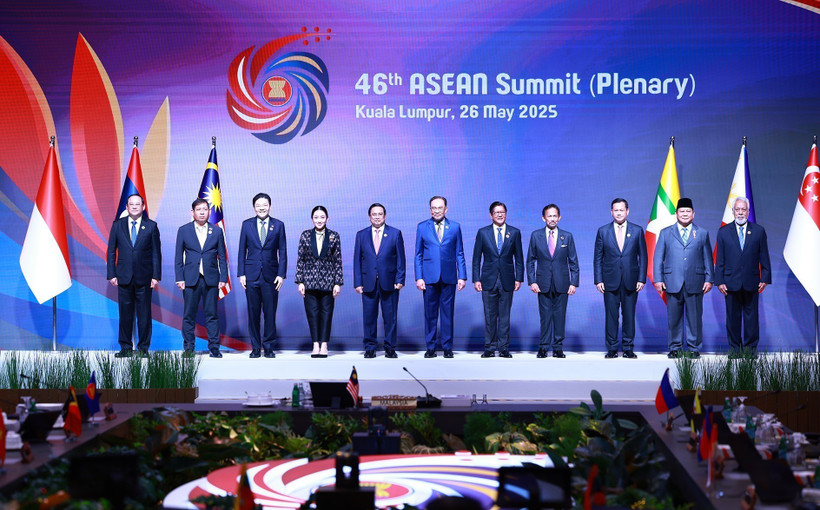
Hanoi (VNA) – Prime Minister Pham Minh Chinh’s freshly-ended official visit to Malaysia has ushered in a new phase of development in bilateral relations, Deputy Prime Minister and Minister of Foreign Affairs Bui Thanh Son has told reporters, describing the trip as a success that aligns with Vietnam’s priorities in its foreign policy.
The visit, which reflects Vietnam’s commitment to deepening ties with neighbouring countries, strategic and key partners as laid out in the foreign policy adopted at the 13th National Party Congress, marked a big step forward for the Vietnam - Malaysia relationship, which has been upgraded to a Comprehensive Strategic Partnership, he said.
According to the official, both nations agreed to establish an annual exchange mechanism between the two prime ministers to address challenges swiftly and enhance cooperation under their newly upgraded partnership framework. They also finalised an Action Programme for 2025-2030, set for formal signing later this year, to guide the partnership’s next steps.
In their talks, PM Chinh and his Malaysian counterpart Anwar Ibrahim shared perspectives on global and regional issues, reaffirming their commitment to maintain ASEAN’s common stance on the East Sea issue.
Regarding economic ties, the two countries set a target of 20 billion USD in two-way trade by 2030, focusing on balanced growth, fewer trade barriers, and increased exports in areas of mutual strength. They also pledged to team up in the fields of digital economy, circular economy, green economy, just energy transition, sci-tech, and innovation.
National defence-security cooperation was also tabled, with agreements reached to combat transnational crime, cybercrime, terrorism, and reactionary activities. The two leaders explored establishing maritime consultation mechanisms and a direct communication line to crack down on illegal, unreported, and unregulated (IUU) fishing.
In addition, major agencies and enterprises actively negotiated and reached three breakthrough agreements in the fields of energy and education-training.
Within the framework of the 46th ASEAN Summit PM Chinh, Malaysian PM Anwar and Singaporean PM Lawrence Wong witnessed the signing of an addendum to a cooperation agreement on offshore wind power export from Vietnam to Singapore. The agreement, involving Petrovietnam Technical Services Corporation, Malaysia’s MY Energy Consortium, and Singapore’s Sembcorp, pushes national renewable energy goals and sets the stage for a unified ASEAN power grid.
Reflecting on the outcomes of the 46th ASEAN Summit and Related Summits, Son highlighted the adoption of the Kuala Lumpur Declaration entitled "ASEAN 2045: Our Shared Future" and the ASEAN Community Vision 2045, which outlines political-security, economic, socio-cultural, and connectivity pillars. He described these as a testament to ASEAN’s proactive leadership in shaping regional development and igniting a collective aspiration for growth and global stature.
Another historic move, he said, was the consensus to admit Timor-Leste as the bloc’s 11th member this October. This marks ASEAN’s first expansion in three decades, underscoring the bloc’s enduring spirit of inclusivity, cohesion, and integration.
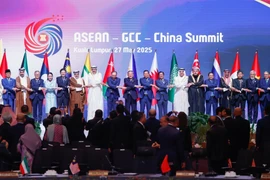
A third major focus was ASEAN’s evolving approach to broaden its external linkages in response to geopolitical and geo-economic shifts. Beyond deepening internal cooperation and stepping up trade and investment ties with existing partners, ASEAN organised the second ASEAN-Gulf Cooperation Council (GCC) Summit and the first ASEAN-GCC-China Summit, forging new pathways for interregional collaboration, market diversification, and resilient supply chains.
At the heart of Vietnam’s message was a push for a new development mindset based on inclusivity and sustainability. PM Chinh’s call for greater solidarity, resilience, proactiveness, inclusiveness, and sustainability offered a clear roadmap for ASEAN to boost collective power, assert strategic autonomy, and ensure progress for current and future generations.
With global uncertainties looming, the Vietnamese leader stressed the need for ASEAN to safeguard its strategic autonomy, reinforce its centrality, and enhance its adaptability to external challenges. He also pushed for sci-tech, innovation, digital transformation, and green, sustainable growth as new pillars of regional cooperation, urging the bloc to pool resources from both public and private sectors.
Responding to rising global fragmentation, the Vietnamese PM called on ASEAN and its partners to foster dialogue, build trust, and uphold multilateralism rooted in free, fair, inclusive, and rules-based trade. He encouraged ASEAN to leverage its existing network of free trade agreements (FTAs) and expand interregional cooperation through frameworks like the ASEAN-GCC and ASEAN-GCC-China, with potential expansion among other strategic partners.
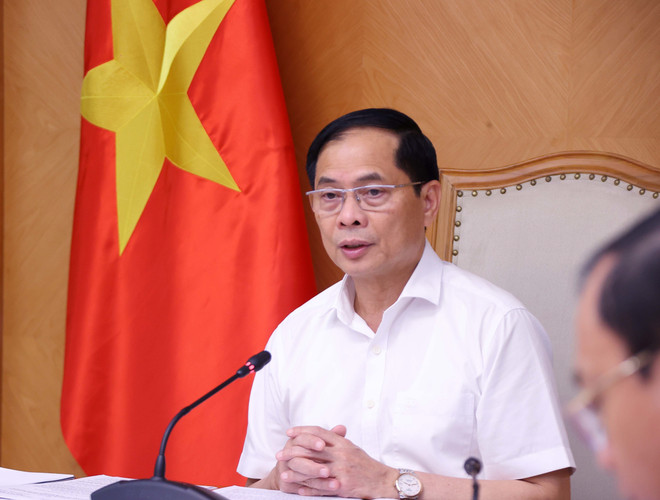
Accordingly, he proposed a series of concrete steps to foster ASEAN-GCC and ASEAN-GCC-China ties, with a focus on trade, investment, and supply chain integration. He called for the early signing of an ASEAN-GCC FTA and building of an ASEAN-GCC-China FTA, with priority given to renewable energy, smart agriculture, sustainable infrastructure, green technology, aviation, tourism, and the creation of a robust financial connectivity network linking major regional hubs.
It could be said that Vietnam’s messages and contributions at the summits struck a chord, aligning with ASEAN’s focus on innovation and resilience, Son said, noting that the country’s active engagement signals its dedication to building a stable, forward-looking, and sustainably developing Southeast Asia.
On the sidelines, PM Chinh met with leaders of countries attending the summits, who spoke highly of Vietnam's role and position in the international arena. They commended Vietnam's balanced and sustainable development strategy, spotlighting its strategic breakthroughs in institutional reform, sci-tech, infrastructure, and human capital as models for addressing global challenges.
In a meeting with Chinese Premier Li Qiang, the two sides highly appreciated the historical significance of the recent visit to Vietnam by Party General Secretary and President of China Xi Jinping. They agreed to focus efforts on effectively implementing the common perceptions between the top leaders of the two Parties and two countries; enhance high-level strategic exchanges, consolidate political trust, promote substantive cooperation to achieve concrete progress, especially in trade, high-quality investment, railway connection, and start construction of the Lao Cai-Hanoi-Hai Phong railway route in 2025. The two sides consented to continue closely coordinating with ASEAN countries to maintain peace and stability in the region, and promote the early finalisation of an effective and substantive Code of Conduct (COC) in the East Sea in accordance with international law and the 1982 UNCLOS.
The Vietnamese PM and leaders of ASEAN nations discussed measures to step up cooperation in trade, investment, national defence-security, culture, education, and tourism. They also stressed the need to expand partnerships into emerging and promising areas like infrastructure connectivity, green transition, circular economy, semiconductors, and artificial intelligence.
In discussions with the GCC, both sides expressed a shared desire to broaden partnership frameworks and initiate negotiations for a Vietnam-GCC FTA, with energy, digital transformation, infrastructure, and the Halal economy as key focus areas.
Son said these bilateral engagements and high-level exchanges sent a clear message: Vietnam is a dynamic, innovative, and deeply engaged player on the global stage. The outcomes, he added, paved the way for deeper, more substantive and effective ties with its partners in the years ahead./.