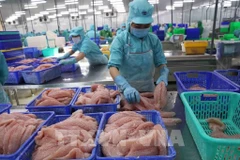
A pork stall at a market in northern Bac Ninh province (Photo: VNA)
 Hanoi (VNS/VNA) –Vietnam’s domestic pork supplies could fall by 20 to 35 percent this yearas a consequence of African swine fever, according to the Institute of Policyand Strategy for Agriculture and Rural Development (IPSARD).
Researchers from IPSARD on February 19 presented two scenarios at a conferencein Hanoi to assess the impacts of the fever on domestic pork supplies anddiscuss solutions to ensure sustainable breeding.
Nguyen Viet Hung, a representative of the research team, pointed out onescenario in which 10 percent (about 580,000) of female pigs in a herdwere infected, and another scenario in which 20 percent were infected.
The domestic pork supply was predicted to decrease from 3.9 million tonnes peryear to 3.15 million tonnes in the first scenario and 2.55 million tonnes inthe second scenario.
According to Hung, insufficient pork supplies would lead to a surge inprices. The normal costs of live pigs without African swine fever standsat 46,000 VND (2 USD) per kilogramme.
The epidemic could raise that by 22 percent (to more than 56,000 VND perkilogramme) in the first scenario and by 45.5 percent (to more than 66,000 VND)in the second scenario.
“Vietnam would have to import 7,100 tonnes of pork in the first scenarioand 8,900 tonnes in the second scenario to compensate for thedomestic shortage,” said Hung.
Researchers from IPSARD on February 19 presented two scenarios at a conferencein Hanoi to assess the impacts of the fever on domestic pork supplies anddiscuss solutions to ensure sustainable breeding.
Nguyen Viet Hung, a representative of the research team, pointed out onescenario in which 10 percent (about 580,000) of female pigs in a herdwere infected, and another scenario in which 20 percent were infected.
The domestic pork supply was predicted to decrease from 3.9 million tonnes peryear to 3.15 million tonnes in the first scenario and 2.55 million tonnes inthe second scenario.
According to Hung, insufficient pork supplies would lead to a surge inprices. The normal costs of live pigs without African swine fever standsat 46,000 VND (2 USD) per kilogramme.
The epidemic could raise that by 22 percent (to more than 56,000 VND perkilogramme) in the first scenario and by 45.5 percent (to more than 66,000 VND)in the second scenario.
“Vietnam would have to import 7,100 tonnes of pork in the first scenarioand 8,900 tonnes in the second scenario to compensate for thedomestic shortage,” said Hung.
The researchers also predicted that domestic pork consumption would decrease by14.6 percent in the first scenario and 25 percent in the second scenario.
Tran Cong Thang, head of IPSARD, said global integration had put pressure onpork producers and the retail market. Pork farms were suffering the biggestlosses because their profits largely depend on breeding.
Despite these challenges, an open domestic market and trade agreementssuch as the EU-Vietnam Free Trade Agreement (EVFTA) and Comprehensive andProgressive Agreement for Trans-Pacific Partnership (CPTPP) had providedopportunities to restructure the domestic agricultural sector, Thangsaid.
State policies should give priority to assisting localities and enterprises inbuilding disease-free chains and zones; supporting small-scale animal husbandryhouseholds to switch their agricultural production to other industries; anddeveloping safe and hygienic poultry and cattle breeding to ensure domesticmeat supply, he said.
Businesses also needed to improve their competitiveness, develop a clearstrategy for the domestic market and study markets in countriesthat are members of the EVFTA and CPTPP. Meanwhile, farmers need to join cooperativesand update market information to seek new chances, he said.
According to IPSARD’s report, Vietnam was one of the biggest pork producers andconsumption markets in the world. Pig breeding was a source of incomefor more than 3.4 million households.
African swine fever appeared in Vietnam last February and spreadto all 63 provinces and cities. Since then, farmers nationwide have been forcedto cull more than 5.9 million pigs (accounting for about 9 percentof the country's total herds)./.
VNA