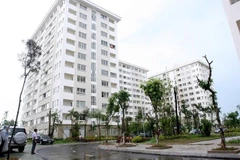
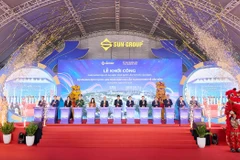
Illustrative image (Source: VietnamPlus)
Hanoi (VNA) – The property market have experienced instable developments due to impacts of the COVID-19 pandemic, while halted projects and overlapping regulations have also hindered the expansion of supply sources.
At the Vietnam Real Estate Forum 2020, which was held on July 9 under the theme “new opportunities from policies and market,” President of the Vietnam Chamber of Commerce and Industry (VCCI) Vu Tien Loc held that “we are living in a challenging crisis – the new normal situation”.
In the context of difficulties brought about by COVID-19 and policies, experts asserted that the settlement of overlapping land and construction-related policies is of urgent need.
Numerous policy obstacles
At the event, Loc said that developments in the property market are among important indications of the development and urbanisation of an economy. But alongside its role as a drive of growth, the sector also contains risks of causing instability for the economy if it is not being under well control.
Statistics showed that foreign direct investment (FDI) in the real estate sector has dropped strongly over the past months. The number of newly-established businesses in the sector reduced 12 percent year on year, while construction firms have halted 94 percent of their operations in the first quarter of 2020, and real estate inventory has increased. This showed that the real estate market is facing a tough period, he said.
Loc underlined the need to seek solutions to boost the sector’s growth as this is one of the factors contributing to the recovery of the economy.
Agreeing with Loc, Nguyen Manh Ha, Chairman of the Vietnam Association of Realtors said that the market is at a low on its 10-year cycle and impacts of COVID-19 have caused difficulties for businesses in the sector.
According to Ha, the real estate market is related to many policies and mechanisms as it is mentioned in more than 10 different laws such as the Land Law, the Law on Investment, as well as laws regarding taxes and fees. The sector is also extremely sensitive to changes in policies. Businesses hope for policies removing obstacles, but new legal documents often contain new regulations.
He took the bidding for land use rights in development projects as an example, with previous legal documents not differentiating between public land and allocated land, but later documents did.
In addition, as preparing for a project, investors will calculate fees into costs, but when new legal documents are issued with higher fees, it interferes with investors’ planning, leading to delay and failure of many projects, he said.
“Therefore, some projects have been delayed for 10 years due to policies and mechanisms,” Ha stressed.
He called for continued support to businesses during the COVID-19 period, including the reduction of interest rate, the extension of payment time by about 12 months.
“Untie” the market for investment attraction
According to Deputy Minister of Construction Nguyen Van Sinh, the market has yet to be able to recover like it was before the pandemic broke due to different obstacles.
Therefore, in order to remove difficulties for business and production and recover the economy, the Government has issued a number of timely policies to implement the “double targets” of promoting production and businesses and controlling the pandemic at the same time.
 Illustrative image (Source: VNA)
For the real estate market, the Government has directed the application of a number of supporting measures to develop social housing, including the allocation of additional 1 trillion VND to the Vietnam Bank for Social Policies and 2 trillion VND in interest rate subsidy for four banks appointed by the State Bank of Vietnam, so that they can mobilise more than 60 trillion VND to support social housing developers.
Meanwhile, the construction ministry is drafting a resolution on the encouragement of low-cost commercial housing to submit to the Government for approval in the third quarter of 2020, he said. Accordingly, the project will provide small apartments with the price of not more than 20 million VND per square metre, so that the maximum price for each apartment is not above 1.5 billion VND. The resolution also gives a number of support policies in land use, tax, construction procedures, and investment mobilisation mechanisms, said the Deputy Minister.
He said that the Government has also focused on adjusting and supplementing Resolution 101/ND-CP on the upgrading and reconstruction of old apartment buildings, with new regulations to encourage businesses’ involvement in the scheme in big cities, including Hanoi and Ho Chi Minh City.
According to Loc, in order to boost the growth of real estate market, the first thing to do is optimising existing support packages.
The VCCI leader held that monetary policies should be flexible while still ensuring the stability of the macro-economy. Meanwhile, fiscal policies should be further loosened to deal with issues related to liquidity and investment of businesses, he suggested. He also stressed the need to increase the room for public debt and budget deficit, but the most important thing will still be stabilising the reform of policies and mechanisms in construction investment.
Pointing out 20 overlapping points in land and construction-related policies, Loc said that the VCCI will urge the Government to settle them. To “untie” the overlapping points will help promote the growth of construction investment, he stressed.
Dennis Ng Teck Yow, General Director of Gamuda Land Ho Chi Minh City said that the company has abided by the same policies as its Vietnamese peers. Policies for foreign investment and M&A activities have opened up new chances, he said, adding that compared with other countries, the real estate market of Vietnam has more potential after the pandemic ends.
Businesses at the event also expressed the hope for more transparent legal policies as well as faster investment approval process./.