Russian cosmonaut talks to Hanoi children

A Russian cosmonaut, who holds the world record as the person spending the most time in space, shared his routine in outer space during an exchange programme with children in Hanoi on July 23.
Russian cosmonaut talks to Hanoi children ảnh 1Russian cosmonaut Sergei Krikaliov (Source: images.ksc.nasa.gov)

Russian cosmonaut Sergei Krikaliov, who holds the world record as the person spending the most time in space with six space flights and 803 days, shared his routine in outer space during an exchange programme with children in Hanoi on July 23.

He recalled that he flew with groups of two-three, saying they were busy with experiments on medicine, biology and technology.

It took the cosmonauts just one hour and a half to travel one circle around the Earth, seeing the continents and other breathtakingly beautiful scenes, he said.

Krikaliov also talked about the difficulties of living in outer space. He said he spent most of his waking hours on maintaining the operation of the space station and conducting experiments.

What is simple on Earth can be extremely difficult in the outer space due to the lack of gravity. Every activity was complicated, he said, sharing he exercised to stay healthy and had to creep into the sleeping bag – tied down to the floor or hanging from the ceiling – to avoid floating into things in his sleep.

He explained that to become an astronaut, it is essential to have good health and study hard.

Sergei Krikaliov was born in 1958 in Leningrad, Russia. His first space flight was conducted in 1988 and the last in 2005. He was the first Russian cosmonaut to conduct a space flight on the space shuttle of the US National Aeronautics and Space Administration (NASA).

The exchange programme was held by the Russian Centre of Science and Culture and the Hanoi’s Children Palace on the occasion of 65 years of Vietnam-Russia diplomatic relations and 35 years of Vietnam-Soviet space flight (July 24, 1980).-VNA

See more

Elderly people take part in activities at a daytime care centre for senior citizens. (Photo: VNA)

Making breakthroughs via policies for older persons

The Politburo’s Resolution No. 72-NQ/TW on groundbreaking solutions to strengthen the protection, care and improvement of public health sets the target of raising average life expectancy to 75.5 years by 2030, with at least 68 years lived in good health.

One of the first-prize winning entries in the “Social housing prototype design ideas – Towards sustainable solutions” contest. (Photo courtesy of the organising board)

Highly applicable social housing design ideas honoured

According to the organising board, the award-winning entries will provide an important foundation for the Ministry of Construction to continue research and develop prototype and typical designs for broad use in localities.

Trinh Quoc Phu (centre) voluntarily hands over a rare forest night heron to the police and authorities of Quy Nhon Nam ward. (Photo: baogialai.com.vn)

Gia Lai rangers receive rare forest night heron

The handover reflects the growing awareness and sense of responsibility among local residents in protecting wildlife, contributing to law compliance and biodiversity conservation efforts in the area.

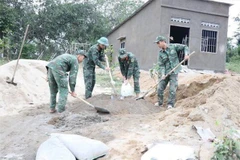
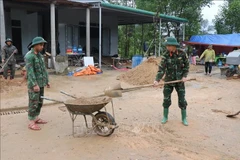
Hue officers, soldiers and local residents in the central city of Hue are working at full speed to complete solid new homes for natural disaster-hit families (Photo: VNA)

Swift campaign brings Tet homes to storm-hit residents in Hue

Quang Trung Campaign is not merely a task, but a political responsibility and a heartfelt commitment to the people. The guiding principle is to act as swiftly and decisively as possible, ensuring no family is left without shelter, especially in the days leading up to Tet, said Major General Nguyen Thanh Tuan, Director of the Hue Department of Public Security.

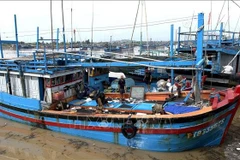
Fishermen in the Dong Tac fishery port of Phu Yen ward, Dak Lak province, prepare for a new trip after storm. (Photo: VNA)

Dak Lak supports fishermen in occupational transition

As of December 5, 2025, Dak Lak had 2,556 fishing vessels, with an annual marine catch of around 68,000 tonnes. An estimated 2,900 workers are in need of occupational transition, as most have limited educational backgrounds, unstable incomes and are increasingly ageing.