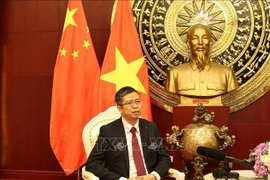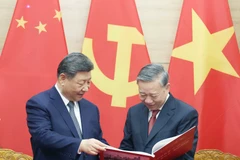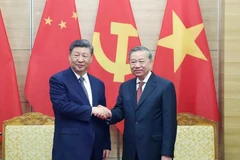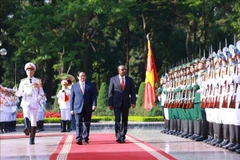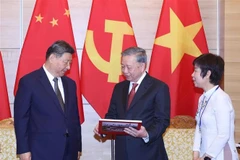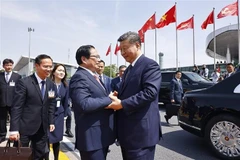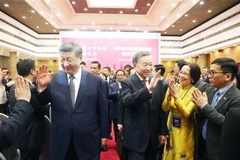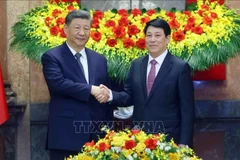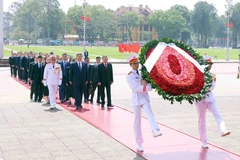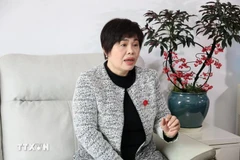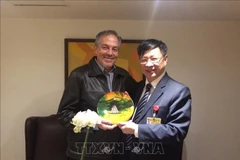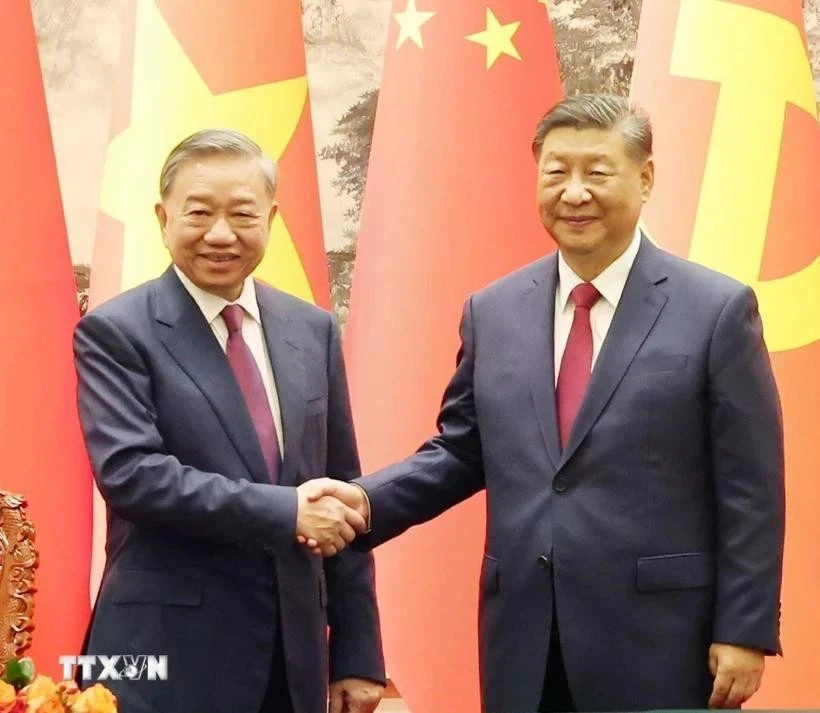
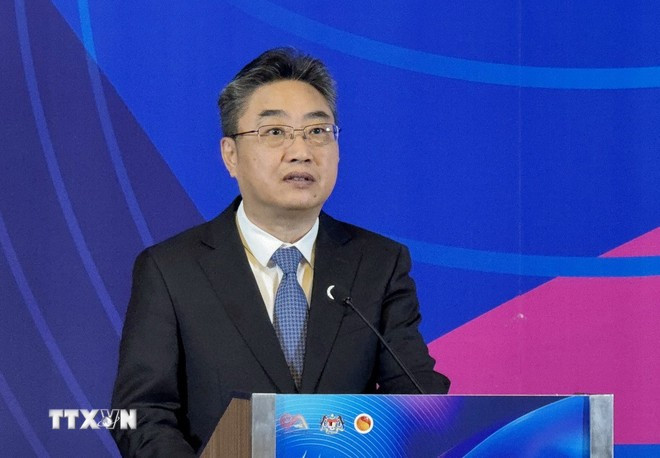
Beijing (VNA) – The state visit to Vietnam by General Secretary of the Communist Party of China (CPC) Central Committee and President of China Xi Jinping from April 14-15 once again demonstrates China's strong commitment to promoting the building of the Vietnam-China community with a shared future, as well as their valuable traditional friendship described as “both comrades and brothers", said Shi Zhongjun, Secretary General of the ASEAN-China Centre (ACC).
Speaking to the Vietnam News Agency (VNA)'s resident correspondent in Beijing ahead the visit, Shi said that China and Vietnam are good neighbours, good friends, good comrades, and good partners. The two countries share geographic proximity with mountains and rivers connected. In recent years, high-ranking leaders of the two countries have maintained regular exchanges.
The top Chinese leader's visit to Vietnam is an important follow-up to his historic visit in December 2023, and the visit to China by Party General Secretary and State President To Lam in August 2024.
This year marks the 75th founding anniversary of diplomatic relations between China and Vietnam and is designated as the Year of Vietnam - China Humanistic Exchange, as well as the 95th founding anniversary of the Communist Party of Vietnam and the final year of China's 14th Five-Year Plan.
Currently, China is comprehensively promoting the great national rejuvenation process through Chinese-style modernisation, while Vietnam is also accelerating its industrialisation and modernisation process.
The building of socialism in both China and Vietnam is at a crucial stage. Under the strategic planning and direct promotion by high-level leaders of both Parties and countries, the comprehensive strategic cooperation between China and Vietnam has achieved significant results, with many notable features. The close coordination and multilateral cooperation not only benefit the two Parties, two countries, and their people, but also bring stability and certainty to a world full of fluctuations and uncertainties.
Shi believes that through this visit, the high-ranking leaders of the two countries, from a high-level and long-term strategic vision, will set out new directions for the development of the Comprehensive Strategic Cooperative Partnership between China and Vietnam; strengthen the traditional friendship between China and Vietnam, enhance mutual strategic trust, and focus on key areas and directions to build a Vietnam-China community with a shared future that carries strategic significance; promote the relationship between the two Parties and two countries to new heights, and together advance stability and prosperity of the region as well as peace, development and progress of humanity.
Regarding the prospects for the two countries’ cooperation in the coming time, Shi noted that in recent years, economic and trade cooperation between China and Vietnam has continued to reach new heights. China has been Vietnam's largest trading partner since 2004, and Vietnam has been China's largest trading partner in ASEAN since 2016.
The bilateral trade volume has exceeded 200 billion USD for four consecutive years. According to Chinese Customs data, in 2024, two-way trade reached 260.65 billion USD, an increase of 13.5% compared to the same period last year. Of this, China's exports amounted to 161.89 billion USD, up 17.7% year-on-year; imports reached 98.76 billion USD, up 7.2% year-on-year. China is the largest export market for Vietnamese agricultural products, accounting for 65.2% of Vietnam's total fruit and vegetable exports. Vietnam has established official export channels for 14 key agricultural products to the Chinese market, including durian, bird's nest, sweet potatoes, dragon fruit, lychee, rambutan, mango, jackfruit, watermelon, and bananas. These products account for about one-fifth of China's total agricultural imports from ASEAN. High-quality agricultural products from Vietnam are widely favoured by Chinese consumers. Vietnam is also an important destination for Chinese foreign investment. In 2024, direct investment from Chinese enterprises in Vietnam exceeded 2.5 billion USD, maintaining a rapid growth rate.
Shi said that China and Vietnam each have unique advantages for economic development, complementing each other strongly and having great potential for economic and trade cooperation. With the establishment of the China-ASEAN Free Trade Area 3.0 and the upgrade of the Regional Comprehensive Economic Partnership (RCEP), economic and trade cooperation between the two countries will have many more development opportunities.
The scholar said that in the future, the two countries need to further strengthen the strategic development connection, promote mutually beneficial cooperation, continue to expand bilateral trade and investment, actively build pilot cross-border economic cooperation zones, and jointly establish safe and stable industrial and supply chains, while further enhancing the level of trade and investment liberalisation and facilitation.
Both sides should continue to effectively implement the "Belt and Road" initiative and the "Two Corridors, One Belt" framework, strengthen policy coordination, and innovate cooperation models. In addition to accelerating "hard connectivity" in infrastructure such as railways, highways, and border facilities, both sides should also enhance "soft connectivity" like smart customs; promote the integrated development of cross-border e-commerce and traditional domestic industries; strengthen cooperation in areas such as digital transformation, online tourism, smart cities, and artificial intelligence (AI); and further explore cooperation potential in digital economy. Moreover, Vietnam has developed a national green growth strategy. By incorporating regulations and cooperative content related to green economy in the China-ASEAN Free Trade Area 3.0, the scope and prospects for cooperation between China and Vietnam in fields like clean energy, new energy-fueled vehicles, environmental governance, green transition, and green finance are also very promising.
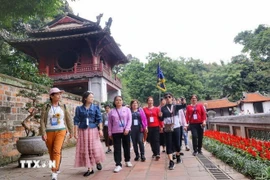
Regarding cultural exchanges, Shi noted that both sides need to seize the opportunity of the Year of Vietnam-China Humanistic Exchange and the ASEAN – China Cultural Exchange Year to continuously strengthen the friendship between the people of the two countries. They should actively explore deeper educational cooperation, expand international student exchanges; promote cooperation in vocational education, education-industry integration, teacher training and development, and digital education; enhance cultural exchanges, improve cultural understanding through joint art performances, exhibitions of intangible cultural heritage, and joint broadcasting of films and television works; expand tourism cooperation, encourage more Chinese tourists to visit Vietnam, and support increasing flights between the two countries; optimise cross-border tourism routes, promote distinctive tourism products to each other, and attract two-way tourist flows; and enhance youth exchanges to strengthen understanding and friendship between young generations through various youth dialogue and exchange activities, while promoting the inheritance of the traditional friendship between China and Vietnam./.