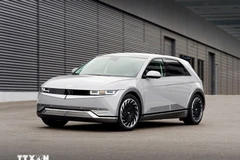
A model of electric car by VinFast. (Photo: VNA)
 Hanoi (VNA) – The Ministry of Transport has justsubmitted its proposal to Deputy Prime Minister Tran Hong Ha on incentives forelectrical vehicle (EV) producers and users.
According to the ministry, Vietnam’s policies to encourage theuse of EVs now only focus on battery EVs (BEVs) with incentives relating tospecial consumption tax and registration fees.
Under its proposal, the ministry suggested three types of EVs toreceive incentives including battery EVs, Fuel cell electric vehicles (FCEVs)which are powered by hydrogen, and solar EVs.
The ministry proposed to add EV manufacturing and assemblingindustries, and battery production to the list of industries that receivespecial investment incentives. It also proposed an exemption and reduction ofimport tax on equipment, production lines, and import of complete componentsand components for the production and assembly of EVs and batteries.
For EV manufacturing, assembly, and maintenance companies, theministry asked for a preferential mechanism that helps them access financialsources. At the same time, a tax incentive mechanism is also needed forimported EVs.
Notably, according to the ministry, many businesses haveproposed the continued application of the special consumption tax incentive of 3% for EVswith 9 seats or less after February 28, 2027, for domestically produced andassembled EVs. The companies also asked for VAT exemptions for the first fiveyears and a reduction of 50% for the five following years.
The registration fee for EVs is exempted for the first fiveyears from March 1, 2022. In the next two years from March 1, 2027, the firstregistration fee is 50% of the fee for petrol and diesel cars with the samenumber of seats.
It was also proposed that EV buyers receive an incentive totaling 1,000 USD per vehicle purchase.
Meanwhile, company exemptions could include import taxon components and equipment for the installation of electric charging stationsand an exemption from land tax for the first five years, a reduction of 50% in thenext five years, a corporate income tax exemption for the first five years and50% reduction for the next five years.
According to the Transport Ministry, Vietnam has only two EVproducers and assemblers - Vinfast (belonging to Vingroup) and TMTAutomobile Joint Stock Company.
Until now, the Thanh Cong Group Joint Stock Company and Truong HaiAutomobile Joint Stock Company have also introduced electric car models toexplore the market and eyed domestic production and assembly.
The number of EVs in Vietnam has increased rapidly in recentyears. From 2018 to 2021, there were only 167 vehicles. By July 2023, thenumber increased to nearly 12,600. However, they are mainly passenger cars andcity buses.
Regarding the electric charging station system, VinFast hasdeveloped a system of charging stations with more than 150,000 charging portsfor electric motorcycles and electric cars in all 63 provinces and cities. Asof October 14, 2022, VinFast had installed 1,560 charging stations nationwide.
Currently, Vinfast is providing the market with four types ofelectric cars. A car with batteries has prices ranging from 538 million VND tomore than 2 billion VND, the versions without batteries are from 458 millionVND to nearly 1.7 billion VND.
To realise Vietnam's commitment to achieve net-zero carbonemissions by 2050, the Prime Minister approved an action programme on greenenergy transformation, reducing carbon and methane emissions in the transportsector.
According to the programme, between 2022 and 2030, Vietnam willpromote the production, assembly, import, and use of electric motorizedroad vehicles, along with charging infrastructure. It is expected that from 2025, all new buses onroads will use electricity and green energy.
From 2030, all new taxis will use electricity and green energy.By 2050, all road motorized vehicles and construction vehicles participatingin traffic will be converted to electricity and green energy. Vietnam aims tocomplete charging infrastructure to sufficiently provide green energy to meetthe demand of people and businesses nationwide./.