Two-tier local administration model will not negatively impact investment environment: Official

Responding to concerns from international reporters about the potential impact of the reform scheme on the business environment, Deputy Minister of Finance Ho Sy Hung emphasised that the changes will not pose obstacles to investment or business operations.

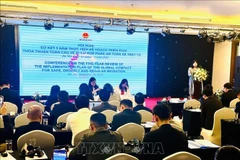
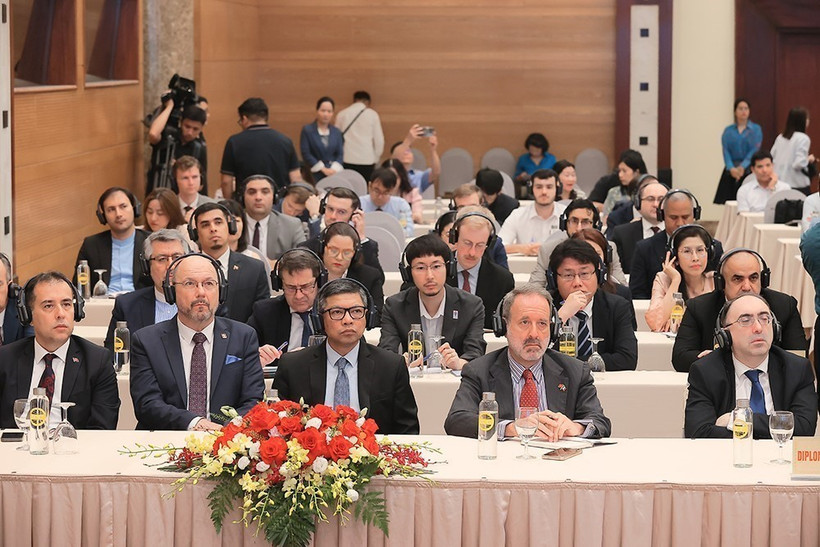
A view of the international press conference in Hanoi on June 17. (Photo: VNA)

Hanoi (VNA) – The implementation of two-tier local administration model will not negatively impact the business environment and foreign investment attraction policies of Vietnam, heard an international press conference in Hanoi on June 17.

Jointly held by the Party Central Committee's Commission for Information, Education, and Mass Mobilisation, the the Party Central Committee's Organisation Commission, the National Assembly Office, the Ministry of Home Affairs, and the Ministry of Foreign Affairs, the event focused on issues related to amendments to certain articles of the 2013 Constitution, and the implementation of the two-tier local administration model starting July 1, 2025.
thang.jpg
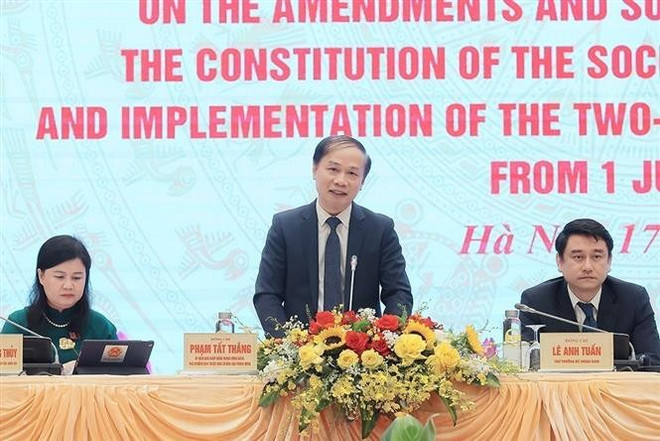
Vice Chairman of the Party Central Committee's Commission for Information, Education, and Mass Mobilisation Pham Tat Thang speaks at the international press conference in Hanoi on June 17. (Photo: VNA)

Responding to concerns from international reporters about the potential impact of the reform scheme on the business environment, Deputy Minister of Finance Ho Sy Hung emphasised that the changes will not pose obstacles to investment or business operations. Instead, they will help create a broader space for socio-economic development, streamline administrative procedures, and delegate greater authority to local units, helping to reduce at least 30% of administrative processes and significantly lower compliance time and costs.

Regarding foreign investment attraction, the deputy minister said the policy for attracting foreign investment does not depend on the organisation of two-tier local administration model.

Vietnam aims to implement the model in tandem with the restructuring of its administrative apparatus and the reform of its management mechanisms, shifting toward a proactive, service-oriented governance model that better serves the people and actively supports and facilitates business and investment activities in the country, he said.

Meanwhile, Vice Chairman of the Party Central Committee's Commission for Information, Education, and Mass Mobilisation Pham Tat Thang stressed that the adoption of the Resolution amending and supplementing certain articles of the 2013 Constitution, and the revised Law on Organisation of Local Government, marks a historic milestone, laying a solid legal foundation for the implementation of the two-tier local administration model, which will be introduced for the first time in Vietnam to facilitate the implementation of key policies of the Party and the State on national development across sectors.

According to Thang, the primary goal of amending the 2013 Constitution and restructuring the local administration model is to build administrations that are closer to the people and better serves them, and pave the way for a new phase in national development with a long-term vision that spans at least the next 100 years.

Vice Chairwoman of the NA's Committee for Legal and Judicial Affairs Nguyen Phuong Thuy said the amendments to the Constitution is an urgent requirement to establish a constitutional basis for streamlining the political apparatus and refining the two-tier local administration model and opening up new development future for the country.

The NA has considered amending and adopting many other laws and resolutions at its ongoing 9th session to ensure consistency with the amended provisions of the Constitution, including the revised Law on Organisation of Local Government, the amended Law on Cadres and Civil Servants, and the Law on amendments and supplements to a number of articles of the Law on Promulgation of Legal Documents, she added.

Deputy Minister of Home Affairs Truong Hai Long said the NA has passed the revised Law on Organisation of Local Government, providing the legal basis for the Government, and relevant ministries, sectors and agencies to issue legal documents and guidelines for implementing the two-tier local administration model starting from July 1, 2025.

The law consists of 7 chapters and 54 articles. After the re-arrangement of administrative units, Vietnam now has 34 provincial-level administrative units, including 28 provinces and six centrally-run cities.

The law has refined the principles for clearly defining the delegation and decentralisation of powers between the central government and local administrations, as well as among different levels of local administrations, in a scientific, synchronous and unified manner, Long said.

Long stated that Vietnam has taken "synchronised, thorough, and comprehensive" steps to prepare for the deployment of the new administration model, focusing on completing the legal framework, building appropriate personnel arrangements plans, investing in infrastructure and digital systems to ensure streamlined administrative procedures, and intensifying public communications to build strong consensus among the people./.
VNA

See more

General Secretary of the 14th Central Committee of the Communist Party of Vietnam To Lam (Photo: VNA)

Foreign leaders extend congratulations to Party General Secretary To Lam

First Secretary of the Communist Party of Cuba Central Committee and President of Cuba Miguel Diaz-Canel Bermudez expressed his belief that under the General Secretary’s clear-sighted leadership, the Party and people of Vietnam will continue advancing firmly on the path towards socialism and usher in a new phase of more prosperous, inclusive, and sustainable development.

Prof. George Toloraya, Director of the Centre for Russian Strategy in Asia at the Institute of Economics of the Russian Academy of Sciences. (Photo published by VNA)

Vietnam enters new development era: Russian scholar

Prof. George Toloraya noted that the 14th Party Congress represents a pivotal shift from Vietnam’s role as a “factory of the world” toward its ambition to become a high-tech powerhouse, with development quality reaching a higher level.

Participants pose for a group photo at the ceremony to mark the 76th founding anniversary of the diplomatic relations between Vietnam and China in Chongqing. (Photo: VNA)

Chongqing ceremony marks 76th anniversary of Vietnam – China ties

Consul General Bui Nguyen Long noted that the fruitful bilateral ties over the past 76 years have clearly demonstrated that the unceasing enhancement and development of Vietnam – China relations is fully consistent with the shared aspirations and long-term fundamental interests of the two peoples.

Delegates at the 14th National Party Congress vote on the list of candidates to the 14th Party Central Committee. (Photo: VNA)

14th National Party Congress: Enduring strength of people-centred path

Kyril Whittaker, a UK-based Vietnam specialist, that Vietnam’s 40-year Renewal (Doi Moi) process has succeeded thanks to three closely intertwined factors - a scientific and practical approach to reform, the Communist Party of Vietnam’s leadership role, and the principle of placing the people at the heart of all policies.

Party General Secretary To Lam speaks at an international press conference announcing the results of the 14th National Party Congress on the afternoon of January 23. (Photo: VNA)

Renewing mindset, setting development vision through 2045: Party General Secretary To Lam

The political report integrates three previously separate documents - the political report, the socio-economic report and the review of Party building - into a single, unified and comprehensive one, with clearer priorities. Designed to be concise, easy to understand, remember and implement, this integration stands out as a key hallmark of the Congress.

Communist Party of Vietnam General Secretary To Lam (right) and General Secretary of the Central Committee of the Lao People’s Revolutionary Party and President of Laos Thongloun Sisoulith during his visit to Vietnam on September 10, 2024 (Photo: VNA)

Top Lao leader to pay state visit to Vietnam

General Secretary of the Central Committee of the Lao People’s Revolutionary Party and President of Laos Thongloun Sisoulith and his spouse will pay a state visit to Vietnam from January 26 to 27.

The article titled “The 14th National Congress of the Communist Party of Vietnam and the Advance toward a New Era,” published on aladaainternacional.com, the website of the Latin American Center for Studies on Asia and Africa. (Photo: VNA)

14th National Party Congress: Vietnam’s strategic shift in new era

Vietnam now stands at the threshold of a new development era, driven by strong aspirations and substantial potential. The 14th Party Congress is, therefore, of decisive importance for the country’s future transformations, particularly amid an international environment marked by uncertainty and volatility. While this phase may be among the most complex of the renewal process, it also presents a critical opportunity for Vietnam to break through and evolve from an “Asian tiger” into a regional “dragon.”