UNESCO delivers congratulatory message on Vietnam’s Resolution No. 80 on cultural development

Politburo Resolution No. 80-NQ/TW represents a significant shift in the development paradigm, formally recognising culture not merely as an auxiliary sector, but as one of the four indispensable and co-equal pillars of sustainable development - alongside the Economy, Society, and the Environment.

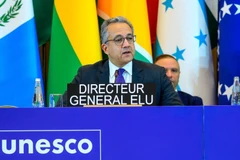
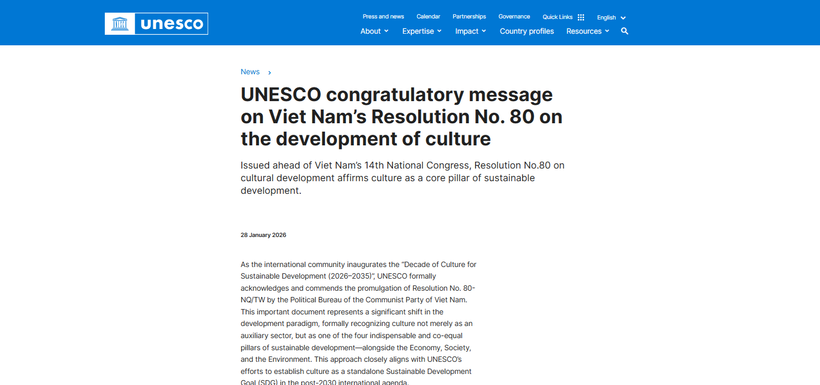
UNESCO posts a congratulatory message on Vietnam's Resolution 80 on the development of Vietnamese culture (The image taken from the screenshot).

Hanoi (VNA) - The website of the United Nations Educational, Scientific and Cultural Organization (UNESCO) on January 28 posted a congratulatory message on Resolution No. 80-NQ/TW of the Politburo of the Communist Party of Vietnam on the development of Vietnamese culture.

In the message UNESCO wrote that it formally acknowledges and commends the promulgation of Resolution No. 80-NQ/TW by the Political Bureau of the Communist Party of Vietnam.

This important document represents a significant shift in the development paradigm, formally recognising culture not merely as an auxiliary sector, but as one of the four indispensable and co-equal pillars of sustainable development - alongside the Economy, Society, and the Environment. This approach closely aligns with UNESCO’s efforts to establish culture as a standalone Sustainable Development Goal (SDG) in the post-2030 international agenda.

Issued ahead of the 14th National Party Congress - a pivotal assembly outlining the national vision toward 2045 and the socio-economic strategy for 2030, Resolution No. 80 demonstrates strong alignment with international commitments at the highest level of national policy.

“The Resolution articulates a concrete roadmap for structural reform, aiming to mobilise social capital, catalyse the creative economy, and safeguard cultural diversity. It builds upon Vietnam’s long-standing cultural advocacy and provides a framework to navigate the complexities of the digital era and a volatile global landscape,” according to UNESCO.

Amid intensifying geopolitical uncertainties and the growing need for cross-cultural cohesion, UNESCO views Vietnam’s strategic positioning of culture as a “regulatory compass” for development as a substantive contribution to the pursuit of global peace.

By prioritising people-centred values and cultural identity, Vietnam promotes a model of development that is both self-sustaining and globally integrated. UNESCO reaffirms its commitment to continued cooperation with Vietnam in realising this vision, further asserting the role of culture as a key driver of equity, prosperity, and social cohesion on a global scale, read the message.

Regarding this important message, Ambassador Nguyen Thi Van Anh, Head of the Vietnam Permanent Mission to UNESCO, expressed her happiness that UNESCO is increasingly paying attention to, valuing, and highly appreciating Vietnam's development direction in the new phase set out by the Party, including the strategic orientations from the 14th Party Congress.

UNESCO's endorsement of Resolution No. 80-NQ/TW on the development of Vietnamese culture clearly reflects its high evaluation of Vietnam's new, highly significant policies in the cultural field.

The ambassador also stated that this demonstrates UNESCO's recognition of Vietnam's role, status, and prestige, as well as the country's contributions to the cultural field at UNESCO. This includes promoting dialogue and connections between cultures, preserving cultural heritage, protecting cultural diversity, and proactively contributing ideas and initiatives. For example, Vietnam proposed a resolution that was adopted by the UNESCO General Conference in November 2025, which recommends that the United Nations General Assembly soon launch the International Decade of Culture for Sustainable Development./.
VNA

See more

A ritual at Hue Nam Temple Festival (Photo: VNA)

Hue Nam Temple Festival: From imperial relic to distinctive cultural celebration in Hue

Historically known as Ngoc Tran Son Tu, the temple was renamed Hue Nam during the reign of King Dong Khanh in the late 19th century, symbolising royal gratitude to the Mother Goddess. It is also the only temple in Hue that harmoniously combines royal ceremonial elements with folk religious practices, creating a distinctive blend of court ritual and popular belief.

Participants in the 20th Cong hien (Devotion) Awards presentation ceremony in Hanoi on April 15 (Photo: VNA)

Devotion Awards mark two decades of honouring excellence in music, sports

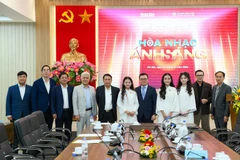
Nguyen Thien Thuat, Editor-in-Chief of the The Thao & Van Hoa newspaper and Head of the organising board of the awards, said, noting that their achievements reflect the spirit of the Politburo’s Resolution No. 80, which emphasises preserving national cultural values while selectively absorbing the essence of world culture.

Artisans and students take part in cultural activities and exchanges in the Xoan singing performance space at Hung Lo ancient communal house in Phu Tho province (Photo: VNA)

Ancestral legends revived through contemporary performance

Beyond cultural value, well-organised festival programmes linked with tourism and media can contribute to the development of cultural industries and enhance Vietnam’s cultural soft power, positioning heritage-based events as distinctive national cultural brands in the international arena.

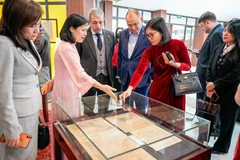
Khue Van Cac (Khue Van Pavilion) stands as a defining cultural symbol of Hanoi, closely associated with Vietnam’s long-standing tradition of valuing education and honouring knowledge. (Photo: VNA)

Greater efforts needed for heritage to shape Hanoi’s identity

As suggested by UNESCO experts, heritage should be approached as an integrated system encompassing space, people and everyday life. This perspective can inform urban planning, cultural tourism development and the creation of clear economic drivers.

Participants at the gathering (Photo: VNA)

Lao, Cambodian students welcome traditional New Year in Ho Chi Minh City

In his speech, Vice Chairman of the municipal People’s Committee Nguyen Manh Cuong said the municipal Party organisation, authorities and people always value the close ties and solidarity among Vietnam, Laos and Cambodia. He described the three nations’ longstanding ties, forged through shared hardships, as an invaluable spiritual asset and a bedrock for sustainable development.

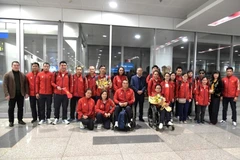
Vietnamese kickboxers win 32 gold medals at the Kickboxing World Cup 2026. (Photo: Vietnam Kickboxing Federation)

Vietnam finish third at Kickboxing World Cup 2026

According to Vu Duc Thinh, President of the Vietnam Kickboxing Federation, the strong results reflected careful preparation by local training centres and the determination of Vietnamese fighters. The team’s participation, funded largely through socialised and local resources, also demonstrated growing support for the development of kickboxing in Vietnam.

Politburo member, Secretary of the Party Central Committee and Head of the Party Central Committee’s Commission for Information, Education and Mass Mobilisation Trinh Van Quyet speaks at the event (Photo: VNA)

National Radio Festival opens in Quang Ninh

The opening night was combined with an artistic programme titled “sounds of the new era,” drawing around 50,000 spectators. The programme was structured in three chapters: Origins of Sound, Heritage Sound, and Sound of the New Era.

Vietnamese puppetry faces pressure to adapt to modern lifestyles, particularly amid growing competition from diverse entertainment forms (Photo: VNA)

Vietnamese puppetry seeks renewal amid preservation challenges

People’s Artist Nguyen Hoang Tuan, Chairman of the Hanoi Theatre Association, noted that while northern Vietnam had 27 puppetry guilds in 1986, only 14 remain today. Many traditional plays and original scripts have been lost, hurting restoration and preservation efforts.