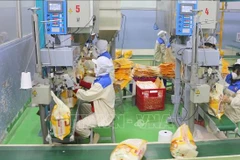
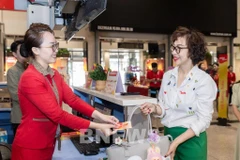
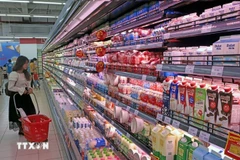
Between 2010 and 2021, the number of supermarkets increased to 1,167 supermarkets. (Photo:VNA)
 Le Viet Nga, Deputy Director of the Domestic Market Departmentunder the Ministry of Industry and Trade (MoIT), said the ministry wouldcontinue to coordinate with relevant ministries, sectors and localities toreview and develop the commercial infrastructure to approve planning, plans andstrategies. They will focus on the development of a wholesale market andlogistics centre.
The MoIT will continue to review and amend mechanisms and policiesrelating to commercial infrastructure development because the existingmechanisms and policies have not yet created a breakthrough.
The ministry has been developing a draft of a circular regulatingthe classification and management of some commercial infrastructure. That willaim at developing further modern commercial infrastructure according to thestrategy of developing domestic trade until 2030 with a vision to 2045.
Its statistics show that from 2010 to 2021, the number ofsupermarkets and trading centres increased rapidly from 567 supermarkets and 95trading centres in 2010 to 1,167 supermarkets and 254 trading centres.
The number of convenience store chains also has increasedstrongly in recent years.
Those changes have shown that the modern commercialinfrastructure has been developed while the traditional market system hasbeen upgraded, especially in rural markets.
Notably, the convenience store system has been thriving in Vietnamas a small and medium-sized retail model. This is considered an upgradedversion of the grocery stores, but they have more advantages, such as savingtime and space and better service quality.
However, experts have pointed out a strong development in severalmarkets, supermarkets, trading centres and convenience stores. Still, theydo not have synchronous development and are mainly located in urban areas.Besides that, the legal framework for them has not kept pace with thedevelopment of commercial infrastructure.
Traditional markets, such as Mo and Hang Da markets in Hanoi, havebeen rebuilt for a long time, but up to now, they still have many emptykiosks without the excitement as before.
That's because Vietnamese consumers often prioritise convenience.They like sitting on a motorbike to buy food and veggies at a small marketalong the pavement or a traditional market.
Vu Vinh Phu, a retail expert, said that there is only Decision1371/QD-BTM dated September 24, 2004, on regulations on developing supermarketsand trading centres. However, those regulations have many outdatedand inappropriate points, especially in convenience stores that have onlydeveloped strongly in the last five years.
The lack of a legal document relating to the management ofconvenience stores makes Vietnam not have clear standards and strategies toencourage the development of convenience stores.
So far, the State management agencies have yet to determine thenumber of convenience stores nationwide. As a result, he said manyconsumers, businesses, State management agencies and localities are confusedbetween mini-marts and convenience stores.
All of the above factors make Vietnam not have a brandedconvenience store chain, although it has had strong development in several ofthose stores.
Vu Thi Hau, Chairwoman of the Vietnam Retailers Association, saidin the context of the growing demand for developing civilised and moderncommercial infrastructure, MoIT needs to build regulations on this issue andtake consultation from many parties to create a legal corridor for enterprisesto invest to those convenience stores.
Last year, the Prime Minister approved a strategy for developingdomestic trade in 2030, with a vision to 2045.
The strategy has set a goal that the revenue of goods and servicesfrom modern retail system accounts for about 38-42% of the nation's totalretail sales of goods and services, higher than the rate of about 25% atpresent.
Therefore, the future development of modern commercialinfrastructure is forecasted to explode thanks to this commercial developmentstrategy. Legal documents are also necessary to keep up with the development ofthe market.
Hanoi has set a goal of developing three trade centres, tensupermarkets and 100 convenience stores, making the trade a high-quality andvalue-added service sector.
Accordingly, the city will promote investment attraction ofcommercial infrastructure, including markets, supermarkets, and commercialcentres, ensuring compliance with the planning.
At the same time, it will support businesses in removingdifficulties and obstacles to speed up the implementation of new commercialinfrastructure projects and rebuilding or renovating markets, supermarkets, andcommercial centres./.
VNA