Vietnam needs comprehensive strategy to tap Halal market potential

Experts believe Vietnam needs a comprehensive, long-term strategy to develop its Halal sector, covering certification, market access, and capacity building.

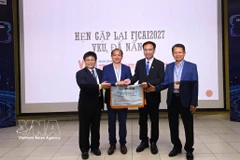
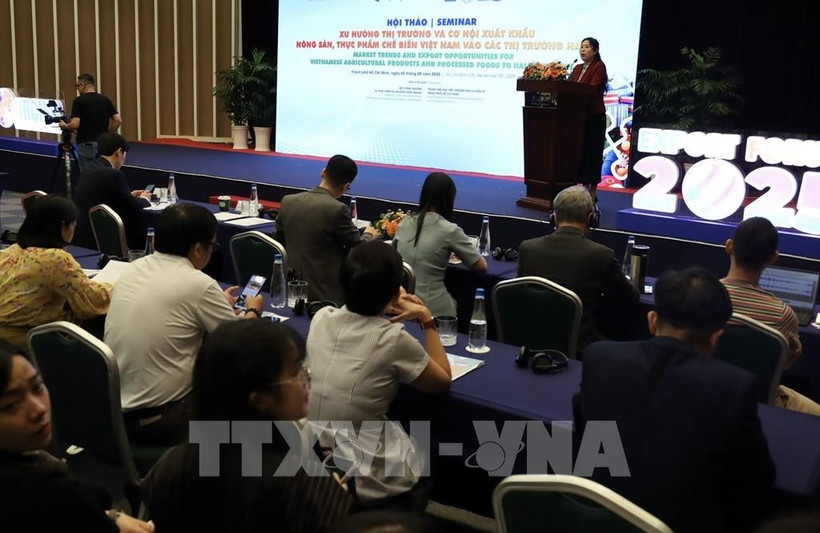
Delegates at the event (Photo: VNA)

HCM City (VNA) – The global Halal industry is expanding rapidly, but Vietnamese exporters have yet to fully capitalise on its opportunities. Experts believe Vietnam needs a comprehensive, long-term strategy to develop its Halal sector, covering certification, market access, and capacity building.

This view was shared at a seminar on “market trends and opportunities for exporting Vietnamese agricultural products and processed foods to Halal markets,” co-organised by the Ministry of Industry and Trade and the Ho Chi Minh City Investment and Trade Promotion Centre (ITPC) in Ho Chi Minh City on September 5.

The Halal economy serves more than 2.2 billion Muslim consumers worldwide, with a market value exceeding 2 trillion USD. Beyond Muslim-majority nations, demand for Halal-certified products is rising in countries such as France, Germany, the UK, and the US.

According to ITPC Deputy Director Ho Thi Quyen, this presents significant opportunities for Vietnam’s competitive products like farm produce, processed foods, cosmetics, and pharmaceuticals to build brands associated with Halal standards and expand international distribution channels.

Similar trends are evident in the Middle East and North Africa, where the Halal consumer market is valued at 240–254 billion USD and projected to reach 380 billion USD by 2030.

Agricultural and food products account for the largest share of imports, as many countries in the region lack sufficient domestic production. The Middle East also serves as a gateway for Vietnamese goods to access broader global markets.

Indonesia, home to the world’s largest Muslim population of nearly 245 million, represents another promising destination. With strong population growth, a fast-expanding middle class, and annual Halal consumption estimated at over 330 billion USD, demand spans food, beverages, pharmaceuticals, cosmetics, fashion, and tourism.

However, Vietnam’s Halal exports to Indonesia remain modest at just 54 million USD in 2024, less than 1% of Vietnam’s total exports to the country, concentrated mainly in confectionery and processed food produced by foreign-invested enterprises in Vietnam.

Despite strong demand, Vietnamese firms face significant barriers. According to Quyen, Vietnam still lacks internationally recognised Halal certification bodies, while domestic certification remains fragmented. This complicates export procedures, particularly for markets with strict quality control and logistics requirements.

Most Vietnamese food and agricultural processors are small and medium-sized enterprises with limited financial resources, weak management capacity, and a shortage of Halal expertise. In addition, businesses often lack strategic information about Halal markets.

Nguyen Thi Ngoc Hang, Marketing Director of Halal Certification Agency Vietnam, noted that Vietnam faces a shortage of professionals with in-depth knowledge of the entire Halal value chain, from production and packaging to logistics and distribution. Without addressing this gap, it will be difficult for Vietnam to integrate effectively into the global Halal supply chain.

Trade Counselor Pham The Cuong from the Vietnamese Trade Office in Indonesia added that certification procedures are time-consuming and costly, while Halal production standards are complex. Few Vietnamese companies have approached the Halal market in a systematic way, and brand visibility remains limited.

Experts agreed that Vietnam should adopt a national strategy to strengthen Halal competitiveness, enhance human resource training, and promote international cooperation.

Cuong suggested that domestic firms link up with established Halal companies abroad to learn best practices, join supply chains, and expand exports. Partnerships with local distributors in Muslim markets can also help Vietnamese products gain easier entry into both traditional and modern retail systems.

By developing clear strategies, improving product quality and safety, and pursuing recognised Halal certification, Vietnamese businesses could gradually build consumer trust and secure a stronger position in the rapidly growing Halal market./.
VNA

See more

Phin Ho Tra – a national five-star OCOP product. (Illustrative photo: VNA)

Hanoi to host Vietnam OCOP Festival 2025

The festival is seen a practical activity celebrating the achievements made by the capital and the country in 2025, affirming OCOP’s role in rural economic development, contributing to realising Vietnam’s aspiration for strong economic growth in the context of deep integration.

The expanded Hoa Binh Hydropower Plant (Photo baochinhphu.vn)

EVN launches major power projects

Among the flagship projects inaugurated was the expanded Hoa Binh Hydropower Plant with a total installed capacity of 480MW per year and average annual output of about 488 million kWh.

An ultra-intensive shrimp farming model linked with environmental protection in Ca Mau province. (Photo: VNA)

Fisheries take the lead in the Mekong Delta’s green transition

Across the Mekong Delta, leading aquaculture producers, processors and exporters, along with suppliers of inputs, are transitioning to circular, high-tech and clean production models that cut greenhouse gas emissions and comply with international certification standards.

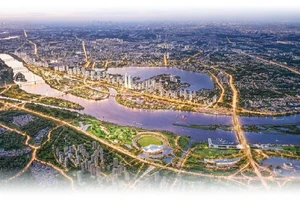
A perspective view of the Red River Landscape Boulevard project in Hanoi (Photo: VNA)

Works starts on Hanoi’s Red River Landscape Boulevard Axis project

The project is among the 234 key works and projects being launched, inaugurated or technically opened simultaneously across 34 cities and provinces nationwide to mark the 14th National Party Congress. Its launch contributes to implementing the country’s strategic development orientations while concretising Hanoi’s development goals in the new period.

The ground-breaking ceremony of the Yen Bai 1 biomass power plant in Lao Cai province on December 19. (Photo: VNA)

Work starts on 114-million-USD biomass power plant in Lao Cai

The project, developed by Erex Yen Bai Biomass Power Co. Ltd. is located in Dong Cuong commune, Lao Cai province. It is backed by Japan’s Erex Group and falls under the Joint Crediting Mechanism, a bilateral initiative between Vietnam and Japan to reduce greenhouse gas emissions.

At the inauguration ceremony (Photo: VNA)

Vietnam Railways Corporation unveils upgraded coaches, digital tools

These moves reflect the VNR's commitment to fulfilling six priority tasks set by the Prime Minister, including leading in innovation and digital transformation, applying sci-tech in line with the Politburo’s Resolution No. 57-NQ/TW, and spearheading advances in digital, green and circular economy.

Producing MDF panels for export at Hai Duong MDF Construction and Manufacturing Co., Ltd., in Ho Chi Minh City (Photo: VNA)

HCM City targets 15 billion USD in wood exports by 2035

The merger of HCM City with Binh Duong and Ba Ria – Vung Tau is expected to give the local wood industry a strong boost into a phase of high-quality growth driven by linkages, innovation, sustainability, and deeper integration into global value chains.

Delegates cut a ribbon to inaugurate the expanded Terminal T2 at Noi Bai International Airport in Hanoi on December 19, 2025. (Photo: VNA)

Expanded Terminal T2 at Noi Bai International Airport makes debut

The project expands the terminal’s floor area to over 200,000 sq.m, increases passenger capacity from 10 million to 15 million, even up to 18 million per year, and boosts operational capacity with boarding gates rising from 17 to 30 and jet bridges from 14 to 27, meeting strong growth in international travel demand.

A section of Can Tho - Ca Mau Expressway (Photo: VNA)

Can Tho – Ca Mau travel time halves from December 19

Stretching more than 110 km with a total investment of over 27.5 trillion VND (1.04 billion USD), the project not only resolves long-standing traffic bottlenecks in the Mekong Delta, but also opens up new development opportunities for the entire region - especially Ca Mau, the last locality in the country to be directly connected to the eastern North–South expressway axis.