Vietnam to promote development of halal products and services

The draft decree states that Vietnamese halal certification organisations will be supported in improving their capacity, achieving international recognition and having their certification results accepted by different countries and territories, especially in target export markets.

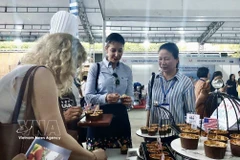
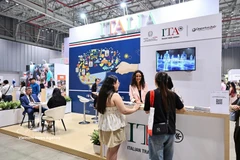
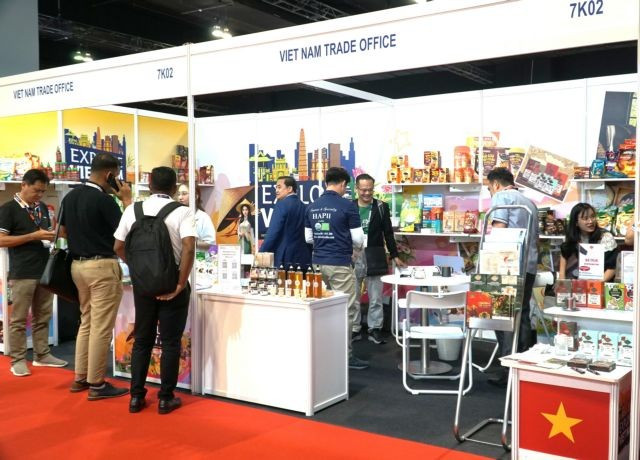
Vietnamese goods at the International Halal Exhibition 2024 held in Kuala Lumpur, Malaysia. (Photo: VNA)

Hanoi (VNS/VNA) - Vietnam will proactively negotiate and sign international agreements to facilitate and support businesses in promoting halal products and services, according to a draft decree on halal products and services quality management compiled by the Ministry of Science and Technology (MST).

Under the draft decree, halal products are those that have been declared lawful or permissible under Islamic law.

Halal services are any activities related to halal products, including transportation, storage, packaging, display and handling.

The draft decree states that Vietnamese halal certification organisations will be supported in improving their capacity, achieving international recognition and having their certification results accepted by different countries and territories, especially in target export markets.

Vietnam will prioritise the integration, research and market development for halal products and services in the National Trade Promotion Programme and other related market development programmes, including supporting costs for businesses to attend prestigious halal trade fairs, exhibitions, forums and events abroad.

Businesses with high quality and reputable halal products and services are encouraged to join the Vietnam National Brand Programme, while promoting national branded halal products to international markets.

Preferential credit

As for support policies for businesses, the draft decree directs credit institutions, credit guarantee funds and small and medium-sized enterprise development funds to consider giving preferential interest rates for investment projects in halal production and technology.

They should also prioritise building quality management systems that meet halal standards and costs for first-time halal certification assessment.

Partial support to build a halal assurance management system and costs for the first halal certification assessment will be inserted into several different initiatives, including Small and Medium-sized Enterprise Support Programmes, Industrial Promotion Programmes and national and local Science and Technology Development Programmes.

Vietnam will help businesses with science and technology projects to research, apply and innovate production technology and preserve halal products.

Companies will also be supported in accessing markets and legal and technical information through the construction, maintenance and development of a State national halal database.

The database must ensure connection with the National Database on standards, measurements and quality.

The national halal database must be public, transparent and easily accessible, and it must provide complete, accurate and timely information.

In-depth tests

The draft decree also regulates support policies for certification and testing organisations.

Vietnam will give financial incentives to investments in specialised testing equipment to serve halal requirements. Funding will come from science and technology development funds, science and technology enterprise development support programmes or specialised projects.

Authorities will also work to support the cost of initial international accreditation for laboratories and halal certification agencies with the potential and commitment to serve the industry's development.

Vietnamese halal conformity assessment organisations will gain support to participate in international networks and associations, seek opportunities for technical cooperation and promote the signing of mutual recognition agreements on testing and certification results with foreign organisations.

Business households, cooperatives and groups can connect with halal processing and exporting enterprises to form stable and controlled halal raw material supply chains.

Pilot production links and halal application certification models will be replicated for cooperatives and cooperative groups to reduce costs and improve access to certification.

The MoST is collecting feedback on the draft decree through comments on its information portal./.

VNA

See more

Officials visit a booth at the festival. (Photo: VNA)

Vietnam OCOP Festival 2025 opens in Hanoi

The festival functions as a space to bring together regional OCOP excellence, a forum connecting OCOP stakeholders with distributors, investors, experts and consumers, and a platform to spread pride in indigenous culture, local knowledge, and the aspiration for legitimate prosperity.

Prime Minister Pham Minh Chinh (third from right) and officials launch the Ministry of Construction’s new information technology systems at the conference on December 21. (Photo: VNA)

Modern, comprehensive infrastructure – a need for fast, sustainable development: PM

The Party and State continue to define infrastructure development as one of the three strategic breakthroughs, with priority given to building comprehensive and modern infrastructure, particularly transport facilities, technological infrastructure, and green – digital transition infrastructure, to help realise the national target of double-digit growth, the PM said.

Prime Minister Pham Minh Chinh addresses he third meeting of the National Steering Committee implementing the Politburo’s Resolution 68 in Hanoi on December 20. (Photo: VNA)

PM pushes trust, breakthroughs to accelerate private sector growth

Prime Minister Pham Minh Chinh noted that since the rollout of Resolution 68, alongside supporting resolutions from the National Assembly (NA) and Government, there has been a marked change in understanding the private sector’s critical position and role in Vietnam’s socialist-oriented market economy.

PM Pham Minh Chinh chairs the meeting (Photo: VNA)

Private sector thrives eight months after Resolution 68’s launch: PM

The private sector has shown marked progress eight months after the launch of Resolution 68, registering about 18,000 new enterprises monthly and pushing the nationwide total to nearly 1.1 million, Prime Minister Pham Minh Chinh told the third meeting of the National Steering Committee in Hanoi on December 20.

Phin Ho Tra – a national five-star OCOP product. (Illustrative photo: VNA)

Hanoi to host Vietnam OCOP Festival 2025

The festival is seen a practical activity celebrating the achievements made by the capital and the country in 2025, affirming OCOP’s role in rural economic development, contributing to realising Vietnam’s aspiration for strong economic growth in the context of deep integration.

The expanded Hoa Binh Hydropower Plant (Photo baochinhphu.vn)

EVN launches major power projects

Among the flagship projects inaugurated was the expanded Hoa Binh Hydropower Plant with a total installed capacity of 480MW per year and average annual output of about 488 million kWh.

An ultra-intensive shrimp farming model linked with environmental protection in Ca Mau province. (Photo: VNA)

Fisheries take the lead in the Mekong Delta’s green transition

Across the Mekong Delta, leading aquaculture producers, processors and exporters, along with suppliers of inputs, are transitioning to circular, high-tech and clean production models that cut greenhouse gas emissions and comply with international certification standards.

A perspective view of the Red River Landscape Boulevard project in Hanoi (Photo: VNA)

Works starts on Hanoi’s Red River Landscape Boulevard Axis project

The project is among the 234 key works and projects being launched, inaugurated or technically opened simultaneously across 34 cities and provinces nationwide to mark the 14th National Party Congress. Its launch contributes to implementing the country’s strategic development orientations while concretising Hanoi’s development goals in the new period.