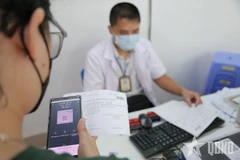
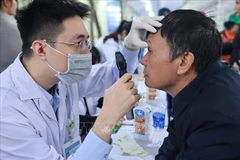
Doctors conduct pre-diabetes tests for a patient.(Photo: VNA)
 Hanoi (VNS/VNA) - Controlling the number of people with hypertension anddiabetes is a big challenge for Vietnam, experts said.
As livingstandards improve, the disease pattern in the country was changing, saidMinister of Health Nguyen Thi Kim Tien at a workshop entitled ‘Associateeducation and treatment in optimising the management of hypertension anddiabetes held in Hanoi over the weekend.
Non-communicablediseases account for about 70 percent of total diseases in Vietnam and are theleading cause of death – accounting for 77 percent of total deaths nationwide.
Statisticsfrom the Ministry of Health (MoH) showed that many people were not aware thatthey suffered from hypertension or diabetes.
Thenumber of patients undergoing treatment was low, with about 29 percent ofdiabetes patients and 14 percent suffering from hypertension undergoing someform of care. The main reason was a lack of knowledge among Vietnamesepatients.
In orderto prevent and limit non-communicable diseases including diabetes, theVietnamese Government has issued the ‘Vietnam Health Programme’ with 11 solutions,Tien said. Of which, four solutions were being actively implemented, includingproper nutrition, strengthening physical activity, and preventing harm causedby tobacco and alcohol.
Inaddition, the MoH was also piloting a programme for early detection of diseasessuch as diabetes, cardiovascular problems and cancer.
Thehealth sector also focuses on primary health care activities and healthpromotion associated with grassroots healthcare in communes and districts.
Accordingto the International Diabetes Federation, there were 3.5 million peoplesuffering from diabetes in Vietnam in 2017, and this figure was predicted torise to over 6 million by 2045.
Given thehigh rate of diabetics in Vietnam, treatment cost for the disease was a keyissue.
Pham LuongSon, Deputy Director General of Vietnam Social Security (VSS), said diabeteswas one of the urgent global issues slowing sustainable development, especiallyin low-income and middle-income countries.
Accordingto the World Health Organisation (WHO), there are now more than 190million people with diabetes worldwide and this number is increasing.
Everyyear, the health insurance fund has paid trillions of VND for diagnosis andtreatment of diabetes. Given the difficulties in balancing the health insurancefund, it was necessary to manage the expenditure for diabetes examination andtreatment properly as this was not only beneficial for patients but alsosociety as a whole.
Speakingat the conference on the management of treatment for diabetes last week, NguyenThi Thanh Ha from VSS said tests and diagnosis of diabetes were always amongthe top 50 technical services with the largest expenditure in Vietnam;accounting for about 8 percent of the health insurance fund’s expenditure.
Lastyear, the total cost of diabetes treatment was over 5.3 trillion VND (226.7million USD), up 13 percent compared to 2017.
Participantsat the workshop emphasised the need to effectively control expenditure as thecost of treating diabetes was expected to increase by 42 percent from 2017 to2045.
They saidit was essential to strengthen the role of healthcare at the grass-roots level,sharing data from health insurers to limit unnecessary technical services. Theapplication of new techniques and drugs was a must to increase efficiency andreduce costs.
Attentionshould be paid to information campaigns on non-communicable disease prevention,reducing salt consumption and controlling weight.
It wasnecessary to strengthen early detection and treatment of the disease;periodically conduct national surveys as part of a non-communicable diseasesurveillance system to monitor risk factors and implementation measures onprevention of the diseases in Vietnam, they said.-VNS/VNA
As livingstandards improve, the disease pattern in the country was changing, saidMinister of Health Nguyen Thi Kim Tien at a workshop entitled ‘Associateeducation and treatment in optimising the management of hypertension anddiabetes held in Hanoi over the weekend.
Non-communicablediseases account for about 70 percent of total diseases in Vietnam and are theleading cause of death – accounting for 77 percent of total deaths nationwide.
Statisticsfrom the Ministry of Health (MoH) showed that many people were not aware thatthey suffered from hypertension or diabetes.
Thenumber of patients undergoing treatment was low, with about 29 percent ofdiabetes patients and 14 percent suffering from hypertension undergoing someform of care. The main reason was a lack of knowledge among Vietnamesepatients.
In orderto prevent and limit non-communicable diseases including diabetes, theVietnamese Government has issued the ‘Vietnam Health Programme’ with 11 solutions,Tien said. Of which, four solutions were being actively implemented, includingproper nutrition, strengthening physical activity, and preventing harm causedby tobacco and alcohol.
Inaddition, the MoH was also piloting a programme for early detection of diseasessuch as diabetes, cardiovascular problems and cancer.
Thehealth sector also focuses on primary health care activities and healthpromotion associated with grassroots healthcare in communes and districts.
Accordingto the International Diabetes Federation, there were 3.5 million peoplesuffering from diabetes in Vietnam in 2017, and this figure was predicted torise to over 6 million by 2045.
Given thehigh rate of diabetics in Vietnam, treatment cost for the disease was a keyissue.
Pham LuongSon, Deputy Director General of Vietnam Social Security (VSS), said diabeteswas one of the urgent global issues slowing sustainable development, especiallyin low-income and middle-income countries.
Accordingto the World Health Organisation (WHO), there are now more than 190million people with diabetes worldwide and this number is increasing.
Everyyear, the health insurance fund has paid trillions of VND for diagnosis andtreatment of diabetes. Given the difficulties in balancing the health insurancefund, it was necessary to manage the expenditure for diabetes examination andtreatment properly as this was not only beneficial for patients but alsosociety as a whole.
Speakingat the conference on the management of treatment for diabetes last week, NguyenThi Thanh Ha from VSS said tests and diagnosis of diabetes were always amongthe top 50 technical services with the largest expenditure in Vietnam;accounting for about 8 percent of the health insurance fund’s expenditure.
Lastyear, the total cost of diabetes treatment was over 5.3 trillion VND (226.7million USD), up 13 percent compared to 2017.
Participantsat the workshop emphasised the need to effectively control expenditure as thecost of treating diabetes was expected to increase by 42 percent from 2017 to2045.
They saidit was essential to strengthen the role of healthcare at the grass-roots level,sharing data from health insurers to limit unnecessary technical services. Theapplication of new techniques and drugs was a must to increase efficiency andreduce costs.
Attentionshould be paid to information campaigns on non-communicable disease prevention,reducing salt consumption and controlling weight.
It wasnecessary to strengthen early detection and treatment of the disease;periodically conduct national surveys as part of a non-communicable diseasesurveillance system to monitor risk factors and implementation measures onprevention of the diseases in Vietnam, they said.-VNS/VNA
VNA