Vietnamese consumers increasingly embrace sustainability

Sustainability has been a growing topic of interest to Vietnamese consumers in recent years though awareness levels remain well below the global average.
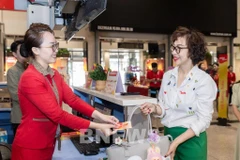
Vietnamese consumers increasingly embrace sustainability ảnh 1Nearly 80 percent of Vietnamese shoppers do not bring their own bags, resulting in the increasing use of plastic bags. (Photo: hanoimoi.com.vn)

HCMCity (VNS/VNA)
- Sustainability has been a growing topic of interest to Vietnameseconsumers in recent years though awareness levels remain well below the globalaverage.
According to Kantar’s lateststudy on the environment done on a global scale, environmental issues such asplastic waste, water pollution and air pollution are among the top fiveconcerns of Vietnamese in addition to food safety.
Facing increasing climatechanges along with escalating levels of pollution, especially in the two keycities of Hanoi and HCM City, there is an increasing environment consciousnessamong a group of Vietnamese consumers who are willing to take action to improvethe situation such as reducing plastic waste, recycling and opting forhealthier and sustainable lifestyles.
But such people only accountfor 35 percent whereas the global rate is 59 percent, Vo Thi Kim Nhu, senioraccount manager, Worldpanel Division in Vietnam, told a recent webinar.
Moreover, nearly 80 percent ofVietnamese shoppers do not bring their own bags, resulting in the increasinguse of plastic bags, the study found.
Nhu also listed the reasonsthat prevent Vietnamese from living ‘green’ as knowledge barrier sinceauthorities and enterprises do not propagate environmental protection, a beliefthe situation is not too bad, which requires an emphasis on the alarming state,and the fact that sustainable and environment-friendly products are hard tofind and are expensive.
In fact, one of the activitiesthat has been promoted and encouraged by the authorities and enterprises inVietnam recently is recycling.
But Vietnamese consumersremain very vague about which products can be reused, recycled and replaced,where these products can be collected, how products are recycled, and what willhappen to them after recycling, Nhu said.
Furthermore,a quarter of the study respondents said recycling is inconvenient.
Vietnamese consumers wantmanufacturers and authorities to take the lead in reducing environmentalimpacts and do not expect retailers to take action in limiting environmentaldamage.
In the past few years theGovernment has been undertaking environmental protection projects with the aidof local and foreign businesses, organisations and individuals.
For instance, nine leadingcompanies in the fast moving consumer goods and packaging sectors formed theVietnam Packaging Recycling Alliance (PRO Vietnam). They include TH Group,Coca-Cola, Friesland Campina, La Vie, Nestle, Nutifood, Suntory PepsiCo, TetraPak, and Universal Robina Corporation.
The establishment of thisalliance promises many practical green initiatives and actions.
Besides, many initiatives havebeen taken by businesses such as using paper and recycled plastic straws andpackaging in coffee and tea shops and supermarkets and food to non-food brands.
However, surprisingly, only 5percent of participants could name manufacturers or brands that are takingenvironment-friendly initiatives.
“To foster more revolutionarychanges towards a shared sustainable development, perhaps we need to considerconveying more green messages along with activities to inspire various consumergroups,” Nhu said.
Kantar's Worldpanel data alsofound that a majority of the aware consumer group stopped buying certainproducts and services because of their impact on the environment or society.
This implies the importance ofthis group of consumers. By involving and engaging with them brands will haveopportunity to achieve a sustainable development in the future.
Doan Quoc Tuan, seniormarketing executive at Tetra Pak, said: “Sustainability is no longer just anice thing to do or trend. It is a licence to do business in the long term.”/.
VNA


See more

Vietnam is emerging as a preferred destination for many foreign enterprises (Photo: hanoimoi.vn)

Vietnam emerges as bright spot of growth, trusted and responsible partner

Despite a volatile global environment, Vietnam recorded solid gains in 2025. With flexible and proactive policies under the leadership of the Communist Party of Vietnam and the Government, all 15 key socio-economic targets were met or exceeded, while GDP expanded by about 8.02%, surpassing expectations.

An image of a Vietnamese game. CIS region has potential for gaming developers from Viet Nam. (Photo: Courtesy of cellphones.com.vn_

CIS: Opportunity for game developers in Vietnam

The CIS region, which includes Eastern Europe and Central Asia, has potential for gaming developers from Vietnam as this market displays user behaviour patterns that are highly favourable for mobile gaming growth, particularly around major holiday periods.

Banks, including MB Bank, have issued alerts about scams conducted via social media platforms such as Zalo and Facebook, where criminals impersonate acquaintances. (Photo: The Courtesy of MBBank)

Financial scams surge ahead of Tet

As the Lunar New Year (Tet) approaches, financial and banking scams in Vietnam are showing a sharp upward trend, prompting banks and law enforcement agencies to issue repeated warnings.

Hai Phong targets 4.3 billion USD in FDI in 2026 (Photo: VNA)

Hai Phong city targets 4.3 billion USD in FDI in 2026

Hai Phong’s investment appeal is underpinned by a rapidly expanding development space, including the Southern Coastal Economic Zone covering more than 20,000 hectares, a planned free trade zone, deep-water ports at Lach Huyen, and 12 industrial parks newly established in 2025.

The relocation of check-in counters aims to better meet the travel needs of residents and visitors. (Photo: VNA)

Vietjet shifts domestic check-in at Tan Son Nhat from January 13

During the recent New Year 2026 holiday peak, Vietjet added 380 flights, equivalent to nearly 78,000 additional seats, on many key domestic routes linking Hanoi and Ho Chi Minh City with destinations such as Vinh, Thanh Hoa, Hai Phong, Da Nang, Phu Quoc, Nha Trang and Da Lat.

Commercial banks are providing approximately 88% of total green credit outstanding in Vietnam. (Photo: nhandan.vn)

Capital sources expanded for sustainable growth

According to the State Bank of Vietnam (SBV), by the end of November 2025, outstanding green credit was estimated at around 750 trillion VND (28.55 billion USD), with an average growth rate exceeding that of overall credit in the economy.

Customers select goods at a supermarket. (Photo: VNA)

Retail market expands sharply, sustainability challenges persist

According to a report on recently released by the Ministry of Industry and Trade’s Agency for Domestic Market Surveillance and Development, the size of the market reached more than 7 quadrillion VND (about 266 billion USD) in 2025, up around 10% compared with 2024.

Oil rigs at the Bach Ho oil field. (Photo: VNA)

Resolution 79: State economy to lead growth

Resolution 79 is described as a “clear action declaration” by the Politburo, saying the state economy is not only responsible for maintaining macroeconomic stability, but must also become the force leading a new growth model that is green and sustainable.

Workers at Garment 10 Corporation produce apparel for export. (Photo: Nhan Dan)

Vietnam leverages export advantages within RCEP region

In 2025, seafood exports to China alone exceeded 2.2 billion USD, up about 33% compared to 2024. Shipments to Japan fetched nearly 1.7 billion USD, a year-on-year increase of 14.6%, while those to the Republic of Korea and Australia grew by 9.6% and 3.2%, respectively.

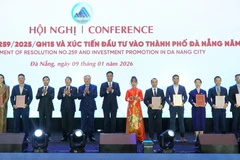
Certificates of membership in the Vietnam International Financial Centre in Da Nang are awarded at the conference on January 9. (Photo: VNA)

Da Nang continues targeted investment promotion approaches

According to Chairman of the Da Nang People’s Committee Pham Duc An, the city prioritises building sustainable economic ecosystems and focuses on key breakthrough sectors with strong spillover effects, including high technology and digital transformation, logistics, urban infrastructure, finance, processing and manufacturing industries, high-tech agriculture, and the pharmaceutical and medicinal herb industry.