Vietnamese firms strengthen foothold globally, better policies needed

As more Vietnamese companies venture into global markets, the key question now is how to enable more domestic enterprises to scale up sustainably and maintain their footing amid intensifying global competition.

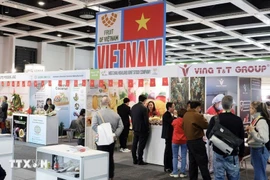
A representative of the Long Son JSC introduces organic cashew nut products to a visitor at BIOFACH 2026, the world's leading trade fair for organic food, held in Germany in February. (Photo: VNA)

Hanoi (VNA) – An increasing number of Vietnamese enterprises are expanding their presence in international markets not by relying solely on low cost or preferential incentives, but through technological innovation, adherence to stringent standards and strong brand development.

However, experts say further policy improvements are needed to help businesses compete on equal terms with foreign rivals.

Confidence in competitiveness

Chairman of the Phuc Sinh Group Phan Minh Thong said Vietnamese enterprises must continuously upgrade their capabilities to enhance international competitiveness.

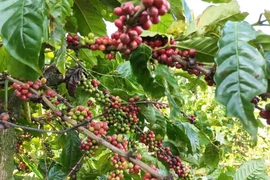
From an exporter of raw peppercorns, Phuc Sinh has shifted toward deep processing, brand building and direct participation in global distribution chains. Its pepper and coffee products are now available in more than 120 markets, with annual export turnover estimated at over 400 million USD.

According to Thong, global competition is no longer about simply selling products but about retaining markets. International partners increasingly prioritise traceability, sustainable production and the ability to guarantee stable and long-term supply over price advantages.

Without a change in mindset, traditional farming practices will erode competitiveness. Meanwhile, standards-based agriculture could be a sustainable “gold mine”, he noted.

Sharing this view, Chairman of the Vina T&T Group Nguyen Dinh Tung stressed that mastering the entire value chain is crucial for competing with multinational corporations.

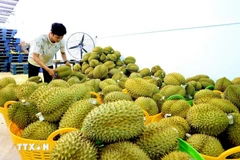
Drawing on the company’s experience in exporting fresh fruits to the US, the European Union and Japan, Tung said supply stability, consistent quality and reliable contract performance are decisive factors. Controlling raw material zones and proactively managing quality and logistics enable enterprises to retain markets and compete fairly with global agribusinesses, he added.

Beyond agriculture, Vietnamese firms are also asserting competitiveness in high-tech sectors.

Dr Luong Viet Quoc, CEO of Real-time Robotics (RtR), said unmanned aerial vehicles researched, designed and manufactured by Vietnamese companies are now capable of competing directly with products from China, Israel and the US.

Designing appropriate policies

vnanet-biofach1.jpg
Organic spices of Vietnam on display at BIOFACH 2026 (Photo: VNA)

Vietnam’s export turnover increased from over 336 billion USD in 2021 to an estimated 475 billion USD in 2025. Tens of thousands of enterprises are involved in export activities, and many sectors have established a stable presence in major markets such as the US, the EU and Japan.

However, experts observed that the number of enterprises able to compete on equal footing internationally remains modest compared to the country’s economic potential.

Nguyen Ngoc Hoa, Chairman of the Ho Chi Minh City Union of Business Associations (HUBA), said resilience and adaptability to new global trade rules pose major challenges. Requirements relating to carbon taxes, ESG standards, trade remedies, rising logistics costs and increasing compliance expenses are exerting mounting pressure on businesses while most of them have limited resources to handle.

From a broader perspective, Prof. Dr Vu Minh Khuong from the Lee Kuan Yew School of Public Policy under the National University of Singapore stressed that enterprise competitiveness must be viewed holistically. While businesses are central, they cannot be separated from institutions, the business environment or linkages within the wider economic ecosystem.

As more Vietnamese companies venture into global markets, the key question now is how to enable more domestic enterprises to scale up sustainably and maintain their footing amid intensifying global competition.

Experts proposed continued administrative procedure reforms to reduce compliance costs, alongside more suitable credit policies to support innovation-driven and green-transition enterprises. Developing logistics infrastructure and strengthening supply-chain linkages among domestic firms, foreign-invested enterprises and international distribution networks are also considered essential./.
VNA

See more

A land-rent contract signing between South Korean firm HS Hyosung Quang Nam and the Chu Lai Industrial Zone Authorities on the development of a new polyester curtain fabric plant in Tam Thang Expanded Industrial Park. (Photo courtesy of Da Nang Portal)

RoK's Hyosung to build new plant in Da Nang

HS Hyosung Quang Nam, under Hyosung Group of the Republic of Korea (RoK), has signed a land-rent contract with the Chu Lai Industrial Zone Authorities for an expansion of its investment in central Vietnam, which started with the introduction of its first plant in 2019.

Electronic components are manufactured at the SANYOU VIETNAM Electronic Equipment Co., Ltd. in Tu Ha Industrial Park, Hue city. (Photo: VNA)

Vietnam remains bright spot for FDI inflows: Sputnik

The article said Vietnam attracted its highest level of FDI over the past five years in 2025 and is expected to maintain its appeal in 2026 as international investors regard the country as one of the region’s most promising long-term investment destinations.

Durians for export gathered at a fruit warehouse in Dong Nai province (Photo: VNA)

Aid for agricultural insurance premiums proposed to rise

Although agricultural insurance policies have been piloted since 2011, the sector remains new and high risk, creating multiple challenges in implementation.In practice, most agricultural insurance participants have been farmers from poor and near-poor households, while participation among non-poor households and agricultural production organisations has remained limited.

Workers of the Lioncore Vietnam Co.Ltd at Dong Mai industrial park, Quang Ninh province. (Photo: VNA)

Quang Ninh accelerates efforts to post 12.08% Q1 growth

In February, Quang Ninh authorities rolled out synchronised measures to sustain production and business activities while ensuring a well-organised Lunar New Year for residents. The province welcomed 4.1 million visitors, including more than 1.1 million during the Tet holiday alone.

Fishermen prepare to go offshore (Photo: VNA)

Gia Lai tightens fishing fleet management to combat IUU fishing

As of February 24, Gia Lai had 5,756 fishing vessels measuring six metres or longer registered, including 3,169 offshore vessels, accounting for 55%. All vessels have been updated on the VNFishbase system, digitally identified and synchronised with national population data via VNeID, while 100% of operating vessels have been granted fishing licences.

Domestic and foreign businesses forge trade links at VIATT 2026. (Photo: VNA)

VIATT 2026 opens in Ho Chi Minh City, spotlighting innovation and sustainability

Jointly organised by the Ministry of Industry and Trade’s Vietnam Trade Promotion Agency (Vietrade) and Germany’s Messe Frankfurt Group, the Vietnam International Trade Fair for Apparel, Textiles and Textile Technologies 2026 (VIATT 2026) features nearly 1,000 booths from more than 450 companies representing 21 countries and territories.

Since the beginning of 2026, domestic fuel prices have undergone nine revisions, with RON 95 and E5RON92 prices rising five times and falling four times. (Photo: VNA)

Fuel prices goes up on February 26

The price of E5RON92 rose by 889 VND (0.034 USD) per litre to a maximum of 19,523 VND per litre, while RON95-III increased by 999 VND to 20,151 VND per litre.

Vice Chairman of the Quang Tri provincial People’s Committee Le Van Bao (top row, fourth from right) presents gifts to fishermen and calls for strict compliance with regulations on IUU fishing. (Photo: VNA)

Quang Tri tightens control of fishing vessels to combat IUU fishing

The event came at a crucial time as Vietnam prepares to work with the fifth inspection mission of the European Commission (EC). It provided an opportunity for the province to comprehensively assess achievements, identify shortcomings, and reaffirm its political commitment to combating IUU fishing and restructuring the fisheries sector towards a modern, responsible and sustainable direction.

The sixth session of the Central Steering Committee for Housing and Real Estate Market Policies on February 26 (Photo: VNA)

Boosting supply key to lowering home prices: PM

The Government has so far issued a resolution packed with several mechanisms to tackle legal hurdles impeding social housing projects, plus a decree amending and supplementing a number of rules in housing and real estate business decrees.

The launch ceremony of the Headquarters of the International Financial Centre in Ho Chi Minh City. (Photo: VNA)

Int’l Financial Centre to attract billion-dollar capital inflows

In early February, on the sidelines of the Singapore Airshow 2026, VIFC–HCMC and Vietjet Air announced the establishment of the Asia-Pacific Aviation Financial Hub under the umbrella of VIFC–HCMC. Immediately following its launch, the hub secured investment commitments exceeding 6.1 billion USD through a series of agreements between Vietjet and international partners.