Vietnamese medical miracle: first-ever heart-lung transplant saves dying woman

The results prove the Southeast Asian nation is levelling up on sophisticated surgeries amid broader healthcare advancements.

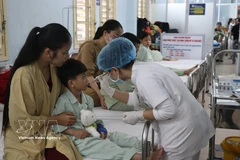
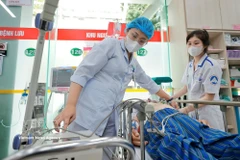
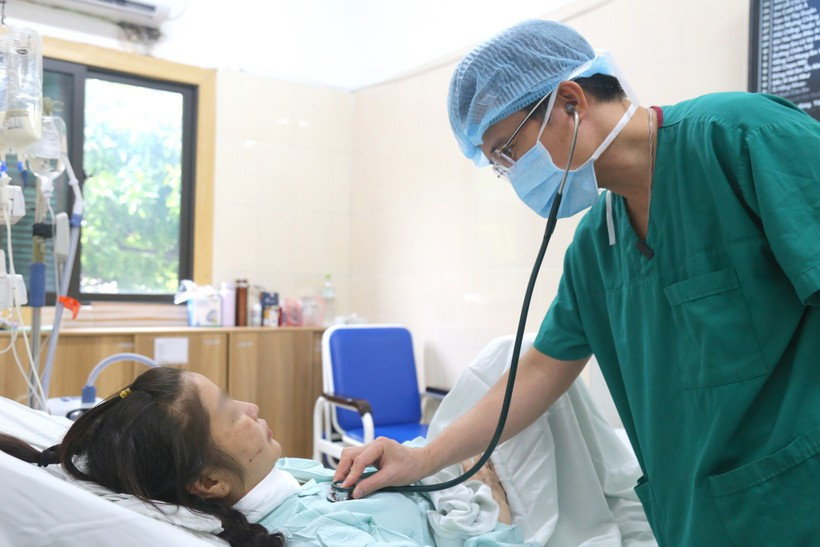
Doctor checks the patient’s health after the transplant (Photo: VietnamPlus)

Hanoi (VNA) – Viet Duc University Hospital announced on August 13 that it had successfully performed Vietnam’s first-ever simultaneous heart-and-lung transplant on a patient battling multi-organ failure. The results prove the Southeast Asian nation is levelling up on sophisticated surgeries amid broader healthcare advancements.

Hospital Director Dr. Duong Duc Hung described the operation as a pivotal achievement, stressing how it has elevated the hospital’s expertise in multi-organ transplants and put Vietnam on the global map of countries with cutting-edge surgical interventions. “This success opens up new opportunities to save critically ill patients,” he declared.

Expanding survival chances

Dr. Pham Huu Lu, deputy head of cardiovascular and thoracic surgery at the hospital, said the patient, 38, suffers from an atrial septal defect and severe pulmonary hypertension. She previously underwent treatment to rectify the defect back in 2011 at the Hanoi Heart Hospital, yet subsequent irregular follow-ups deteriorated her condition over time.

Upon admission, doctors diagnosed her with Eisenmenger Syndrome, accompanied by irreversible right ventricular failure and severe tricuspid regurgitation. This condition is life-threatening, leaving combined heart-lung transplantation as the only option. The patient was also malnourished, the donor lungs were larger than the patient’s chest cavity, and she was suffering from an infection of Acinetobacter baumannii.

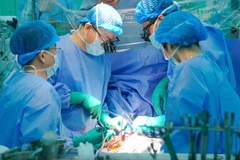
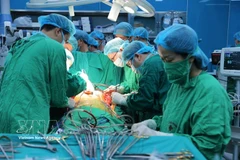
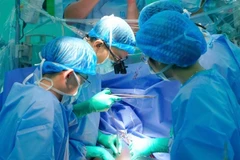
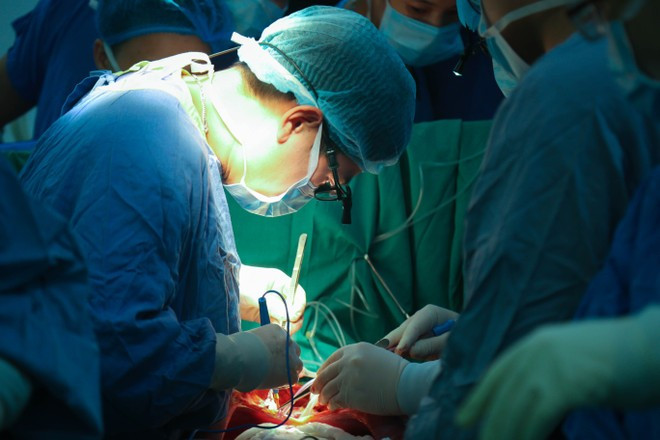
The seven-hour operation involved nearly 40 specialists across multiple fields, including cardiothoracic medicine, anesthesia and resuscitation, surgery, rehabilitation and nutrition. Surgeons used extracorporeal circulation to temporarily replace heart and lung function during the procedure.
ee.jpg
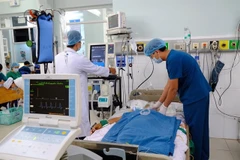
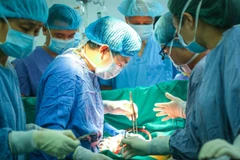
Doctors perform organ transplant for the patient (Photo: VietnamPlus)

Global significance

According to Dr. Hung, heart-lung transplantation is among the most sophisticated interventions in medicine, typically reserved for patients in final stages of both cardiac and pulmonary failure when no other treatments are effective. The procedure requires highly complex techniques, seamless coordination among numerous specialties and intensive postoperative care.

On a global scale, such transplants remain exceedingly rare, with only about 100 performed annually, primarily due to the acute shortage of suitable donor organs, the complexities of the surgery, and high risk of complications. Nevertheless, advancements in medical science have bolstered outcomes, with international statistics indicating that roughly 60% of recipients survive for at least five years post-surgery.
eee.jpg
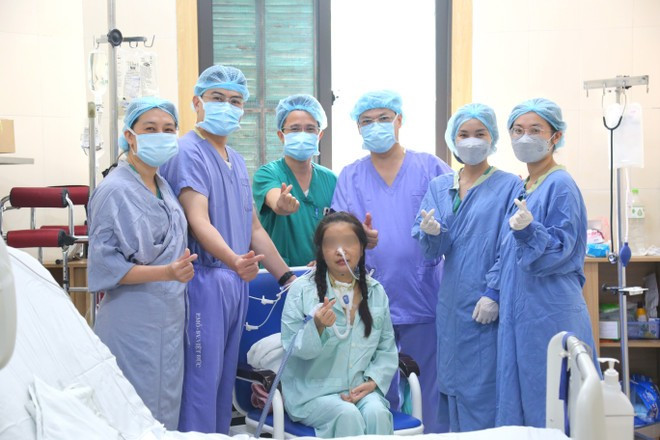
The patient’s heart and both lungs are simultaneously replaced with healthy organs from a compatible donor (Photo: VietnamPlus)

“This represents one of the most challenging procedures performed anywhere in the world,” said Ha Anh Duc, Head of the Department of Medical Services Administration at the Ministry of Health. “It is a major achievement not only for Viet Duc hospital but for Vietnamese healthcare as a whole, placing us on par with developed nations despite significant differences in available resources.”

Rising organ donations

In 2025, Viet Duc University Hospital logged its peak volume of multi-organ retrievals and transplants sourced from donors since launching such a drive in 2010. The hospital has long been a pioneer in the field, with an average of 8–10 donors each year until recently.

From late 2023 through 2025, donations rose sharply. Between August 2024 and August 2025, more than 50 families of patients with severe traumatic brain injuries agreed to organ donation, enabling 34 multi-organ retrievals.

As of August 12, 2025, the hospital performed 2,478 transplants in total, including 109 heart, 8 lung, 169 liver and 2,192 kidney procedures./.

VNA

See more

A representative of the Health Strategy and Policy Institute shares the results of a study titled “Assessment of Vietnam’s Readiness for Self-Care and Its Influence Factors”. (Photo courtesy of the organiser)

Vietnam ranks 4th in health self-care readiness

Self-care is an essential component of primary healthcare, with WHO defining it as the ability of individuals, families, and communities to promote and maintain health, prevent disease, and cope with illness with or without the support of healthcare professionals.

A proton machine in a hospital in Singapore. Proton beam therapy provides more options for cancer patients. (Photo courtesy of IHH Healthcare Singapore)

Proton therapy, an alternative method for cancer patients

In recent years, Vietnam's Ministry of Health has held numerous meetings with relevant units to assess the progress in developing proton therapy centres in the country. The project for establishing proton therapy centres is set to commence preparations in 2025 and aims for completion between 2026 and 2030.

At the event (Photo: VNA)

First hospital in Mekong Delta earns US AACI accreditation

Nam Can Tho University Hospital on December 15 hosted a ceremony to announce its accreditation by the American Accreditation Commission International (AACI), a US-based body, becoming the first facility in the Mekong Delta and among a select few in Vietnam to earn the distinction.

A health worker administer IPV polio vaccine to a child in Dong Thap province. (Photo: VNA)

Vietnam proactively takes polio prevention measures amid outbreak in Laos

The meeting took place following an assessment by the World Health Organisation (WHO) warning that Vietnam is facing a very high risk of polio import and re-emergence. The risk arises after neighbouring Laos officially declared a polio outbreak on October 7, following the detection of circulating vaccine-derived poliovirus type 1 (cVDPV1).

A view of the International Conference on Molecular Diagnostics in Microbiology and Diseases, organised by Rencontres du Vietnam and the International Centre for Interdisciplinary Science and Education (ICISE) in the central province of Gia Lai on December 11. (Photo: VNA)

Nearly 100 international scientists attend molecular diagnostics conference in Vietnam

The conference features almost 80 presentations across plenary sessions, parallel sessions and poster sessions, focusing on leading research trends such as point-of-care diagnostics; predictive biomarkers used to anticipate individual responses to therapy; and the development of new tools and platforms for rapid molecular-level detection and diagnosis.

Digital transformation in healthcare is being strongly promoted. (Photo: Organising Committee of the 2024 “Technology with Heart” Award, co-hosted by Vietnam News Agency and Viettel)

AI and precision medicine: Emerging prospects for Vietnam-Canada cooperation

Canada has strong experience in compiling and analysing genomic data, while Vietnam has a large population with diverse genetic structures. This complementarity can help Vietnam narrow its technological gap and enhance its capacity to treat rare diseases — an area many countries are prioritising for development.

Maternal and child healthcare in Tuyen Quang province. (Photo: VNA)

Vietnam on path to become a healthy nation

Resolution 72 not only focuses on health care but is also closely interlinked with other sectors, helping to build a solid foundation for sustainable national development and create momentum for Vietnam to “take off” and further integrate into the world.

The emergency ward at Bach Mai Hospital, Hanoi. (Photo: VNA)

Health sector targets free hospital fee for all

The total value of medical expenses not covered by the health insurance fund is estimated at around 24.8 trillion VND (942 million USD) per year. Health insurance contributions remain low, at 4.5% of the salary or reference base used for calculation.

Sen. Lieut. Gen. Vongsone Inpanphim, Lao Deputy Minister of National Defence and Director of the General Department of Politics presents the Friendship Order of Laos to Vietnam’s Central Military Hospital 108. (Photo: VNA)

Vietnam, Laos expand cooperation in military medicine

Over the past two decades, many Vietnamese experts have undertaken long-term missions at the Central Hospital 103 to provide training and technical assistance, contributing to the successful treatment of complex cases. The Central Military Hospital 108 has also trained 206 Lao doctors, six nurses and two engineers — a clear demonstration of substantive, long-standing cooperation.

Deputy Minister Do Xuan Tuyen (left) and Alberto Anaya Gutiérrez, General Secretary of the Mexican Workers' Party (PT). (Photo: VNA)

Vietnam, Mexico boost medical cooperation

As both nations look to keep their long-standing partnership in good health, the health ministries of Vietnam and Mexico have been accelerating cooperation, especially in traditional medicines.

The opening of Vietnam Medi-Pharm 2025 and Vietmedicare Expo in Ho Chi Minh City on November 27, 2025. (Photo: VNA)

Major medical, pharmaceutical exhibitions kick off in HCM City

The 33rd Vietnam International Medical and Pharmaceutical Exhibition (Vietnam Medi-Pharm 2025) and the International Exhibition on Pharmaceuticals, Medical Devices and Healthcare (Vietmedicare Expo 2025) kicked off at the Saigon Exhibition and Convention Centre on November 27.

Doctors Do Thi Ngoc Linh (left) and Le Diep Linh at the RCS membership certificate award ceremony in London. (Photo: VNA)

Vietnamese surgeons honoured with prestigious Royal College Fellowship

The fact that the Vietnamese doctors have been awarded with FRCS certificate proves Vietnam’s surgical expertise has met international standards, contributing to improving the quality of treatment at home, expanding academic cooperation with world leading medical institutions and inspiring younger doctor to pursue higher standards.