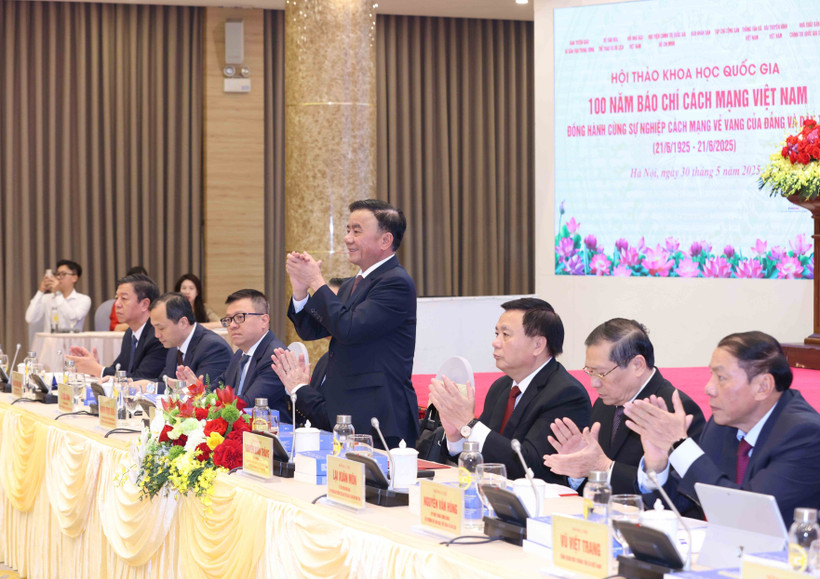
Hanoi (VNA) - A national scientific seminar was held in Hanoi on May 30 to look back on the 100-year journey of the Vietnamese revolutionary press accompanying the glorious cause of the Party and the nation (June 21, 1925 - 2025).
The event was chaired by the Party Central Committee’s Commission for Information, Education and Mass Mobilisation and co-organised by the Ministry of Culture, Sports and Tourism, the Vietnam Journalists’ Association, the Ho Chi Minh National Academy of Politics, the Nhan Dan newspaper, the Communist Review, the Vietnam News Agency, the Vietnam Television, and the Su That (Truth) National Political Publishing House.
Politburo member, Permanent member of the Party Central Committee’s Secretariat Tran Cam Tu called on the press to closely follow the Party's viewpoints, guidelines, and policies, stressing the need for relentless, in-depth, and timely reporting on critical issues, including preparations for the upcoming Party congresses at all levels in the lead-up to the 14th National Party Congress in 2026. The press must also promptly reflect the thoughts and aspirations of officials, Party members and the people.
The Party and State always have high expectations and offer all possible support to the press to fulfill its functions and tasks, he stressed.
The seminar was an opportunity to summarise the glorious 100-year history of the formation, construction and development of the Vietnamese revolutionary press; clarify the historical role, mission, achievements and important contributions to the cause of national construction and development; and share and discuss challenges, opportunities and requirements, tasks and solutions for the Vietnamese revolutionary press in the new era of national development.
President of the Ho Chi Minh National Academy of Politics (HCMA) and Chairman of the Central Theory Council Nguyen Xuan Thang opened the symposium by reaffirming the Party’s leadership and State’s management over journalism, which, he said, are essential for the press to develop in the right direction and fulfill its mission as the voice of the Party, the State, and the people.
He laid stress on the need to complete media legal framework to address digitalisation challenges as well as strengthen journalists' political mettle, professional ethics and professional capabilities. He emphasised serious implementation of the Press Law and professional conduct codes, alongside promotion of the learning and following President Ho Chi Minh’s ideology, morality, and style.
Thang urged the adoption of digital technologies in journalism operations, particularly AI, big data and cloud computing, helping improve newsrooms’ management efficacy, accelerate information processing, and enable personalised content delivery to different audience segments.
He called press agencies to continue reorganising their apparatus towards lean and effective operations adaptive to modern communications management models. Following the recent merger, media outlets must stabilise their organisational structures and human resources, while maintaining professional quality standards.
To help Vietnamese journalism keep pace with global standards, the officials underlined the importance of international cooperation in content production, technology transfer, journalist training, and media management.
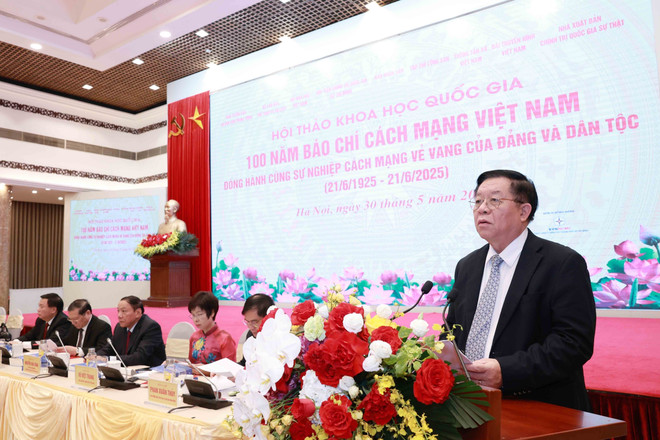
Concluding the event, Politburo member, Secretary of the Party Central Committee and Chairman of its Commission for Information, Education and Mass Mobilisation Nguyen Trong Nghia reaffirmed that the press, as a sharp ideological - cultural tool of the Party, must always operate under the Party's unwavering leadership. This, he said, ensures the revolutionary, ideological, and humanitarian essence of Vietnamese journalism, which contributes to maintaining political stability, strengthening national unity, and creating social consensus and public trust in the renewal process.
Building on the legacy of the past century, Nghia called for the cultivation of a new generation of journalists who are deeply committed to serving the nation and its people.
He urged completion of legal frameworks, particularly amendments to the 2016 Press Law and guiding documents, as well as institutionalisation of the Party’s new viewpoints, especially Resolution 57 on science – technology breakthroughs, innovation and digital transformation.
To this end, he emphasised the importance of integrating science-technology advances like AI and IT into the media sector, adding Vietnamese revolutionary journalism must also strengthen its presence on social media platforms, master the information front amid the booming of cross-border digital platforms, and maintain its reputation and standing in global media flows, contributing to successfully realissing the national development and protection.
Regarding media economic efficiency, he encouraged research and pilot of new business models that fit the digital environment. The State, he said, should establish a favourable legal framework and consider initial support for pilot projects. Additionally, he reaffirmed the importance of continued funding and policy support for political contents, foreign affairs coverage and ethnic minority programmes to ensure media fulfills its social responsibilities.
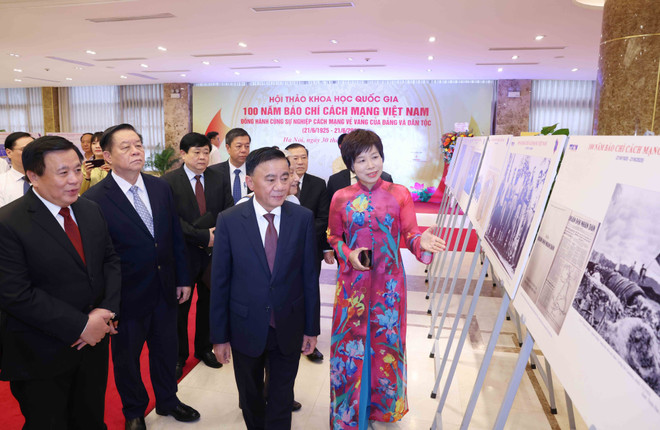
Earlier, delegates visited a photo exhibition honouring 100 years of Vietnamese revolutionary press by the Vietnam News Agency, featuring outstanding images on the press's development across different periods and its role in the struggles for national independence and reunification as well as current reform and defence efforts./.