Vietnam’s e-motorbike market enters stage of fierce competition

As the world’s fourth-largest motorbike market with some 50 million vehicles in circulation, Vietnam is under pressure to transition from petrol to electric in response to air pollution and climate change.

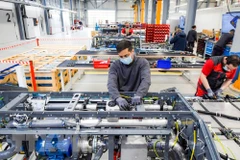
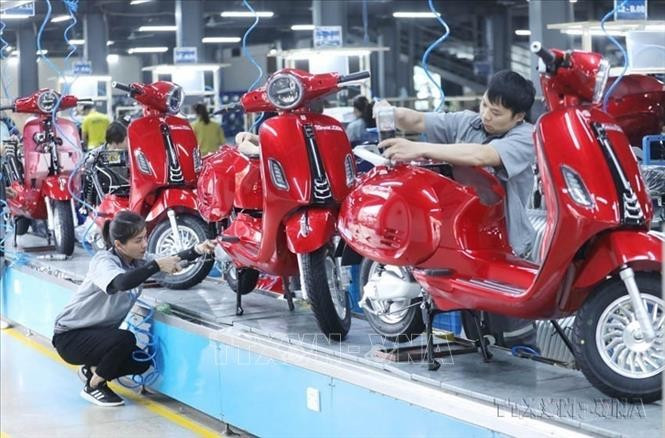
Illustrative Image (Photo: VNA)

Hanoi (VNA) - Vietnam’s electric motorbike market is entering a new phase of intense competition as domestic and foreign manufacturers are accelerating their expansion, diversify products, and invest heavily in infrastructure.

Observers noted that rivalry is no longer limited to pricing or design but increasingly revolves around battery technology, charging ecosystems, and strategies to capture different customer segments.

As the world’s fourth-largest motorbike market with some 50 million vehicles in circulation, Vietnam is under pressure to transition from petrol to electric in response to air pollution and climate change.

A variety of brands have already joined the race. VinFast has positioned itself as a pioneer by offering models across multiple price ranges and recently introduced new versions equipped with dual removable batteries.

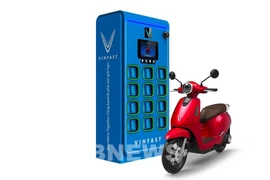
The company plans to launch the country’s first battery-swapping motorbike in October, followed by additional models aimed at meeting diverse customer demand.

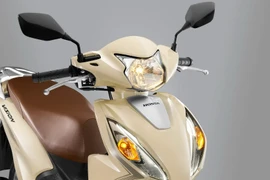
Yadea, a leading Chinese manufacturer, is targeting students and young consumers, while Honda, facing pressure to electrify despite its dominance in petrol bikes, has started with two electric models and promises more by 2030. Yamaha, which launched its first electric scooter in 2022, has so far maintained a limited presence.

Alongside these giants, local firms such as Pega, Dat Bike, and Selex Motor are carving out niches ranging from affordable commuter bikes to long-range premium models and specialised vehicles for delivery services.

Industry executives suggestED that Vietnam, with its population of around 100 million, holds enormous potential. They estimated the domestic two-wheel market could reach a value of 8 billion USD, while the broader Southeast Asian market may expand to 25 billion USD, making it highly attractive for both established players and startups.

Attention, however, is shifting toward infrastructure and battery solutions, which are seen as decisive in determining long-term market leadership. VinFast has announced an ambitious plan to deploy 150,000 battery-swapping stations nationwide within three years, with the first 50,000 to be in place by the end of 2025.

Other manufacturers are also exploring different models, from Honda’s removable battery system through its dealer network to Selex Motor’s focus on delivery riders. TMT Motors, the distributor of Wuling electric cars, has even revealed plans to enter the motorbike segment with automated swap stations, underscoring the growing strategic importance of this area.

Consumers, particularly younger groups such as students and office workers, are emerging as early adopters. They value modern design, smart features like GPS and smartphone connectivity, as well as environmental benefits and lower running costs. Older riders remain cautious, citing concerns about battery life and range, suggesting that shifting consumer habits will take time.

Experts stressed that Vietnam will need a coherent policy framework, significant public and private investment in charging infrastructure, and greater support for local production of batteries and components to reduce reliance on imports. Public awareness campaigns may also help accelerate the transition.

Analysts believed electric motorbikes will gradually replace petrol vehicles in large cities within a few years. The contest unfolding today, they argued, is not only about short-term sales but also about securing strategic positions in an industry expected to be worth tens of billions of dollars in the near future.

Vietnam’s e-motorbike market has reached a pivotal moment with fierce competition, full of opportunities, but equally marked by significant challenges./.

VNA

See more

Phin Ho Tra – a national five-star OCOP product. (Illustrative photo: VNA)

Hanoi to host Vietnam OCOP Festival 2025

The festival is seen a practical activity celebrating the achievements made by the capital and the country in 2025, affirming OCOP’s role in rural economic development, contributing to realising Vietnam’s aspiration for strong economic growth in the context of deep integration.

The expanded Hoa Binh Hydropower Plant (Photo baochinhphu.vn)

EVN launches major power projects

Among the flagship projects inaugurated was the expanded Hoa Binh Hydropower Plant with a total installed capacity of 480MW per year and average annual output of about 488 million kWh.

An ultra-intensive shrimp farming model linked with environmental protection in Ca Mau province. (Photo: VNA)

Fisheries take the lead in the Mekong Delta’s green transition

Across the Mekong Delta, leading aquaculture producers, processors and exporters, along with suppliers of inputs, are transitioning to circular, high-tech and clean production models that cut greenhouse gas emissions and comply with international certification standards.

A perspective view of the Red River Landscape Boulevard project in Hanoi (Photo: VNA)

Works starts on Hanoi’s Red River Landscape Boulevard Axis project

The project is among the 234 key works and projects being launched, inaugurated or technically opened simultaneously across 34 cities and provinces nationwide to mark the 14th National Party Congress. Its launch contributes to implementing the country’s strategic development orientations while concretising Hanoi’s development goals in the new period.

The ground-breaking ceremony of the Yen Bai 1 biomass power plant in Lao Cai province on December 19. (Photo: VNA)

Work starts on 114-million-USD biomass power plant in Lao Cai

The project, developed by Erex Yen Bai Biomass Power Co. Ltd. is located in Dong Cuong commune, Lao Cai province. It is backed by Japan’s Erex Group and falls under the Joint Crediting Mechanism, a bilateral initiative between Vietnam and Japan to reduce greenhouse gas emissions.

At the inauguration ceremony (Photo: VNA)

Vietnam Railways Corporation unveils upgraded coaches, digital tools

These moves reflect the VNR's commitment to fulfilling six priority tasks set by the Prime Minister, including leading in innovation and digital transformation, applying sci-tech in line with the Politburo’s Resolution No. 57-NQ/TW, and spearheading advances in digital, green and circular economy.

Producing MDF panels for export at Hai Duong MDF Construction and Manufacturing Co., Ltd., in Ho Chi Minh City (Photo: VNA)

HCM City targets 15 billion USD in wood exports by 2035

The merger of HCM City with Binh Duong and Ba Ria – Vung Tau is expected to give the local wood industry a strong boost into a phase of high-quality growth driven by linkages, innovation, sustainability, and deeper integration into global value chains.

Delegates cut a ribbon to inaugurate the expanded Terminal T2 at Noi Bai International Airport in Hanoi on December 19, 2025. (Photo: VNA)

Expanded Terminal T2 at Noi Bai International Airport makes debut

The project expands the terminal’s floor area to over 200,000 sq.m, increases passenger capacity from 10 million to 15 million, even up to 18 million per year, and boosts operational capacity with boarding gates rising from 17 to 30 and jet bridges from 14 to 27, meeting strong growth in international travel demand.

A section of Can Tho - Ca Mau Expressway (Photo: VNA)

Can Tho – Ca Mau travel time halves from December 19

Stretching more than 110 km with a total investment of over 27.5 trillion VND (1.04 billion USD), the project not only resolves long-standing traffic bottlenecks in the Mekong Delta, but also opens up new development opportunities for the entire region - especially Ca Mau, the last locality in the country to be directly connected to the eastern North–South expressway axis.