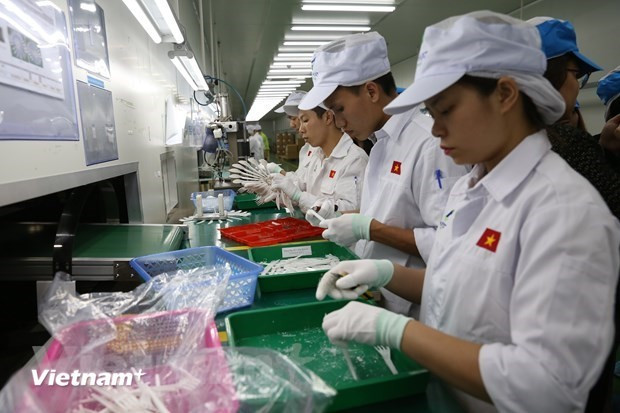
Hanoi (VNA) - Vietnam’s industrial sector made a strong mark in 2025, overcoming a host of challenges to post impressive growth. However, the target of growth exceeding 10% in 2026 will remain a major test.
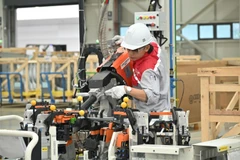
In 2025, despite facing the “dual impact” of unpredictable global economic turbulence and severe damage caused by natural disasters at home, Vietnam’s industrial sector remained resilient. Evidence lies in the industrial production index (IIP), which rose by more than 9.3% over the first 11 months of the year. Notably, the processing and manufacturing sector continued to assert its role as the key growth engine, expanding by nearly 10.6% and serving as the main driver of the overall economy.
A VietnamPlus reporter spoke with Quach Quang Dong, Deputy Director General of the Department of Industry under the Ministry of Industry and Trade, about the sector’s bright spots over the past year and orientations for the period ahead, contributing to the goal of achieving GDP growth in 2026.
Bright spots in industrial growth
Reporter: Looking back at the economic picture over the past 11 months, industrial sectors have delivered very impressive results and made a significant contribution to overall economic growth. In your view, what are the key bright spots of the industrial sector?
Quach Quang Dong: The striking growth figures for industry in general, and for processing and manufacturing in particular, over the first 11 months of 2025 are the outcome of relentless efforts by the Government, ministries, sectors and localities. This success is evident across several fundamental dimensions.
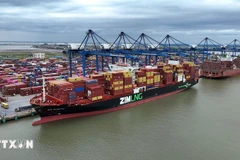
First, diplomatic activities, international trade negotiations and the search for new export markets through new-generation free trade agreements have delivered clear results. Measures to support enterprises were also implemented effectively in the context of US reciprocal tariffs affecting Vietnam’s key export sectors. As a result, despite the impact of these tariffs, Vietnam’s export turnover still recorded positive growth over the 11 months of 2025.
In addition, government support measures to address the aftermath of natural disasters, together with the Prime Minister’s strong direction on disbursement of public investment and implementation of key projects, created spillover effects that promoted recovery and growth in domestic production.
Efforts to stimulate domestic consumption were another bright spot. Total retail sales of goods and consumer service revenues rose by 9.1% year on year in the first 11 months of 2025, clearly demonstrating the positive impact of domestic demand on industrial production.
Positive results in attracting and disbursing foreign direct investment also helped to expand domestic production capacity.
Finally, the capacity of enterprises, particularly domestic ones, has improved thanks to government support policies and strengthened confidence under a stable macroeconomic environment. The recovery trend of the global market, together with Vietnam’s increasingly enhanced international standing, has also played an important role. Notably, the country has upgraded relations with 10 countries of strategic importance across regions and established 13 comprehensive strategic partnerships.

Reporter: Public investment has long been regarded as a key driver of economic development, especially in 2025, a year marked by large-scale disbursement. In your view, what concrete impacts has this resource had on the growth of industrial manufacturing?
Quach Quang Dong: First of all, public investment affects industrial development in multiple ways, including boosting overall market demand and playing a catalytic role in mobilising private investment across the economy, including investment in industry.
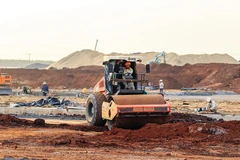
Public investment projects are primarily focused on infrastructure development. Therefore, higher disbursement of public investment capital means a more complete infrastructure system serving production and goods circulation. This creates more favourable conditions for business operations, while encouraging enterprises to invest more confidently in production activities. Moreover, improved infrastructure facilitates greater movement of goods, thereby directly generating demand for goods-producing industries.
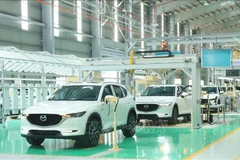
In addition, large-scale public investment projects in infrastructure such as expressways and energy open up substantial market opportunities for several industrial sectors, including steel, construction materials and mechanical engineering. Notably, the gradual completion of the North–South expressway system is set to become a powerful driver for the stronger development of transport manufacturing industries, particularly automobile production.
At a time when the domestic economy is facing numerous challenges, alongside the Government’s efforts to remove obstacles in the real estate market, strong direction to accelerate public investment disbursement and speed up the completion of major public projects is of critical importance. This not only creates new momentum for industrial production but also contributes significantly to economic recovery and growth in the current period.
Preparing for a double-digit growth target
Reporter: 2025 has brought both notable achievements and considerable challenges for the industrial sector. Looking back on this journey, what are the key lessons that can serve as a springboard for 2026, with a growth target of over 10%?
Quach Quang Dong: Vietnam’s economic growth in general, and industrial production in particular, remains heavily dependent on exports, especially to major markets such as the US. Therefore, maintaining foreign relations and international trade ties to ensure the stability of export markets for key manufacturing sectors is critically important. Alongside safeguarding traditional export markets, Vietnam needs to make better use of new-generation free trade agreements to expand into emerging markets, particularly those with strong growth potential.
Macroeconomic stability also plays a vital role in promoting rapid and sustainable growth for manufacturing industries. Given the sector’s characteristics – requiring large capital outlays, long capital turnover cycles and profit margins that are not as attractive as in some other sectors – industry needs to avoid major macroeconomic fluctuations in order to maintain stability and achieve sustainable development.
In particular, rolling out more large-scale and efficient projects in areas such as energy, mining, infrastructure and foundational industries, through either public or private investment, will create new momentum for industrial production and help realise the target of growth of 10% or higher in the coming period.
In addition, appropriate incentive and support policies for enterprises, especially in taxation, credit and land access, need to be prioritised to ensure that businesses have sufficient resources to sustain production and business activities.
Reporter: As Vietnam moves into 2026, with an ambitious growth target and mounting pressures from both domestic and international contexts, what strategic solution groups has the Department of Industry prepared to ensure that the industrial sector continues to assert its role as the “locomotive” of the economy?
Quach Quang Dong: The Department of Industry will need to focus on implementing three main groups of solutions to help achieve a growth target of 10% or higher.
First, priority will be given to strengthening policy advisory work to further refine institutions, policies, legislation and development strategies for a number of foundational, spearhead and priority industrial sectors. This includes researching and formulating a law on the development of key industries, along with relevant legal documents and development schemes for manufacturing industries in areas such as power generation and the railway industry. These will form an important foundation for creating new growth drivers for industrial sectors in both the short and long term.
Second, it is essential to continue effectively implementing policies and programmes to support enterprises, while accelerating the commissioning of new industrial production projects to meet the needs of exports and domestic consumption. This will not only expand production capacity but also increase the supply of goods for export.
Third, enterprises should be supported in seizing opportunities arising from major public investment projects, alongside the development of mechanisms and policies that encourage the procurement of domestically produced goods. This will help minimise the use of imported products and materials that can already be produced domestically. In parallel, efforts should be stepped up to explore new markets for key export industries such as textiles and garments, footwear and electronics, in order to expand growth potential and enhance export value.
Reporter: Thank you very much./.