Vietnam’s manufacturing sector hit by wave of COVID-19 infections

The Vietnam Manufacturing Purchasing Managers' Index (PMI) dropped to 51.7 in March from 54.3 in February, as the latest wave of the COVID-19 pandemic led to widespread labour shortages in the manufacturing sector during March, according to S&P Global.
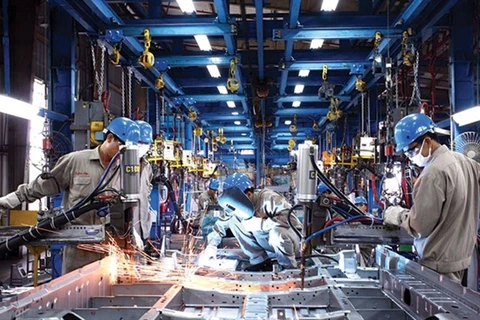
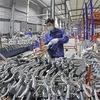
Vietnam’s manufacturing sector hit by wave of COVID-19 infections ảnh 1An auto component production line of Keihin Vietnam Co Ltd. The issues around the pandemic and price rises also impacted new orders at the end of the first quarter (Photo: VNA)
Hanoi (VNS/VNA) - The Vietnam Manufacturing Purchasing Managers' Index(PMI) dropped to 51.7 in March from 54.3 in February, as the latest wave of theCOVID-19 pandemic led to widespread labour shortages in the manufacturingsector during March, according to S&P Global.

In a report released last week, S&P Global said that although the situationstill pointed to an overall strengthening of business conditions, the latestimprovement was the least marked in the current six-month sequence of growth.

Central to the slowdown in the rate of improvement overall was the current waveof the COVID-19 pandemic in Vietnam. One of the main impacts on firms came inthe form of widespread infections among workers, resulting in a first declinein employment in four months, according to the report.

Staff shortages meant that firms were unable to maintain production volumes,with output falling for the first time in six months. Inflationary pressuresalso contributed to the drop in production, which was nonetheless only modestas some firms expanded output in line with higher new orders.

Difficulties raising production due to labour shortages led to a furtheraccumulation of backlogs of work, with the latest increase the most markedsince September last year.

The report said the issues around the pandemic and price rises also impactednew orders at the end of the first quarter. That said both total new businessand new export orders increased for the sixth month running.

Efforts to keep up with order requirements were helped by the use ofinventories given difficulties with production. As a result, stocks of finishedgoods decreased for the first time in three months.

The aforementioned inflationary pressures were highlighted by both of thesurvey's price indices in March.

The rate of input cost inflation surged higher, reaching the fastest in close to11 years. More than half of all respondents signalled that their input priceshad risen over the month, with higher costs for oil and gas mentioned inparticular. Rising shipping and raw material prices were also cited.

In turn, manufacturers raised their selling prices at an accelerated pace. Theincrease was the fastest since last November's ten-and-a-half year high.

Although purchasing activity rose slightly in March, the rate of growth slowedsharply and was the weakest in the current six-month sequence of expansion.Stocks of purchases were also up modestly. With current production requirementsfalling, any inventory building largely reflected efforts to accumulatereserves.

A range of factors led to longer suppliers' delivery times in March, includingthe effects of the COVID-19 pandemic such as labour shortages and restrictionsat the border with China. The war in Ukraine also acted to delay deliveries,with lead times lengthening to the greatest extent since last October overall.

According to the report, the severity of the latest wave of the COVID-19pandemic and worries about inflationary pressures acted to dampen expectationsfor the future. Business confidence dropped to the lowest in six months.However, firms remain optimistic that output will rise over the coming year,based on hopes that the pandemic will fade and new orders expand.

Andrew Harker, Economics Director at S&P Global, said: “The surge inCOVID-19 cases in Vietnam during March took its toll on the manufacturingsector, pushing output back into contraction territory. This was primarily dueto labour shortages, as so many workers were off with infections that factorieswere unable to maintain production volumes.

"While firms will be hoping that infection levels start to ease soon,providing some alleviation on that front, the war in Ukraine provides a furtherheadwind. The most noticeable impact for Vietnamese firms in March was onprices. Input costs increased at the sharpest pace in almost 11 years on theback of higher costs for oil and gas following the outbreak of war. This hasdashed any hopes that inflationary pressures might be set to ease over themonths ahead."/.
VNA

See more

The VSS reported that total accumulated reserves across the social, health, and unemployment insurance funds now top 1.5 quadrillion VND. (Illustrative photo: VNA)

VSS pledges tighter fund management, diversified investments

The VSS will also impose stricter financial discipline in fund management, while pursuing broader diversification of investment portfolios, as guided by the principle of “safety, sustainability, and efficiency”. This approach aims to secure strong liquidity for prompt benefit payouts and support growth in Vietnam’s capital markets and overall economy.

The ceremony unveiling AFT Connect portal (Photo: nhandan.vn)

AFT Connect portal links Vietnamese clean food producers

The platform is expected to serve as shared digital backbone enabling stakeholders in the clean food sector to gradually digitise, standardise, and publicly disclose information, ultimately aiding the fight against unsafe products and protecting consumer interests.

A Vietcombank employee guides a client in biometric process (Photo: qdnd.vn)

Vietnam's biometric surge powers digital banking overhaul

As the Party identified breakthroughs in science – technology and innovation as a key driver of national progress, the mastery and adoption of biometric technologies must go hand in hand with safeguarding public trust, data security, and citizens’ interests, all aligned with the people-first philosophy guiding the country's digital agenda.

A spring fair kicks off in the central Da Nang city on January 22, 2026 (Photo: VNA)

Da Nang 2026 spring fair features 200 booths

The fair features a diverse range of products and services, focusing on items for Tet such as food and beverages, regional specialties, OCOP products, and rural and industrial goods; fashion, footwear, cosmetics, and sports equipment; health care products and beauty services; household items, interior and exterior décor, and handicrafts; as well as equipment, technology, and services in sectors like electronics, automobiles, and telecommunications.

The Ministry of Finance is working to establish a mechanism for regular and ongoing dialogue with international credit rating agencies, including Fitch, Moody’s and S&P. (Illustrative image: VNA)

Fitch Ratings upgrades Vietnam’s senior secured long-term debt rating to BBB-

The rating for Vietnam’s secured long-term debt was raised to BBB-, equivalent to investment grade, one notch higher than the country’s long-term foreign-currency rating on unsecured debt, which remains at BB+. The upgrade followed Fitch’s review under its revised Sovereign Rating Criteria issued in last September, said the Ministry of Finance.

A view of the site where the Ninh Thuan 1 Nuclear Power Plant is located in Phuoc Dinh commune, Khanh Hoa province (Photo: VNA)

Nuclear experts urge century-long commitment at 14th Party Congress

VietNuc’s executive board, including Chairman Bui Nguyen Hoang from the Électricité de France SA (EDF) (EDF), Ung Quoc Hung from Setec Nucléaire Group, and Vu Minh Ngoc from French National Radioactive Waste Management Agency Andra, hoped that the Congress would refine mechanisms and policies to better tap OV nuclear talents.

Ahmad Haikal Hasan, Head of the Halal Product Assurance Organising Agency (BPJPH) of Indonesia, speaks at the seminar (Photo: VNA)

Indonesia ready to cooperate with Vietnam in halal sector

Ahmad Haikal Hasan, Head of the Halal Product Assurance Organising Agency (BPJPH) of Indonesia, described Vietnam as a “potential supplier” of halal products with the capacity to play a larger role in the market, particularly in the fast-moving consumer goods (FMCG) sector. He revealed a plan to visit Vietnam next week to discuss the country’s progress in the global halal industry.

Delegates perform the opening ceremony. (Photo: VNA)

Thailand Week 2026 opens in Hanoi

The event brings together more than 100 companies, including Thai enterprises and Vietnamese importers, across about 120 booths. It features a wide range of Thai products aligned with consumer trends in Vietnam, including food and beverages, health and beauty, mother-and-baby and pet products, fashion and jewellery, household goods and tourism services.

Illustrative image (Photo: VNA)

Vietnam remains Singapore’s third-largest seafood supplier in 2025

Data released by the Accounting and Corporate Regulatory Authority of Singapore (ACRA) show that Singapore spent 125.5 million SGD (97.7 million USD) importing seafood from Vietnam last year, up 10.7% year on year, accounting for 10.3% of the city-state’s total seafood import market.

Workers assemble mobile phone components at Diem Thuy Industrial Park in the northern province of Thai Nguyen. (Photo: VNA)

Electronics exports surpass 107 billion USD in 2025

With an export turnover of 107.75 billion USD in 2025, computers, electronic products and components not only maintained their position as Vietnam’s largest export by value, but also contributed more than half of the overall increase in the country’s export turnover in 2025.