Hanoi (VNA) - To overcome the middle-income trap and become a high-income nation, Vietnam must rethink and reshape its development trajectory. The key lies in technological innovation, institutional reform, and industrial upgrading, according to a Chinese professor.
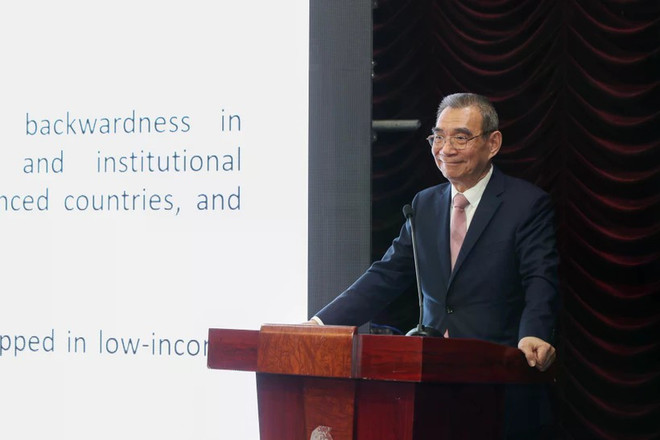
Professor Lin Yifu, Dean of the Institute of New Structural Economics at Peking University – one of China’s leading universities – made the remarks at a symposium titled “Vietnam's prosperity in the new era”, organised by Vietnam National University, Hanoi (VNU-Hanoi) on 15 April. The event coincided with the state visit to Vietnam by General Secretary of the Communist Party of China Central Committee and President of China Xi Jinping on 14–15 April.
According to the professor, who is former World Bank Chief Economist and Senior Vice President for Development Economics, most developing countries are stuck in the middle-income trap. For Vietnam, Lin noted that the renewal period in the late 1980s and early 1990s marked a significant turning point for the country.
He noted that both the low-income and middle-income traps stem from the inability to implement continuous and dynamic structural transformation, which prevents developing countries from growing at a pace that allows them to catch up with high-income economies.
To escape such traps, he stressed the importance of understanding a country’s unique developmental conditions and identifying industries that align with its evolving resource endowments and comparative advantages. Supporting the growth of such industries, he said, is essential to achieving sustained development.
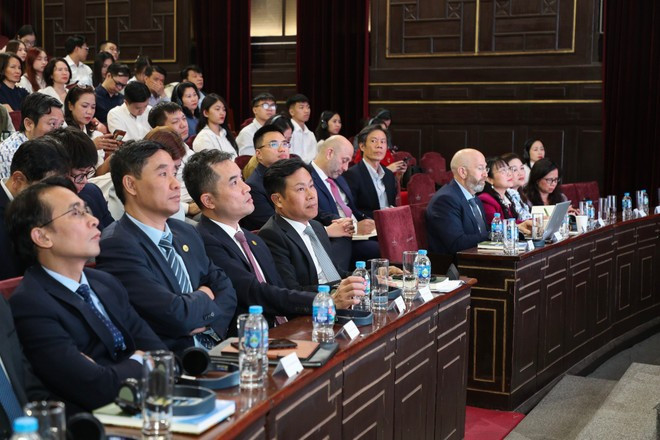
Dr Vu Hoang Linh from the University of Economics, VNU-Hanoi, remarked that the foreign-invested sector plays an increasingly pivotal role in Vietnam’s socio-economic development. He believed that the transformation model proposed by Professor Lin could be adopted in Vietnam to foster new industries and enhance foreign investment attraction.
The symposium also explored ways to promote science, technology, innovation, and the development of new economic models. Participants agreed that private enterprises should be seen as a central driver of economic growth and must be a focus of national policy. The private sector contributes significantly to GDP, generates employment for millions, and holds the potential to enhance national competitiveness if properly supported.

For this potential to be realised, the government must continue to improve the business environment and ensure fair, transparent, and equitable competition across all economic sectors.
However, Dr Le Duy Binh, Managing Director of Economica Vietnam, highlighted that 97% of Vietnam’s 940,000 active businesses are small or micro-sized. He noted that limited scale constrains their capacity for technological innovation, advanced management, and research and development. Many of these enterprises remain focused on short-term survival, relying heavily on traditional advantages such as low labour costs and natural resources.
Professor Lin responded by highlighting China’s consistent support for small and medium-sized enterprises, which has enabled them to become active participants in economic development. This support includes financing mechanisms and long-term policy commitment.
Experts also stressed the importance of enhancing cooperation between universities and enterprises. Academic institutions, they said, must adjust curricula and training programmes to better meet the practical needs of the labour market. Lecturers and students are encouraged to carry out applied research that responds to real-world demands and business needs, thereby ensuring stronger alignment between education and economic development./.