Vietnam’s seaport plans set to make waves by 2030

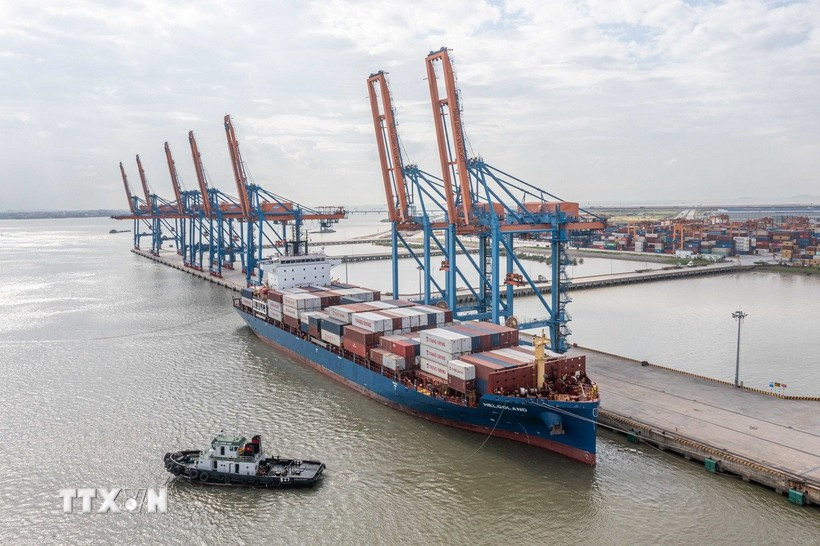
Under the new plan, by 2030, the investment capital demand for the country’s entire seaport system is estimated at about 359.5 trillion VND.

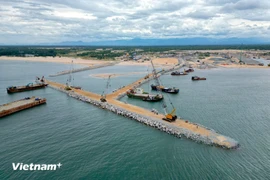
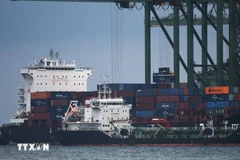
The total demand for seaport land nationwide by 2030 is about 34,000 hectares. (Photo: VNA)

Hanoi (VNS/VNA) – Vietnam will need more than 359 trillion VND (14 billion USD) to develop its seaport system by 2030, including numerous new projects in the central province of Gia Lai.

The development is under the Ministry of Construction’s recently issued decision, which partially adjusts the detailed plan for seaports, ports, wharves, buoys, water areas and water regions for the 2021–30 period, with a vision to 2050.

According to the ministry, this is an important update to meet the needs of Vietnam’s socio-economic development and international integration.

Under the new plan, by 2030, the investment capital demand for the country’s entire seaport system is estimated at about 359.5 trillion VND, of which 72.8 trillion VND is allocated for public maritime infrastructure, and the remaining 286.7 trillion VND is for ports providing cargo handling services.

The total demand for seaport land nationwide by 2030 is approximately 34,000 hectares, of which 17,500 hectares are designated for seaports, with the remainder allocated for industrial parks and logistics associated with ports. The demand for water surface is about 606,000 hectares, excluding 900,000 hectares of managed water areas without maritime works.

According to the new plan, the seaport system of Gia Lai province alone is expected to handle 17.65–18.75 million tonnes of goods per year by 2030, including 0.32–0.37 million TEU in containers and 150,000–200,000 passengers. The system will comprise nine ports and 20 wharves, with a total quay length of 5,104 metres.

The total land use demand for Gia Lai seaports by 2030 is approximately 217.3 hectares, excluding the area allocated for industrial parks and logistics. The investment capital demand for this system is about 11.87 trillion VND, of which 1.25 trillion VND is for public maritime infrastructure, and 10.62 trillion VND is for ports providing loading and unloading services.

The planning adjustment is expected to help the Vietnamese seaport system, especially in Gia Lai province, to develop synchronously, improve capacity for goods handling, and support the economic growth of the region and the country as a whole./.

VNA
See more

PM Pham Minh Chinh chairs the meeting (Photo: VNA)

Private sector thrives eight months after Resolution 68’s launch: PM

The private sector has shown marked progress eight months after the launch of Resolution 68, registering about 18,000 new enterprises monthly and pushing the nationwide total to nearly 1.1 million, Prime Minister Pham Minh Chinh told the third meeting of the National Steering Committee in Hanoi on December 20.

Phin Ho Tra – a national five-star OCOP product. (Illustrative photo: VNA)

Hanoi to host Vietnam OCOP Festival 2025

The festival is seen a practical activity celebrating the achievements made by the capital and the country in 2025, affirming OCOP’s role in rural economic development, contributing to realising Vietnam’s aspiration for strong economic growth in the context of deep integration.

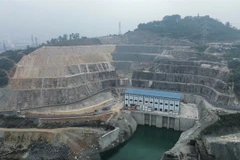
The expanded Hoa Binh Hydropower Plant (Photo baochinhphu.vn)

EVN launches major power projects

Among the flagship projects inaugurated was the expanded Hoa Binh Hydropower Plant with a total installed capacity of 480MW per year and average annual output of about 488 million kWh.

An ultra-intensive shrimp farming model linked with environmental protection in Ca Mau province. (Photo: VNA)

Fisheries take the lead in the Mekong Delta’s green transition

Across the Mekong Delta, leading aquaculture producers, processors and exporters, along with suppliers of inputs, are transitioning to circular, high-tech and clean production models that cut greenhouse gas emissions and comply with international certification standards.

A perspective view of the Red River Landscape Boulevard project in Hanoi (Photo: VNA)

Works starts on Hanoi’s Red River Landscape Boulevard Axis project

The project is among the 234 key works and projects being launched, inaugurated or technically opened simultaneously across 34 cities and provinces nationwide to mark the 14th National Party Congress. Its launch contributes to implementing the country’s strategic development orientations while concretising Hanoi’s development goals in the new period.

The ground-breaking ceremony of the Yen Bai 1 biomass power plant in Lao Cai province on December 19. (Photo: VNA)

Work starts on 114-million-USD biomass power plant in Lao Cai

The project, developed by Erex Yen Bai Biomass Power Co. Ltd. is located in Dong Cuong commune, Lao Cai province. It is backed by Japan’s Erex Group and falls under the Joint Crediting Mechanism, a bilateral initiative between Vietnam and Japan to reduce greenhouse gas emissions.

At the inauguration ceremony (Photo: VNA)

Vietnam Railways Corporation unveils upgraded coaches, digital tools

These moves reflect the VNR's commitment to fulfilling six priority tasks set by the Prime Minister, including leading in innovation and digital transformation, applying sci-tech in line with the Politburo’s Resolution No. 57-NQ/TW, and spearheading advances in digital, green and circular economy.

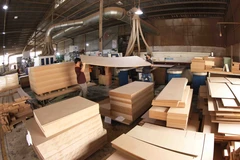
Producing MDF panels for export at Hai Duong MDF Construction and Manufacturing Co., Ltd., in Ho Chi Minh City (Photo: VNA)

HCM City targets 15 billion USD in wood exports by 2035

The merger of HCM City with Binh Duong and Ba Ria – Vung Tau is expected to give the local wood industry a strong boost into a phase of high-quality growth driven by linkages, innovation, sustainability, and deeper integration into global value chains.

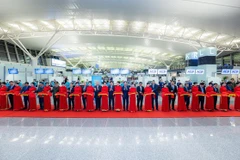
Delegates cut a ribbon to inaugurate the expanded Terminal T2 at Noi Bai International Airport in Hanoi on December 19, 2025. (Photo: VNA)

Expanded Terminal T2 at Noi Bai International Airport makes debut

The project expands the terminal’s floor area to over 200,000 sq.m, increases passenger capacity from 10 million to 15 million, even up to 18 million per year, and boosts operational capacity with boarding gates rising from 17 to 30 and jet bridges from 14 to 27, meeting strong growth in international travel demand.