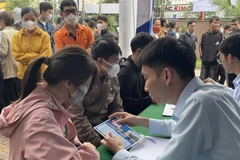
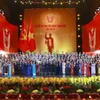
Speakers discuss working conditions at industrial zones in Vietnam at the seminar held in HCM City. (Photo: VNA)
 HCMCity (VNS/VNA) - Workers, especially in industrial zones, areencountering dual challenges amid the COVID-19 pandemic: keepingtheir job in uncertain times while continuingto demand that their rights and entitlements remain protected,the deputy head of Cooperation at the EU Delegationto Vietnam said.
Speaking at a recent seminar on working conditions of workers in IZs in HCMCity, Jesús Lavina noted that evidence-based research showed that thepandemic threatened to exacerbate the working and living conditions ofworkers in many parts of the world.
In Vietnam, 31.8 million people were seriously affected by the pandemic in thefirst nine months, including those who lost jobs, or had working hourscut or income reduced.
The service sector was the worst hit by the pandemic, with nearly 70percent of its workers affected, followed by the industrial and constructionsectors with 66.4 percent of its workers affected, according to Lavina.
Worldwide, working hour losses in the final quarter are expected toreach 8.6 percent, or 245 million full-time equivalent jobs. The highworking-hour losses have translated into substantial losses in labour income,at a global decline of 10.7 percent during the first nine months compared tothe same period last year.
Prof Dr Nguyen An Ha, coordinator of the Empowering Civil Society and Workers,said due to the impact of the pandemic, working conditions atindustrial parks had become even more difficult.
According to the research results of the project, workers in the garment andelectronics industries are still facing difficulties in their jobs and lives.
“Workers still rely heavily on working overtime to improve their incomes, whilesavings are very low despite the much raised minimum wages in recent years.Most workers are migrants and it is just too unaffordable to buy a house incities where they work,” Ha said.
Married workers face even more obstacles, as most of the workers have no choicebut to send their children to their hometowns for care by relatives or others.
According to Lavina, the EU views the EVFTA as the most ambitiousfree trade deal the EU has ever concluded with a developing country. The tradepact could bring 15 billion EUR (18.4 billion USD) worth of additionalexports annually to the EU by 2035.
EVFTA is not just about boosting trade and investment. It also includeslegally binding rules on climate, labour protection and human rights,among others.
It includes commitments to implement International Labour Organisation(ILO) core conventions. “Vietnam has made some progress on the commitments. Ithas ratified seven out of eight ILO core conventions,” he said.
The conventions, which advance social justice and promote decentworking conditions, cover freedom of association, collective bargaining,equality of opportunity and treatment, tripartite consultation, labouradministration, labour inspection, employment policy and vocational guidanceand training.
Vietnam’s new Labour Code (which will take effect in January 2021) will forthe first time provide rights to employees in enterprises to set upor join a labour representative organisation, according to Lavina.
The new law will also extend legal protection for employees who do not have awritten employment contract, as well as give clear definition of sexualharrassment in the workplace.
“The amended code offers greater protection for employees and is viewed asbetter aligned with international best practices,” he said.
The conference organised by the Institute for European Studies was held withinthe framework of the Empowering Civil Society and Workers project.
The project, from 2017 to 2021, is a follow-up action after two previouslabour-related projects funded by the European Union, including Empowerment ofWorkers and Trade Unions in Vietnam (2009-2011) and Strengthening Workers’Rights and Representation (2012-2015).
The project is conducted in three key economic regions (with a focus onindustrial zones in Hanoi, Da Nang and HCM City and surrounding provinces)./.
VNA