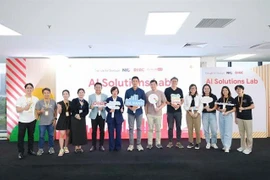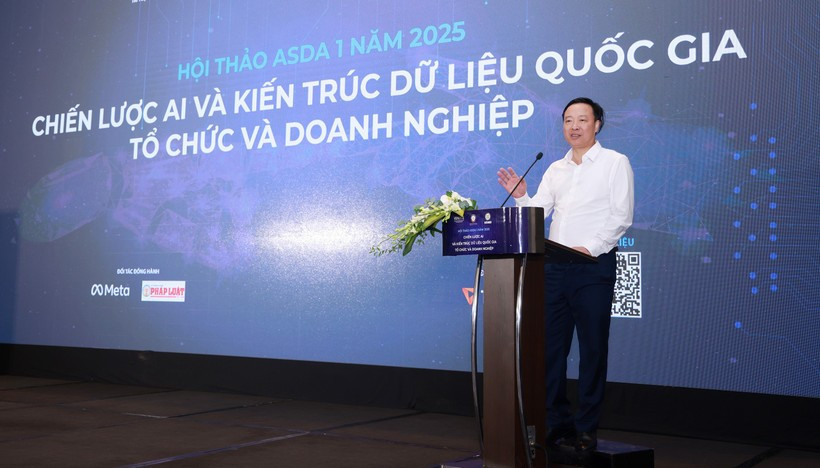
Hanoi (VNA) – The National Data Association, in collaboration with the Institute of Generative New Intelligence Technology and Education (IGNITE) and partners, on September 10 held a conference on AI strategy and national data architecture for Government, organisations, and enterprises (ASDA 1).
The event created a forum for in-depth discussions where scientists, businesses, and policymakers could share perspectives, analyse challenges, and seek consensus on approaches to developing AI and data strategies for the coming years.
Speaking at the event, Assoc. Prof. Dr. Nguyen Ai Viet, Director of IGNITE, emphasised that Vietnam is at a historic turning point. According to him, opportunities for the country to achieve prosperity and strength are now within reach, as technology, geopolitics, leadership determination, and people’s aspirations converge.

He said that five years ago, many plans seemed like distant hopes. Today, history is advancing at lightning speed, from institutional reforms and new legislation to the rise of major tech corporations—together forming national strength.
Recalling remarks by Party General Secretary To Lam, he underlined that countries that can grasp important data, resources, and production materials of the digital economy will break through, while those who 'miss out' will be left behind.
He acknowledged that Vietnam’s path will not be without challenges, citing institutional barriers, ingrained habits, system complexity, and cultural constraints.
But in hardship, the intelligence and resilience of the nation will shine, he affirmed.
He stressed that Vietnam must move beyond slogans or simply serving as a manufacturing hub for others. What is needed is strategic thinking, scientific architecture, and national consensus.
Sharing this view, Tran Van Khai, Vice Chairman of the National Assembly’s Committee for Science, Technology and Environment, said current legislation is not sufficient to regulate issues arising from AI.

Resolution 57 sets the goal for Vietnam to be among Southeast Asia’s leaders in AI by 2030. To achieve this, an AI Law is needed. The period 2025–2026 is the right time to establish a legal framework for AI development and management, he stressed.
According to Khai, the law should codify key policies such as human-centered AI principles, privacy and ethical safeguards, risk management and transparency, including mandatory labeling of AI-generated content to curb disinformation. It should also address data infrastructure, innovation incentives and sandbox mechanisms for AI applications, and clearly define legal responsibilities of developers and organisations.
On the data front, Major General Nguyen Ngoc Cuong, Director of the National Data Centre under the Ministry of Public Security and Vice Chairman of the National Data Association, noted that nations capable of effectively collecting, processing, and exploiting data will hold competitive advantages in the global economy.
With a large population and rapid digital transformation, Vietnam possesses a “data treasure.”

He described data as the fourth factor of production, alongside labour, capital, and land, enhancing the efficiency of all three traditional inputs.
However, he warned of serious challenges in data governance. Despite abundant data, Vietnam faces problems of fragmentation, weak connectivity, sovereignty concerns, and governance gaps. A particularly pressing risk, he said, is “data colonialism”, where most citizen data is stored on foreign platforms, leading to dependency, value drain, and security vulnerabilities.
Nguyen Ngoc Cuong outlined three priorities including establishing a unified data governance system based on institutions, technology, processes, and people; developing comprehensive data-mining capabilities; and building a sustainable data ecosystem that enables government, businesses, research institutions, and citizens to share and benefit.
Speakers at the conference agreed that AI and data are no longer merely technological issues. Instead, they are core factors shaping national sovereignty, competitiveness, and global standing in the new era.
Vietnam, they concluded, can only unlock its “data treasure” and AI potential if it translates vision into concrete laws, strategies, and actions, rather than stopping at slogans./.