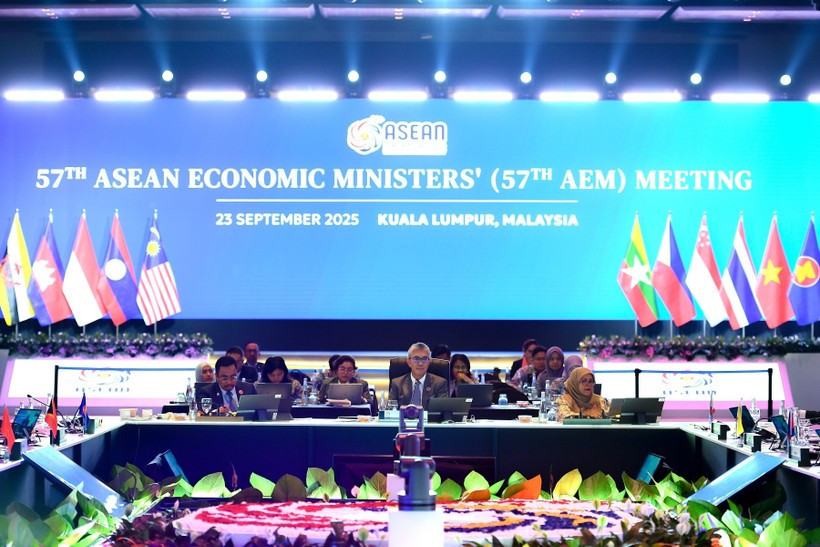
Kuala Lumpur (VNA) - Within the framework of the 57th ASEAN Economic Ministers’ Meeting (AEM) on September 24, ASEAN ministers held consultations with key dialogue partners – China, Japan, the Republic of Korea, and the US – to foster closer economic ties.
Vietnamese Deputy Minister of Industry and Trade Nguyen Sinh Nhat Tan attended the events.
At the consultations, ASEAN ministers and their partners focused on strengthening economic relations, promoting trade and investment, and reinforcing ASEAN’s central role in maintaining regional stability and prosperity.
In a press communique issued later on the day, Malaysian Minister of Investment, Trade and Industry Tengku Datuk Seri Zafrul Abdul Aziz said that through deeper integration and strategic partnerships, ASEAN was shaping a trade and investment ecosystem that is open, resilient and future-ready.
The consultations produced significant consensus. The ASEAN and Chinese ministers agreed in principle to build a closer economic relationship, with a key priority being the signing of the ASEAN–China Free Trade Area (ACFTA 3.0) Protocol at the ASEAN Summit next month. The upgrade is expected to elevate the trade framework to a new level, rules-based and future-oriented.
Notably, the consultation with the Republic of Korea (RoK) centred on upgrading the ASEAN–Korea Free Trade Agreement (AKFTA), with particular emphasis on priority areas such as digital economy, critical minerals, supply chain resilience, micro-, small- and medium-sized enterprises (MSMEs), sustainability, and green economy.
At the consultation with Japan, the two sides focused on the progress of implementing the ASEAN–Japan Comprehensive Economic Partnership (AJCEP), discussing issues such as supply chain resilience, green economy and digital economy, and building an inclusive ASEAN.
At the meeting with the US Trade Representative, the two sides reviewed the Trade and Investment Framework Agreement (TIFA) for 2024–2025 and adopted the TIFA Work Plan for 2025–2026, with key areas of cooperation covering digital economy, MSME development, trade facilitation, and intellectual property.
In addition, the ASEAN+3 consultation (with China, Japan, and the RoK) discussed ways to enhance the utilisation of the Regional Comprehensive Economic Partnership (RCEP), digital economy, capacity-building for MSMEs, and joint research initiatives./.