Hoi An ancient street (Photo: VNA)
 Quang Nam (VNA) - Experiencing the changes of space andtime, yet Hoi An ancient streets still keep their old beauty, and reliccomplexes are maintained intact along with a huge intangible cultural base.
Hoi An is an ancient town of the Vietnamese. It is located in the lowerreach of Thu Bon River in the coastal plain in Quang Nam province, about 30 kmsouth of Da Nang city.
Hoi An has been known in the international market with various nameslike Lam Ap, Faifo, Hoai Pho and Hoi An. The only Southeast Asian port-marketin Vietnam and very rare in the world, Hoi An keeps almost intact 1,360architectural relics like streets, houses, assembly halls, communal houses,pagodas, shrines, clan houses, ancient wells and tombs. They bear both theVietnamese traditional art characteristics and the convergence of eastern andwestern cultures.
Through centuries, yet customs and practices, rites, cultural andbelief activities as well as traditional foods of Hoi An are still kept andpreserved along with generations of ancient street dwellers.
Hoi An also boasts a natural environment which is healthy and peacefulwith small suburban villages engaged in crafts like carpentry and pottery.
The cultural and economic exchanges that ran from the 16th to the 19th centuries have left in Hoi An ancient town most of theforms of Vietnam’s ancient architectures, grouping traditional national artsenriched with sketches of foreign arts.
Researchers hold that the ancient architecture in Hoi An was renewed inthe early part of the 19th century, but their real starting pointcan be much earlier. The ancient architecture is clearest seen in the ancientquarter located inside Minh An ward, covering about 2 square km and housingmost of the famous relics in Hoi An.
The streets in the ancient quarter are short, narrow and crisscrossing.
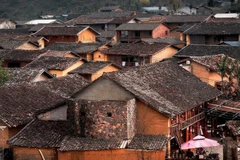
Architectural works in the ancient quarter were mostly built fromtraditional materials, including brick and wood, and they are not higher thantwo storeys.
It is easy for tourists to recognise traces of the time not only in thearchitectural design of each construction but everywhere, from moss-coveredtile roofs, walls, sculptures depicting a strange creature or an ancient story.It must be a convergence of Chinese, Japanese, Vietnamese and Cham artisans aseach construction now still bears the cultural hallmarks of many nations. Atpresent, Hoi An is still the dwelling place of thousands of residents, servingas a living museum in terms of architecture and urban lifestyle.
On December 4, 1999, in Marrakech city of Morocco, the 23rd session of the World Heritage Committee of the UNESCO officially included HoiAn ancient town into the list of world’s cultural relics as it met two necessarycriteria.
Hoi An is the dwelling space of people of various classes, origins andnationalities. It is a cradle of Catholicism and Buddhism in Vietnam’s southernpart, one of the two cradles of the Romanised Vietnamese script in the 17th century, and a convergence of the civilisations of Cham, Vietnamese, Chinese,Japanese, Indian and western countries.
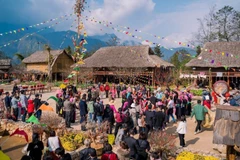
Hoi An sees traditional cultural festivals almost all the year round,including those of riverside communities. The traditional festive atmosphere inHoi An creates a unique attraction. The full-moon festival, held in the nightof every 14th day of each lunar month, is a special case in point inwhich the streets are lit only by lanterns and moonshine which creates aromantic beauty for the streets. Visitors can also plunge themselves into folkgames by locals.
Statistics show that Hoi An is home to 1,360 relics, including 1,068ancient houses, 11 ancient wells, 38 clan houses, 19 pagodas, 43 shrines, 23communal houses, 44 ancient tombs and a bridge.
It is where visitors can find a relic complex kept almost intact. Thenucleus of the complex is the ancient street architecture, considered as a“living museum” as for generations, Hoi An residents have been “living togetherwith and for ancient streets”.
A common type of the architecture of the ancient houses is that they areof the shape of a tube: long but narrow. The front serves as a shop, there is ayard and living rooms in the middle, and the back gate faces another street orthe river.
Hoi An is the only case in Vietnam and among the very rare cases in theworld. With its values, Hoi An has been recognised by the UNESCO as a world’scultural legacy and honoured by many famous travel magazines. In July 2019,with 90.39 points, Hoi An was elected by the Travel and Leisure travel magazineas the most attractive city in the world in the year. It is also the firsttourist site in Vietnam honoured by the Google Doodle./.
VNA