Breakthrough in institutions creates space for development

With the guiding principle of “serving the people,” every decision and activity of ward-level authorities will aim to improve the quality of life for citizens.

the-che-1.jpg
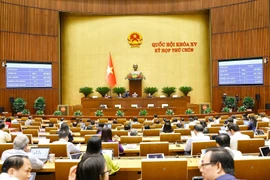
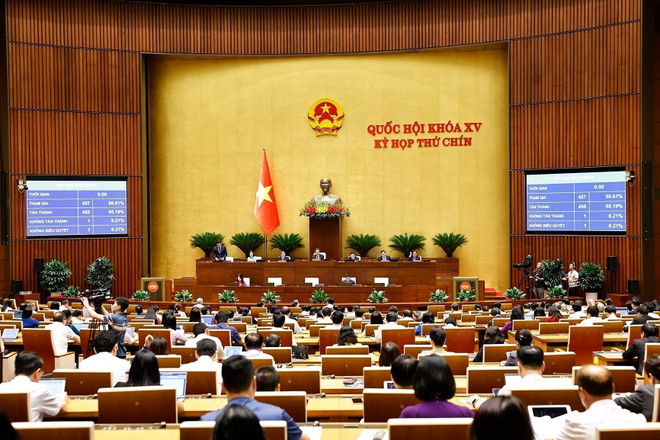
The National Assembly votes to adopt amendments to the Law on Enterprises. (Photo: VNA)

Hanoi (VNA) - With the guiding principle of “serving the people,” every decision and activity of ward-level authorities will aim to improve the quality of life for citizens.

The ninth session of the 15th National Assembly was a historic one. With overwhelming consensus, deputies approved amendments to the Constitution and the revised Law on the Organisation of Local Government, officially transforming the governance model from three tiers to two – provincial and commune levels. This is an unprecedented, breakthrough decision in both organisational thinking and state administration.

As National Assembly Chairman Tran Thanh Man said in his closing remarks on June 27, the decisions and laws adopted at this session are revolutionary, marking the start of fundamental institutional reform and setting the direction for the country’s new phase of development.

Amending the Constitution and restructuring provincial-level administrative units not only opens up new space for socio-economic growth but also allows businesses to better harness regional and geographical advantages, drive innovation, and accelerate the shift to a green and sustainable growth model. Crucially, the streamlining of administrative layers reduces costs, enhances efficiency, and creates opportunities for digital governance, data-based management and direct administration in place of paper-based bureaucracy.

Reorganising administrative boundaries and implementing the new two-tier local government system is an objective necessity for national development in the era of globalisation, digital transformation and the Fourth Industrial Revolution. It is also a golden opportunity to renew leadership thinking, reform state management, apply science and technology, improve national governance and strengthen services for the people.

Institutional reform was the most significant highlight of the ninth session. By unblocking systemic bottlenecks, a leaner, more effective local government structure will serve as a lever to better support both citizens and businesses, enabling them to contribute more to national development in the new era.
the-che-4.jpg
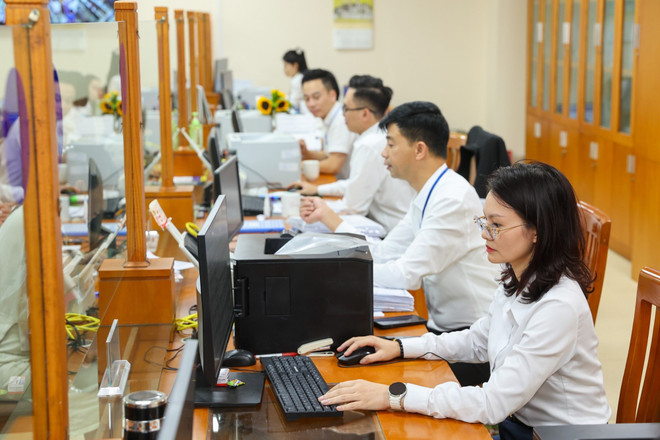
Staff at Hanoi Public Administration Service Centre (Photo: Minh Son/Vietnam+)

Nguyen Tien Thang, Deputy Secretary-General of the Vietnam Private Business Association, said the streamlined apparatus would reduce unnecessary intermediaries and procedures, improving services for enterprises.

For businesses, the two-tier model offers clear benefits. Currently, launching a project often requires navigating multiple administrative levels and agencies, wasting time and resources. Under the new model, fewer intermediaries and centralised processing will shorten procedures for investment, construction, land use and environmental approvals, allowing companies to access public services more quickly and make business decisions faster.

A “friendly, people-oriented government” remains the highest goal of the Party and State. Commenting on this, Vu Ngoc Viet, Secretary of Dong Da ward’s Party Committee, stressed that after reorganisation, the spirit of “new thinking – new action – serving the people” must be expressed in concrete deeds, not just slogans.

Nguyen Quang Trung, Secretary of Vinh Tuy ward’s Party Committee, said the new ward-level administration would lead in innovation, embracing new methods and ideas to improve its work, promptly address grassroots issues, and encourage local creativity to foster development.

Particularly, he emphasised the determination to build a lean, efficient apparatus by reviewing and reorganising structures scientifically, eliminating redundant procedures and ensuring clarity in the responsibilities of every official.
“Our guiding principle is ‘serving the people.’ Every decision and every activity of ward authorities must aim to improve people’s lives. We are committed to listening, understanding, sharing and promptly addressing legitimate concerns; strengthening dialogue; ensuring transparency; and enabling the public to know, discuss, monitor and benefit from all policies,” he said./.
See more

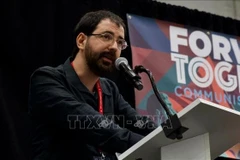
Assaf Talgam, a historian and a journalist of Zo HaDerekh, the official newspaper of the Communist Party of Israel. (Photo: VNA)

CPV's leadership - central factor shaping Vietnam’s enduring stability, impressive achievements: Israeli historian

Talgam said that from a comparative and historical perspective, the CPV’s leadership has been the central factor underpinning the country’s enduring political stability and impressive development trajectory. In a world marked by rapid and unpredictable changes, few political organisations have been able to maintain continuity of leadership while simultaneously adapting their governance approach as effectively as the CPV.

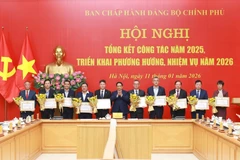
Prime Minister Pham Minh Chinh presents Certificates of merit from the Government’s Party Committee to individuals with outstanding achievements. (Photo: VNA)

Prime Minister outlines five specific strategies for Government’s Party Committee

PM Chinh noted that the Government’s Party Committee exercised comprehensive leadership over the Government's operations, proactively and effectively responded to emerging issues, with a particular focus on socio-economic development. As a result, 2025 witnessed high economic growth, sustained macroeconomic stability and ensured major balances.

Politburo member, Standing member of the Party Central Committee’s Secretariat Tran Cam Tu attends the rehearsal. (Photo: VNA)

Security forces stage rehearsal for 14th National Party Congress

The People’s Public Security forces have been praised for their core role in closely working with the army and relevant ministries and agencies, with success in thwarting hostile plots at an early stage, drastically combating fake news and disinformation surrounding the 14th National Party Congress.

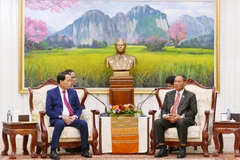
Senior Lieutenant General Le Quoc Hung (L), member of the Communist Party of Vietnam (CPV) Central Committee and Deputy Minister of Public Security, and General Vilay Lakhamfong, Politburo member and permanent member of the Secretariat of the Lao People’s Revolutionary Party (LPRP) Central Committee. (Photo: VNA)

Deputy Minister of Public Security congratulates Lao officials following succesful 12th National Party Congress

Deputy Minister of Public Security Senior Lieutenant General Le Quoc Hungconveyed the warmest congratulations of the Central Public Security Party Committee, the Ministry of Public Security leadership, and the Vietnamese People’s Public Security Forces to Lakhamfong and other Lao public security leaders on the congress’s success and their election to key leadership positions for the new term.

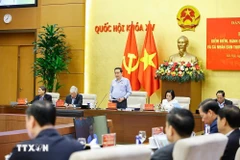
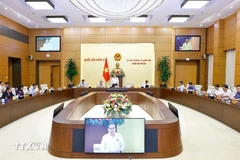
A session of the National Assembly Standing Committee. (Photo: VNA)

NA Standing Committee's key work agenda for 2026 approved

A major focus will be preparations for the election of deputies to the 16th NA and to People’s Councils at all levels for the 2026–2031 term. The NASC will coordinate with the National Election Council, the Government, the Vietnam Fatherland Front Central Committee, and relevant agencies and organisations to continue implementing the election plan, organise oversight of the electoral process, and carry out its duties and powers as prescribed.

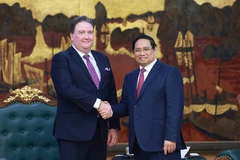
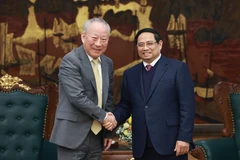
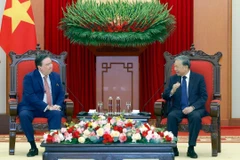
Party General Secretary To Lam receives US Ambassador Marc Evans Knapper in Hanoi on January 9, 2026. (Photo: VNA)

Party leader receives outgoing US Ambassador

Vietnam always values its relationship with the US and looks forward to continuing close cooperation with the US government to deepen bilateral relations based on mutual respect for each other’s independence, sovereignty, territorial integrity, and political institutions, contributing positively to peace, stability, cooperation, and development regionally and globally.