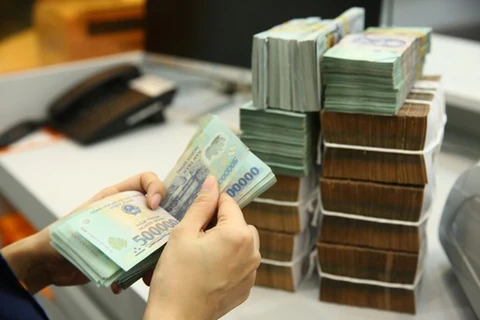
Central bank focuses on improving credit quality

Governor of the State Bank of Vietnam (SBV) Nguyen Thi Hong has issued Directive No.01/CT-NHNN on organising the implementation of the key tasks of the banking sector, with a focus on improving credit quality and tightly controlling loans to potentially risky industries.
Central bank focuses on improving credit quality ảnh 1Headquarters of the State Bank of Vietnam. (Photo: SBV)
Hanoi (VNS/VNA) - Governor of the State Bank of Vietnam (SBV) Nguyen Thi Honghas issued Directive No.01/CT-NHNN on organising the implementation of the keytasks of the banking sector, with a focus on improving credit quality andtightly controlling loans to potentially risky industries.

Accordingly,the Governor has required banks to take necessary measures for controllingcredit size and growth, focusing loans on production and priority fields inaccordance with the Government's policy to support economic recovery and development,while strictly controlling loans for potentially risky areas such as realestate, the stock market, Build-Operate-Transfer (BOT) and Build-Transfer (BT)transport projects.

Banksmust accelerate the implementation of measures to control and limit any newlyarising bad debts and maintain the bad debt ratio below 3 percent, theGovernor said, adding the SBV’s authorities would strengthen the inspection andsupervision of banks' operations, especially in the areas with high potentialrisks.

Accordingto the SBV, the banking industry this year might suffer a stronger impact ofbad debts due to the pandemic. If including debts, which had repayment termsrestructured or interest rates reduced according to the SBV’s Circular01/2020/TT-NHNN, the bad debt ratio of the banking system is about 7.31 percentto date.

Currentpolicies on restructuring and delaying the debt payment time are a temporaryand necessary solution in the short term, but extending the restructuring timewill be risky for the banking system in the medium term.

Underthe directive, the Governor also said it was necessary to continually implementmeasures to restructure credit institutions, especially weak ones, to help thebanking system operate healthily, effectively and transparently, meetinginternational standards.

Besides,the Governor has directed SBV’s agencies to manage the monetary policiesproactively and flexibly in order to control the inflation in line with theGovernment’s target of about 4 percent for 2022.

Accordingto the SBV, its monetary policy management in 2022 will be greatly influencedby inflationary pressure, especially in the context that a loose monetarypolicy has lasted for the past few years.

“Themeasures must contribute to maintaining macro-economic stability, supportingeconomic recovery, and adapting to international and domestic marketdevelopments,” the Governor noted. 

TheSBV sets the credit growth this year at 14 percent, but said it might beadjusted in accordance with the actual situation.

TheGovernor said the SBV would also continually promote non-cash payments anddigital transformation in banking operations./.
VNA
See more

Ahmad Haikal Hasan, Head of the Halal Product Assurance Organising Agency (BPJPH) of Indonesia, speaks at the seminar (Photo: VNA)

Indonesia ready to cooperate with Vietnam in halal sector

Ahmad Haikal Hasan, Head of the Halal Product Assurance Organising Agency (BPJPH) of Indonesia, described Vietnam as a “potential supplier” of halal products with the capacity to play a larger role in the market, particularly in the fast-moving consumer goods (FMCG) sector. He revealed a plan to visit Vietnam next week to discuss the country’s progress in the global halal industry.

Delegates perform the opening ceremony. (Photo: VNA)

Thailand Week 2026 opens in Hanoi

The event brings together more than 100 companies, including Thai enterprises and Vietnamese importers, across about 120 booths. It features a wide range of Thai products aligned with consumer trends in Vietnam, including food and beverages, health and beauty, mother-and-baby and pet products, fashion and jewellery, household goods and tourism services.

Illustrative image (Photo: VNA)

Vietnam remains Singapore’s third-largest seafood supplier in 2025

Data released by the Accounting and Corporate Regulatory Authority of Singapore (ACRA) show that Singapore spent 125.5 million SGD (97.7 million USD) importing seafood from Vietnam last year, up 10.7% year on year, accounting for 10.3% of the city-state’s total seafood import market.

Workers assemble mobile phone components at Diem Thuy Industrial Park in the northern province of Thai Nguyen. (Photo: VNA)

Electronics exports surpass 107 billion USD in 2025

With an export turnover of 107.75 billion USD in 2025, computers, electronic products and components not only maintained their position as Vietnam’s largest export by value, but also contributed more than half of the overall increase in the country’s export turnover in 2025.

Experts said that Vietnam’s economic outlook continues to be underpinned by stable foreign direct investment inflows and public investment, which is playing an important role in driving growth. (Photo: thoibaotaichinh.vn)

Foreign investors maintain strong confidence in Vietnam’s market

Looking ahead to 2026, prospects remain bright as manufacturing, economic growth and foreign investment in Vietnam are expected to stay robust, with the country forecast to post the highest growth rate in the region this year, according to Adam Sitkoff, Executive Director of the American Chamber of Commerce (AmCham) in Vietnam.

Toy production at a Hong Kong-invested factory (Photo: VNA)

Vietnam targets deeper market penetration in Hong Kong in 2026

Vietnam-Hong Kong trade hit 62.3 billion USD in the first 11 months of 2025, soaring 73.1% annually. Vietnamese exports to Hong Kong amounted to 36.8 billion USD, a 90.6% hike, ranking fourth among Hong Kong’s import sources, while imports from Hong Kong stood at 25.5 billion USD, up 52.9% and ranking third.

Vietnam’s start-up market enters restructuring phase

Vietnam’s start-up market enters restructuring phase

In 2026, venture capital inflows into Vietnam’s start-up ecosystem are expected to recover gradually, though in a more selective manner. VinVentures forecasts that capital will focus on start-ups that have survived the rigorous screening of 2024–2025, possess clear business models, strong commercialisation capacity, and the ability to generate real cash flows.