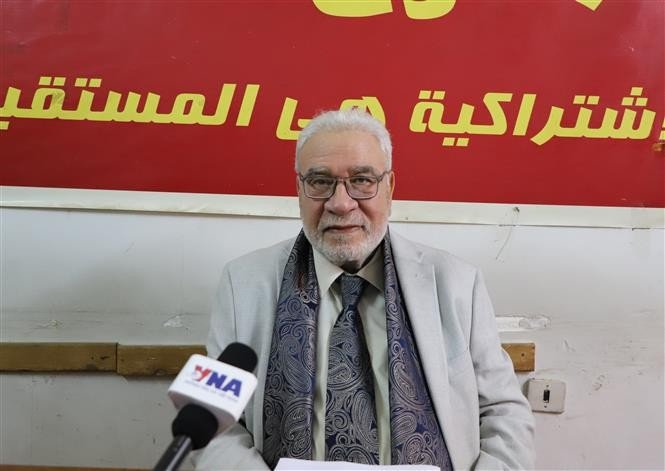
Cairo (VNA) – The Communist Party of Vietnam (CPV)'s leadership has been the decisive force behind every victory of the Vietnamese revolution over nearly a century, guiding the nation to independence, reunification, firm protection of national sovereignty and steady development along the socialist path, according to Salah Adly Abdelhafiz, General Secretary of the Egyptian Communist Party.
In an interview with the Vietnam News Agency in Cairo, Abdelhafiz said the Doi moi (Renewal) process launched by the CPV in 1986 marked a historic turning point, helping Vietnam overcome crises, secure landmark socio-economic achievements, improve living standards and steadily enhance its international standing.
He stressed that in national construction and defence, the CPV has not only set out sound guidelines but also ensured political stability, strengthened the great national unity bloc and effectively combined national strength with the strength of the times. The Party’s leadership, he noted, is evident in its strategic vision and flexible responses to challenges in increasingly complex and fast-changing regional and global environments.
As Vietnam enters a new phase of development, Abdelhafiz underscored the need to further strengthen the CPV’s leadership through building a clean, strong and comprehensive Party, while enhancing its leadership capacity, combat strength and ruling capability.
He said the Party must remain steadfast in the goal of national independence linked with socialism, while continuing to renew thinking, improve institutions, promote democracy and place people at the centre and as the driving force of development. Close ties with the people, he added, will remain the decisive factor in steering Vietnam towards rapid and sustainable growth and in consolidating its position on the international stage.
Reviewing 40 years of renewal, the Egyptian party leader highlighted Vietnam’s notable achievements across socio-economic development, infrastructure, national defence and security, and external relations. Sustained high economic growth, rising GDP and per capita income have brought the country closer to upper-middle-income status. Vietnam has also emerged as an important manufacturing and export hub in global supply chains, while accelerating infrastructure development, maintaining socio-political stability and strengthening defence and security capabilities. Expanding external relations and deeper international integration have further enhanced the country’s stature and prestige.
Turning to the 14th National Party Congress, Abdelhafiz described it as a major milestone that will comprehensively review four decades of renewal and reaffirm the correctness of Vietnam’s development path of national independence associated with socialism. The congress is expected to clearly define the vision, goals and strategic breakthroughs for a new development phase towards 2030 and a vision to 2045, with a focus on rapid and sustainable growth, the knowledge and digital economies, science and technology, and innovation. It is also anticipated to set out major orientations to further improve institutions and strongly promote human resources, considering them the centre, subject and motivation of development.
Against a backdrop of complex regional and global changes, he said the congress will play a pivotal role in shaping Vietnam’s development trajectory, while reaffirming a foreign policy of independence, self-reliance, multilateralisation and diversification, elevating the country’s international standing and closely linking development with the firm protection of national sovereignty and interests. Abdelhafiz affirmed that the 14th National Congress will mark the beginning of a new development chapter, creating momentum and confidence for Vietnam to realise its aspiration for a strong and prosperous nation in the new era.
He also noted that the global landscape presents both opportunities and challenges for Vietnam, as trends towards peace, cooperation and integration open new avenues for market expansion, investment attraction and access to science and technology, even as strategic competition, protectionism, stricter standards, climate change and non-traditional security challenges demand greater adaptability and competitiveness.
In this context, he said, the CPV must remain steadfast in its strategic objectives, while renewing thinking, enhancing forecasting and policy responsiveness, mobilising internal strengths, effectively combining national and global resources, and proactively pursuing deep and substantive international integration to seize opportunities, overcome challenges and achieve development goals in the period ahead./.