Craft villages in Hanoi resume production

As social distancing measures have been eased in Hanoi since September 15, production facilities in local craft villages have begun preparing for the restoration of production after being standstill for a long period. However, craft villages still face many difficulties and need more support from local authorities and relevant agencies.
Craft villages in Hanoi resume production ảnh 1Phu Tuc grass weaving village in Phu Xuyen district. (Photo: vov.vn)

Hanoi (VNA) – As social distancing measures have been eased in Hanoi since September 15, production facilities in local craft villages have begun preparing for the restoration of production after being standstill for a long period. However, craft villages still face many difficulties and need more support from local authorities and relevant agencies.

Bui Hong Luyen, Chairman of the People's Committee of Phu Tuc Commune, Phu Xuyen district, which is famous for grass weaving production, said upon being informed that they can resume production, a bustling atmosphere has been restored in the commune. Many orders are being completed.

Nguyen Huy Khiem, Director of the Phuc Loc Wooden House company in Chang Son Carpentry village, Thach That district, said 80 percent of its employees have returned to work.  Most production facilities in the locality are operating at least at 40 percent of their capacity, he said,  adding that they all followed the requirement on pandemic prevention and control.

In recent years, craft villages have made a significant contribution to the local economic structure. Their revenue, production, and export value have increased over the years. 

There are about 100 craft villages with a turnover of 10 - 20 billion  VND (437,000 - 874,000 USD) per village per year, nearly 70 villages with 20 - 50 billion VND per year, and about 20 with over 50 billion VND per year, contributing significantly to the local budget. 

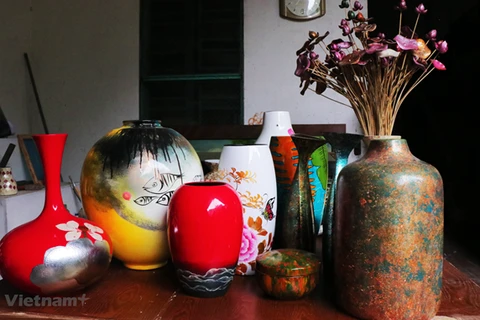
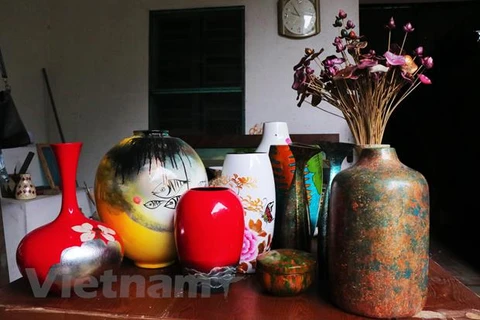
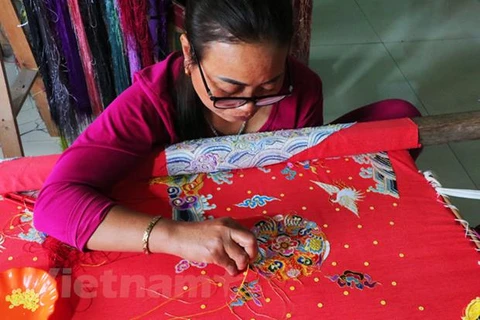
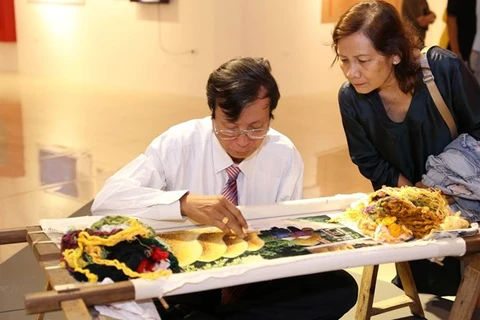
Craft villages in Hanoi resume production ảnh 2An artisan from Kieu Ky gold laminating craft village at work. (Photo: VNA)

The stagnant production during the fourth wave of the COVID-19 pandemic, seriously affected revenue, budget contributions and employments for employees. Therefore, when the city eases the restrictions, the villagers are very excited and focus on their production.

However, craft villages are facing many difficulties such as limited income and obstacles in investing in reproduction. For craft villages that sell their products mainly on the domestic market, it was impossible to make a breakthrough in consumption during this period.

Vu Quoc Thuong, Chairman of the People's Committee of Chuyen My commune, Phu Xuyen district, said a lack of new orders was the main reason behind the fact that many production establishments in the locality have yet to restore operation, adding that the production at craft villages wouldn’t be resumed soon.

Besides, many households are operating on a small scale and haven’t completed business registration or tax registration. 

Although many households had to stop working during the social distancing period, it was difficult for them to receive support under the Government's resolution. Thus, representatives of facilities in craft villages want to access preferential loans so that they can gradually restore production.

The capital city is home more than 1,300 craft villages with many products like porcelain, ceramics, lacquer, mosaic, silk, embroidery, bamboo and rattan.

Nguyen Van Chi, head of Hanoi's rural development division under the municipal Department of Agriculture and Rural Development, said the products are diverse in design and have good quality. They have been developed under the city's “One Commune, One Product” (OCOP) programme.

OCOP does not only standardise quality and design but also allows producers to access more markets and have better support to develop, Chi said.

According to Ha Thi Vinh, chairwoman of the Hanoi Association of Handicrafts and Traditional Craft Villages, the city is home to the largest number of craft villages and artisans in the country.

Craft villages have helped develop related services such as raw material production, transportation and food service, and generated jobs for workers amid urbanisation, Vinh said.

Several traditional crafts in the city have been recognised as national intangible cultural heritages. Each year, local authorities make dossiers to honour artisans for their dedication to building and preserving the traditional crafts./.

VNA

See more

Farmers in the Mekong Delta province of An Giang harvest rice grown under the project 'Sustainable Development of One Million Hectares of High-Quality, Low-Emission Rice Associated with Green Growth in the Mekong Delta by 2030.' (Photo: VNA)

Promoting high-quality rice exports amid mounting challenges

According to the Ministry of Agriculture and Environment (MAE), an estimated 600,000 tonnes of rice worth 370 million USD was exported in January, up 12.4% in volume and 16.9% in value year-on-year. The average export price reached 616.6 USD per tonne, up 4%.

Fuel supply in Hanoi remains stable. (Photo: VNA)

Fuel prices rise sharply from 3 pm on March 7

Since the beginning of this year, domestic fuel prices have undergone 11 adjustments. During this period, both RON95 and E5 RON92 experienced four decreases and seven increases, while diesel oil two falls and nine hikes.

Customers buy and sell fuel at a Petrolimex petrol station. (Photo: VNA)

Capital’s fuel market remains stable after March 5 price adjustment

Operations at several petrol stations across Hanoi have run normally. Along major routes, petrol stations remained open and continued to serve customers as usual. The number of vehicles refueling showed no major changes compared to the days before the price adjustment. Sales activities continued without interruption, and there were no long queues or supply disruptions.

Thang Long II Industrial Park in Hung Yen province. (Photo: VNA)

Green industrial parks draw FDI to northern Vietnam

From 2026, the industrial real estate market in the northern region is forecast to enter a new growth phase as strategic infrastructure projects near completion, supply expands, and green industrial parks become a decisive factor for foreign direct investment (FDI).

Border guards from Thanh Hai Border Guard Station patrol fishing vessels entering Phu Hai port in Phu Thuy ward, Lam Dong province. (Photo: VNA)

Lam Dong orders swift action to address IUU fishing gaps

Vice Chairman of the provincial People’s Committee Le Trong Yen has directed heads of relevant departments, sectors and localities to strictly implement directives and newly issued regulations on IUU prevention, while strengthening public awareness efforts so fishermen and businesses better understand and comply with the rules.

Permanent Deputy Prime Minister Nguyen Hoa Binh speaks at the meeting to review the development strategy and operational framework for the international financial centre. (Photo: VNA)

Deputy PM urges early establishment of trading platforms at Int’l Financial Centre

Chairing a meeting in Hanoi on March 6 to review the development strategy and operational framework for the international financial centre, Binh acknowledged the progress made by relevant ministries and localities in a short period of time. However, he noted that current efforts have largely focused on building the organisational structure and legal framework.

Regza Vietnam Electronics Co., Ltd. (fully invested by Taiwan, China) installs four modern production lines in 2024. (Photo: VNA)

FDI disbursement in Jan–Feb reaches five-year high

The NSO noted that the Republic of Korea (RoK) and Singapore were the largest investors during the period, each registering over 1 billion USD in newly committed capital, accounting for a significant share of total foreign investment inflows into Vietnam.

Rising geopolitical tensions in the Middle East on Vietnam’s economy under the baseline scenario is expected to remain limited. (Photo: VNA)

Middle East tensions likely to have moderate impact on Vietnam’s economy: VinaCapital

According to Michael Kokalari, Director of Macroeconomic Analysis and Market Research at VinaCapital, the conflict is unlikely to significantly affect Vietnam. Exports to the Middle East account for less than 3% of Vietnam’s total export turnover, while the likelihood of a large-scale and prolonged ground campaign in Iran is considered relatively low.

VinFast has signed a strategic partnership with six electric motorbike dealers in Indonesia, marking a new step in expanding its distribution network in one of the region’s and the world’s largest motorcycle markets. (Photo: VNA)

VinFast partners with six e-scooter dealers in Indonesia

In preparation for the launch of its electric scooters in Q2/2026, VinFast has signed additional MoUs with six dealers, including PT. IB Motor, PT. Sentrik, PT. Axara Marani, PT. Sukses Sejati Indonesia, PT. Tangguh Inti Motor, and PT. Kiki Motor Persada. These partners are distributors with strong experience in key markets and share a common direction toward green mobility solutions.

Fishermen at Dong Tac fishing port in Phu Yen ward, Dak Lak province prepare to head back to sea after the storm (Photo: VNA)

Dak Lak reviews fishing vessel fleet, steps up fight against IUU fishing

Local authorities are focusing on managing registered fishing vessels and reviewing all records and data related to fishing, purchasing and processing seafood. Violations related to IUU fishing are being strictly handled under the principle of “facing the problem, not avoiding it”.

UK Ambassador to Vietnam Iain Frew addresses the event (Photo: nhandan.vn)

Vietnam, UK step up cooperation in derivatives commodity market development

The British Embassy in Vietnam and the British Consulate-General in Vietnam, in coordination with Boston Consulting Group (BCG), held a capacity-building session under the UK–Vietnam Growth Gateway initiative in Hanoi on March 5 to discuss strategies for developing a transparent and globally connected commodity and derivatives market.