
Hanoi (VNA) - As Vietnam accelerates its digital transformation, a critical mission has emerged: safeguarding national cyberspace. This is no longer merely a technical issue but an urgent necessity for ensuring national security, social stability, and public trust in digital technologies.
At the 2025 annual meeting of the National Cybersecurity Association (NCA) on April 11 in Hanoi, experts, policymakers, and business leaders engaged in in-depth discussions on the challenges and solutions for cybersecurity in the modern age.
In his remarks, Lieutenant General Nguyen Minh Chinh, Director of the Department of Cybersecurity and High-Tech Crime Prevention and Control (A05) under the Ministry of Public Security and NCA Permanent Vice President, noted that the Politburo had issued Resolution No. 57. The decree includes breakthroughs in science, technology, innovation, and national digital transformation, focusing on effective cybersecurity, safety measures, and countermeasures against high-tech crimes.
According to Lieutenant Colonel Nguyen Ba Son, A05 Deputy Director, cyberattacks and cyber-espionage by hacker groups are becoming increasingly dangerous. High-tech crimes are growing more sophisticated, employing ever more cunning methods and tactics.
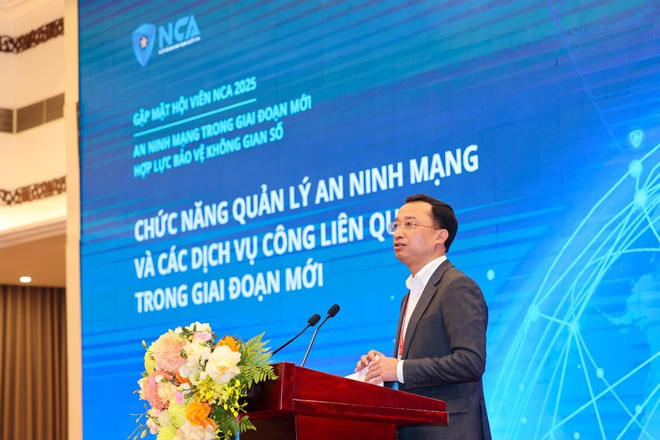
Le Cong Trung, head of the Business Unit Security at MobiFone, highlighted the rising trend of cybercrime involving information theft, particularly from browsers, Facebook accounts, and sensitive personal data for profit.
According to a survey by the NCA, online scams cost Vietnamese users approximately 18.9 trillion VND (over 728 million USD) in 2024, with one in every 220 smartphone users falling victim to fraud, MobiFone added.

Director of Banking and Financial Solutions at NGS Consulting Nguyen Duc Bang said in 2024, cybercriminals earned an estimated 4.5 trillion USD, making them the third-largest “economy” in the world after the US and China.

The NGS Consulting representative further cautioned that with the rapid advancement of AI and the boundless nature of the global internet, cybercriminals and fraudsters are becoming increasingly sophisticated, employing unpredictable and complex techniques.
Echoing this view, Vu Anh Tu, Chief Technology Officer of FPT Group, observed that in the AI era, artificial intelligence is both a weapon for attack and a shield for defence.
According to him, 90% of global cybersecurity platforms have now integrated AI. Governments are investing heavily in AI-powered cybersecurity operation centres, while AI-driven cybersecurity startups continue to attract significant capital.
He urged organisations and businesses to form intelligent cybersecurity alliances and establish multi-layered Supplier Control Obligation (SCO) platforms applying AI to automate alerts and responses.
According to Vu Ngoc Son, head of technology at the NCA, agencies and businesses in Vietnam must continue to strengthen their cybersecurity capabilities. Currently, over 20% of agencies and enterprises lack dedicated cybersecurity staff, while 35.56% report insufficient personnel. The nation is projected to face a shortfall of more than 700,000 cybersecurity professionals.

One of the proposed solutions from the NCA is to develop the nCademy platform, which will provide cybersecurity training and certification. The goal is to foster a learning community, raise awareness, and support in-depth research in cybersecurity.
Notably, the Ministry of Public Security has proposed consolidating and updating the legal framework for cybersecurity by merging the 2018 Cybersecurity Law and the 2015 Law on Network Information Security into the 2025 Cybersecurity Law. This aims to align with the ministry’s expanded functions and responsibilities in the cybersecurity domain. The proposed law is expected to undergo a fast-track review process and be presented to the 15th National Assembly for discussion and approval during its 10th session in October 2025.
In parallel, the Personal Data Protection Law is currently under review by the Government and will be submitted to the National Assembly Standing Committee for comments, before its anticipated approval at the 9th session of the 15th National Assembly in May.
A05 has begun drafting a decree detailing specific provisions of the 2025 Cybersecurity Law under the fast-track process, to follow shortly after adoption./.