Da Nang Port handles over 774,000 tonnes of cargo in June

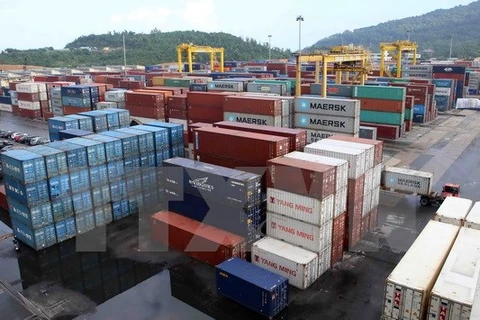
Da Nang Port in the central coastal city of Da Nang, handled over 774,000 tonnes of cargo during June, the highest level so far, according to Vietnam National Shipping Lines (Vinalines).
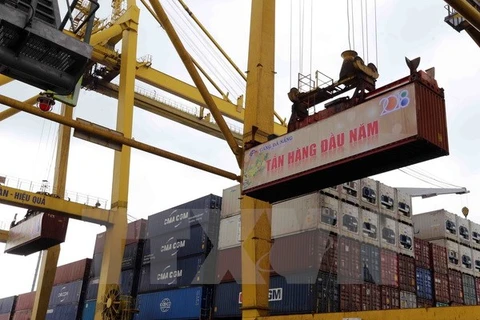
Da Nang Port handles over 774,000 tonnes of cargo in June ảnh 1Cargo handled at Da Nang Port (Photo: VNA)

Hanoi (VNA) –
Da Nang Port in thecentral coastal city of Da Nang, handled over 774,000 tonnes of cargo duringJune, the highest level so far, according to Vietnam National Shipping Lines(Vinalines).

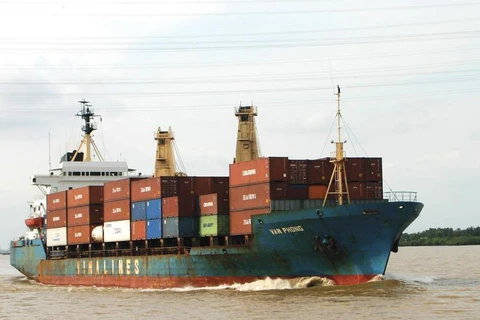
In particular, the volume of cargo transportedthrough the port on container ships reached a record of 32,406 TEUs (20-footequivalent unit) over the month, up nearly 4 percent compared to the highestlevel of 31,280 TEUs in December 2017.

The port received over 4 million tonnes of cargoin the first six months of 2018, a year-on-year rise of 6.14 percent. Itwelcomed 912 ship arrivals, including 551 container ones, a year-on-year riseof 3.3 percent.

Those commodities with high growth includeclinker (up 141 percent), wood chip (up 80 percent), coal (up 40 percent),cement (up 88 percent), and equipment (up 64 percent).

As an important seaport in the city, Da NangPort also welcomed a large number of cruise ships.

In the January-June period, the port received 71cruise liners, up 36 percent from the previous year’s same period, while serving107,381 tourists and crew members, up 7.6 percent. 

The increased presence of high-end cruise ships,such as Costa Atlantica and World Dream, has affirmed the port’s brand value inregional and global tourism maps.

Located within Da NangBay and shielded by Hai Van mountain and Son Tra peninsula, Da Nang Port iscapable of receiving vessels of up to 50,000 DWT. 

It is a gateway to the east-west economiccorridor and is connected with an extensive road network, as well as aviationand railway routes. 

Currently, the port serves containers, cruises,and high-capacity vessels, while also providing them with logistics services.

According to the Ministry of Transport, Da Nangcity’s port system will handle 29 million tonnes of cargo by 2030.

Da Nang has become increasingly popular among touristsat home and abroad, thanks to its beautiful landscapes, friendly people andgood services.

According to the municipal Departmentof Tourism, the number of visitors to the central coastal city is increasingwith annual average growth of 20.06 percent in the 2013-2017 period.

In 2017, the city welcomed 6.6million tourists, 2.1 times higher than the figure in 2013. The tourismindustry generated 186,770 jobs in 2017 and grossed over 19.5 trillion VND(854.1 million USD) in revenues, 2.5-fold increase from 2013.

This year, the city was ranked secondin the list of the 10 most popular destinations among solo or couple travelers,according to the Republic of Korea’s Ticket Monster Inc.

The website said people who plan totravel abroad with family members chose Da Nang as the most populardestination.

The city is also the second-mostpopular destination among couple of travelers, followed by Bangkok (Thailand)and Guam (the US), it said."

The US’s New York Times listed DaNang among 52 places to go in 2015. The city was recgonised as one of theworld’s 20 low-carbon cities at the 44th APEC Meeting on Energy in the US in2012.

Da Nang International Airport wasranked third among the best airports in the world in 2014, according to asurvey by Dragon Air.

The InterContinental Danang SunPeninsula Resort won the Asia’s Leading Luxury Resort in 2014 thanks to itsperfect combination of traditional beauty and modern, luxurious standards.

The US’s Forbes Magazine selected MyKhe Beach in Da Nang as one of the six most attractive beaches on the planet in2013.

The cable line that takes visitors tothe peak of Ba Na Hills at an altitude of 1,487 metres in just 17 minutes andis able to carry 3,000 passengers per hour won four Guinness Records in 2013.

Sun Wheel, which is 115 metres inheight and situated in Asian Park, Hai Chau district, Da Nang, was listed amongthe 10 tallest wheels in the world.-VNA
VNA
See more

Thanks to digital transformation among local officials, Tam Dao commune of Phu Tho province has achieved an almost 100% on-time rate for processing administrative applications, helping improve public services for residents. (Photo: VNA)

Institutional reform fuels private sector's growth in Phu Tho province

The private sector is increasingly emerging as a key growth engine of the economy. To unleash its potential and ensure sustainable development, the northern province of Phu Tho is stepping up institutional and administrative reforms to cut costs, shorten procedures, and build a more transparent, business-friendly investment climate.

Hoa Phat Wharf inside the Dung Quat Economic Zone (Photo: VNA)

Dung Quat EZ, Quang Ngai IPs draw nearly 19.4 bln USD

The Dung Quat Economic Zone and Quang Ngai industrial parks have so far attracted 441 projects worth around 19.4 billion USD, according to the Dung Quat Economic Zone and Quang Ngai Industrial Parks Authority (DEZA).

The Kim Long Motor Hue factory (Photo: VNA)

Hue courts capital to turn industrial zones into growth engine

The economic and industrial zones in Hue city host more than 200 active investment projects worth over 152 trillion VND (5.84 billion USD), with 139 already operational. Since the start of 2026, they have generated about 32 trillion VND, contributed 4.2 trillion VND to the state budget and brought in 730 million USD in exports, while employing more than 46,000 workers.

Processing cashew nuts for export at Nguyen Thong Co., Ltd. in Dak Lak province. (Photo: VNA)

Vietnam’s exports to New Zealand post strong growth

According to the Customs Department, two-way trade reached 844 million USD in the first half of 2026, of which Vietnam’s exports to New Zealand totaled 399.7 million USD, up 18.8% year-on-year, while imports stood at 444 million USD.

Starting from September 2026, agricultural products from the Mekong Delta are expected to be transported directly from Cai Cui Port to Guangxi, China. (Photo: VNA)

Investing in logistics to boost agricultural production and exports

Logistics is increasingly becoming a major bottleneck for exports as transport costs rise and requirements for data management, low emissions and supply chain transparency become more stringent, requiring coordinated investment in logistics infrastructure, data infrastructure and transport capacity.

Harvesting rice in the Mekong Delta (Photo: VNA)

Vietnam seen as gateway for Canadian farm produce to ASEAN

As Canada steps up trade diversification and seeks to reduce its dependence on the North American market, Vietnam could serve both as a market for Canadian goods and a base for Canadian businesses to build production capacity and expand operations in the region.

Illustrative image (Photo: VNA)

Turkish cooperatives open sourcing channel for Vietnamese businesses

The Vietnam Trade Office recommended that Vietnamese businesses in agriculture and food actively study cooperative networks in different localities in Türkiye and consider them an additional channel for accessing raw materials, processing partners, and distribution networks.

Delegates at the signing ceremony (Photo: VNA)

VPI, Beicip-Franlab Asia deepen oil, gas cooperation

Under the MoU, VPI and Beicip-Franlab Asia will undertake advanced studies in geology, geophysics, and reservoir engineering to support exploration, field development, and oil and gas resource assessment.

A visitor explores Vietnamese coffee at the expo. (Photo: VNA)

Vietnam pushes coffee, farm produce at Hong Kong food expo

After nearly 200 years, especially since the Doi Moi (renewal) began in 1986, Vietnamese coffee is now exported to more than 100 countries and territories and supports about 2.6 million jobs. Vietnam remains the world’s second largest coffee exporter, holding roughly 19-21% of the global market, and is the top producer of Robusta coffee.