Dollar appreciates in domestic market due to surge in foreign debt repayment

The State Bank of Vietnam (SBV)’s central exchange rate this week even set a new peak, surpassing 25,000 VND per dollar for the first time. The dollar selling price at commercial banks has also remained close to the ceiling, indicating that pressure on the USD/VND exchange rate has not decreased.

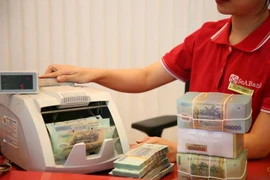
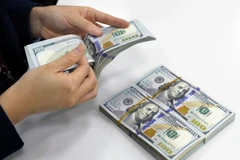
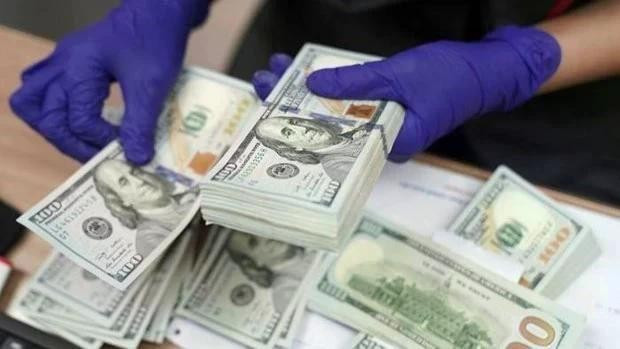
The US dollar at Vietnamese commercial banks has so far this year increased by about 2.6-3% against the dong. (Photo: VNA)

Hanoi (VNS/VNA) - The increase in the USD/VND exchange rate in Vietnam is in contrast to the continuous cooling of the greenback in the international market due to a surge in domestic dollar demands for foreign debt repayment.

Currently, the US dollar index (DXY) is trading at around 99, down about 10% compared to the peak set at the beginning of this year. Meanwhile, the dollar at Vietnamese commercial banks has increased by about 2.6-3% this year against the Vietnamese dong.

The State Bank of Vietnam (SBV)’s central exchange rate last week even set a new peak, surpassing 25,000 VND per dollar for the first time. The dollar selling price at commercial banks has also remained close to the ceiling, indicating that pressure on the USD/VND exchange rate has not decreased.

According to banking expert Can Van Luc, the dong is still depreciating compared to the dollar, while other currencies in the region are appreciating against the dollar.

Luc explained that despite global depreciation, the US dollar is still the main currency for international payments, maintaining its strength in the international financial market, especially as other major economies are slowing. Amid a risky and unstable world economy, the dollar is still considered a safe haven currency, so demand for dollars is increasing. This explains why the VND/USD exchange rate keeps increasing even though the dollar has cooled down globally.

Notably, Luc said, the appreciation of the dollar in the domestic market is due mostly to a sharp increase in demand for the currency to repay foreign debts for both the Government and private enterprises.

The State Treasury saw nine foreign currency purchase offers with a total value of nearly 1.6 billion USD to pay the Government’s foreign debts in the first five months of 2025. The amount of foreign currency offered by the State Treasury in the first five months of this year was higher than the amount purchased in 2023 (more than 1.2 billion USD) and equal to 86% of the amount purchased in all of 2024.

The Government has increased its foreign debt repayment since 2021, decreasing the amount of debt from its peak of 47.9% in 2020 to 31.8% by the end of 2024.

Private enterprises have also shifted from net dollar borrowing to net dollar debt repayment in recent years, because interest rates for dollar loans are higher than for loans in dong.

According to CEO of data provider Wigroup Tran Ngoc Bau, the pressure on the USD/VND exchange rate this year is not due to trade, or imports and exports, but is mainly due to the debt repayment obligations of the Government and businesses. Therefore, the exchange rate will not increase suddenly, but gradually.

Luc forecasts that the exchange rate this year will increase by about 3%, noting that the SBV is still able to control exchange rate fluctuations within the permitted range, which contributes to stabilising the macro economy./.

VNA

See more

Professor Tao Yitao, Director of the China Centre for Special Economic Zone Research (Photo: VNA)

Stable beginnings, powerful breakthroughs for Vietnam’s private economic sector

Vietnam is now at a critical juncture in pursuing what its leadership has described as a new era of national rise. In the long term, the development of the private economic sector will depend not only on supportive policies but also on a stable, transparent institutional environment that guarantees fair competition, said Professor Tao Yitao, Director of the China Centre for Special Economic Zone Research.

The trade policy review of Uruguay at the WTO headquarters. (Photo: VNA)

Vietnam participates in WTO review of Uruguay's trade policy

Vietnam also welcomed Uruguay's active engagement in the multilateral trading system as a founding member of the WTO. Uruguay has ratified the Agreement on Fisheries Subsidies, joined the Multi-Party Interim Appeal Arbitration Arrangement (MPIA), and contributed to Joint Statement Initiatives (JSIs) on e-commerce and micro, small and medium-sized enterprises (MSMEs).

Experts discuss cooperation opportunities in Vietnam-Germany manufacturing value chains at the forum. (Photo: VNA)

Vietnam-Germany cooperation creates new opportunities for sustainable manufacturing

Germany is an important partner of Vietnam and a global leader in green technology, smart manufacturing, automation and circular economy solutions. The combination of German technological expertise and Vietnam's manufacturing capabilities and strong commitment to transformation would create significant opportunities in green production, supporting industries, digital transformation, supply chain management and eco-industrial park development.

Businesses introduce Halal market products at the workshop. (Photo: VNA)

Da Nang businesses eye growth in booming global Halal market

Huynh Xuan Son, Deputy Director of the Da Nang Department of Industry and Trade, said the Halal market has emerged as a strategic destination for Vietnamese exporters amid persistent global economic uncertainties. Serving more than two billion consumers across over 110 countries and territories, the market offers significant opportunities for business expansion.

Vietnamese bananas are sold at an AEON supermarket in Japan. (Photo: VNA)

Vietnamese products promoted at AEON stores across Japan

Speaking at the opening ceremony, Deputy Minister of Industry and Trade Phan Thi Thang highlighted the significance of 2026, which marks a decade of cooperation between the ministry and AEON in organising Vietnam Week in Japan.

Growing demand for financing for infrastructure and green transition projects is driving Vietnam’s search for new sources of capital. In the photo: A section of Noi Bai – Lao Cai Expressway. (Photo: VNA)

Vietnam seeks to unlock capital for infrastructure, green transition

As Vietnam advances its sustainable growth agenda and commitment to achieving net-zero emissions by 2050, the need for long-term capital is rising rapidly. Experts say meeting these financing requirements will depend not only on expanding available resources but also on broadening funding sources and improving project financing models.

Private technology enterprises are increasingly viewed as a driving force at the heart of the innovation ecosystem. (Photo: VNA)

Vietnam pushes to develop world-class technology startups

Vietnam’s startup ecosystem now comprises roughly 4,000 startups, 208 investment funds, 84 incubators and more than 20 startup support centres. With an estimated valuation of 75 billion USD, the ecosystem has established most of the key foundations needed for long-term growth.