Education sector aims to meet Asia's advanced standards in five years

Deputy Prime Minister Le Thanh Long has signed a decision approving the national education development strategy until 2030 with a vision to 2045, with an aim to ensure that Vietnam's education sector meets advanced standards of Asia in five years and those of the world in 10 years.

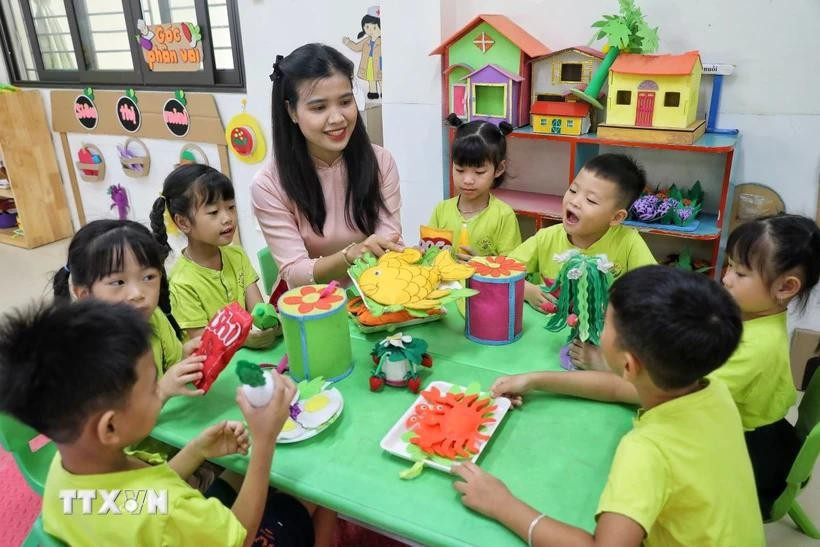
A creative corner of art at Song Mai Kindergarten in Bac Giang city, Bac Giang province (Photo: VNA)

Hanoi (VNA) – Deputy Prime Minister Le Thanh Long has signed a decision approving the national education development strategy until 2030 with a vision to 2045, with an aim to ensure that Vietnam's education sector meets advanced standards of Asia in five years and those of the world in 10 years.

Under Decision No. 1705/QD-TTg, the strategy’s objectives is to modernise Vietnam's education system, build on and enhance the nation’s good traditions, adopt global civilisations, foster the comprehensive development of Vietnamese people, and meet the requirements of socio-economic development in the new era.

It aims to actively participate in and adapt to the Fourth Industrial Revolution and the latest advancements in science and technology, with a focus on morality and personality education, maximising each individual's potential and creative abilities, laying the foundation for achieving the goal of a prosperous, democratic, fair, and civilised nation with happiness and prosperity.

Specifically, for pre-school level, the strategy sets a target of 38% of children of pre-school age to attend nursery school, and 97% of children of kindergarten age to be enrolled. Meanwhile, 100% of kindergarten teachers are expected to meet the required qualification standards as stipulated by the Education Law.

For general education, the strategy aims to firmly maintain the results of universal primary and secondary education, with 75% of centrally-run cities and provinces meeting level-3 primary education standards, 40% meeting level-3 secondary education standards, and 60% satisfying level-2 secondary education standards.

The strategy also sets goals for high completion rates, including 99.7% for primary education, 99% for secondary, and 95% for high school education. Additionally, the promotion rates from primary to secondary, and from lower secondary to high school are hoped to reach 99.5% and 95%, respectively. Furthermore, 100% of primary school students are expected to attend two sessions per day.

Private general education establishments are set to comprise 5% of the total, drawing 5.5% of total students.

All primary, lower secondary, and high school classrooms will be solidly constructed, with 70% of primary schools, 75% of secondary schools, and 55% of high schools meeting national standards, according to the strategy.

For tertiary education, the strategy aims to achieve at least 260 university students per 10,000 people, with 33% of university students aged 18-22, and 1.5% being international students in Vietnam. At least 40% of faculty members should hold doctoral degrees.

The proportion of students enrolled in Science, Technology, Engineering, and Mathematics (STEM) fields is hoped to reach 35%.

Vietnam expects at least five universities to rank among the top 500 globally, with five more ranked among the top 200 universities in Asia, advancing the nation to the top four Southeast Asian countries with the best higher education systems and among the top 10 in Asia.

By 2030, 10 administrative units should join UNESCO’s Global Learning Cities Network.

To achieve these goals, the strategy outlines 10 major tasks and solutions, focusing on improving the legal framework; innovating education management and school governance; ensuring equal access to education; expanding the network of educational institutions to meet citizens' learning needs; modernising content, teaching methods, and assessment; developing teachers and education administrators; securing financial resources and infrastructure for education development; promoting the use of technology and digital transformation in education; enhancing scientific research and innovation in higher education; and strengthening international integration.

The strategy also sketches out a number of support policies for children and students with disadvantaged backgrounds./.

VNA

See more

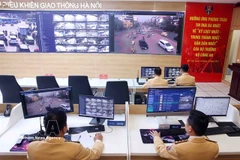
Police officers at the Hanoi traffic control centre (Photo: VNA)

A turning point in Hanoi’s city management

With 1,837 AI cameras integrated into traffic signals at 195 key intersections, Hanoi now operates a citywide network capable of monitoring and regulating traffic in real time.

The Vietnam National University, Ho Chi Minh City leads Vietnamese institutions in natural sciences, social sciences, and management, ranking in the 401–450 and 341 bands, respectively. (Photo: vnuhcm.edu.vn)

Vietnamese universities climb global rankings in multiple disciplines

In the broad subject rankings, seven Vietnamese universities were listed, three more than last year. Van Lang University ranked 260th globally in arts and humanities, the highest position for Vietnam in this category. Duy Tan University maintained a strong standing in engineering and technology, placing 346th worldwide.

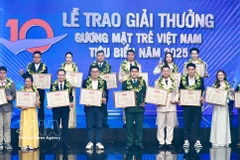
Outstanding young Vietnamese faces and promising young Vietnamese faces in 2025 (Photo: VNA)

Top 10 Vietnamese Outstanding Young Faces of 2025 honoured

Among the 10 outstanding young Vietnamese of 2025 are Dr. Pham Anh Tuan from KTH Royal Institute of Technology in Sweden, listed among the world’s top 2% most influential scientists, and Dr. Dang Thi Le Hang from the Vietnam Academy of Science and Technology, recognised for her work in biomedical materials.

Young trailblazers power Vietnam’s digital future

Young trailblazers power Vietnam’s digital future

Digital transformation is an unstoppable trend, driving the renewal of growth models, enhancing governance, and improving the quality of life. In this shift, young people – armed with knowledge, adaptability to new technologies, and creativity – are stepping up as a leading force.

Former Minister of Health Nguyen Thi Kim Tien (Photo: VNA)

Former Health Minister Nguyen Thi Kim Tien prosecuted

The Supreme People's Procuracy has prosecuted former Minister of Health Nguyen Thi Kim Tien for “violating regulations on management and use of State property, causing losses and wastefulness” in a case related to the construction of the second campuses of Bach Mai Hospital and Viet Duc University Hospital. ​

Ngo Minh Hai, Secretary of the Ho Chi Minh Communist Youth Union and President of the Vietnam Youth Federation of Ho Chi Minh City, presents portraits to the family of Heroic Vietnamese Mother Nguyen Thi Dau and her two children, martyrs Tran Thi Sau and Tran Van Chan. (Photo: VNA)

Youth Month: Restoring portraits to honour war heroes

The initiative on restoring and digitising portraits of Heroic Mothers and martyrs across Ho Chi Minh City not only helps safeguard valuable historical records but also highlights the creativity and volunteer spirit of young people in applying technology to meaningful community projects.

Team K91 under the Dong Thap provincial Military Command search for martyrs’ remains in Cambodia. (Photo: VNA)

Campaign launched to boost search, identification of fallen soldiers’ remains

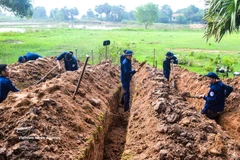
The “500-day-and-night campaign” aims to mobilise the combined strength of the entire Party, political system, armed forces and society to accelerate progress in carrying out the task, regarded as both a special political mission and a meaningful activity of gratitude to those who laid down their lives for the Fatherland's independence and freedom and the people's happiness.

A publication printed in the romanised Vietnamese script in 1883.(Photo: VNA)

Event series honours romanised Vietnamese script pioneer, promotes Vietnam–Portugal exchange

APCV Chair Diane Nguyen Duc Thu Dung said that the initiative aims to pay tribute to missionary Francisco de Pina, one of the early contributors to the formation of the modern writing system of the Vietnamese language (quoc ngu). Beyond its historical significance, the project is expected to serve as a platform to promote cultural exchange and expand cooperation between Vietnam and Portugal across various fields.

The Filipino sailor suffering from a serious illness is brought ashore for treatment. (Photo: VNA)

Foreign sailor brought ashore for emergency treatment

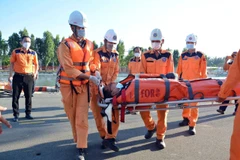
A specialised search-and-rescue ship which was on standby off Ho Chi Minh City’s Phuoc Thang ward was immediately dispatched, accompanied by a medical team from the Vung Tau General Hospital, to give first aid and bring the patient ashore.

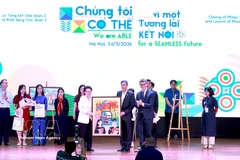
Delegates at the event to launch the third phase of the “We Are ABLE” project in Hanoi on March 24 (Photo: VNA)

UNESCO-backed STEAM initiative helps boost gender equality

Launched in 2019, the “We Are ABLE” initiative aims to promote gender equality, support girls’ education, and foster safe and inclusive learning environments. During its second phase from 2023 to 2025, the project reached more than 8,000 students and their families in the provinces of Cao Bang, Vinh Long, and Khanh Hoa.

Youth delegates take part in hands-on cultural experiences such as calligraphy writing, Dong Ho folk painting, mask painting, traditional games, and exchanges with young performers of “tuong”, “cheo” and “cai luong” theatre (Photo: VNA)

Youth - Key force in preserving, promoting national cultural values

The initiative “Bringing youth members to traditional theatres” has become a flagship model of the ministry’s Youth Union in recent years, helping popularise traditional arts among the public, particularly younger generations, and contributing to the implementation of the Politburo’s cultural development orientation under Resolution 80.