New decree simplifies rules for vehicle inspection centres

From the start of this year, vehicle inspection centres can be established at bus stations and rest stops, under new regulations to streamline services.

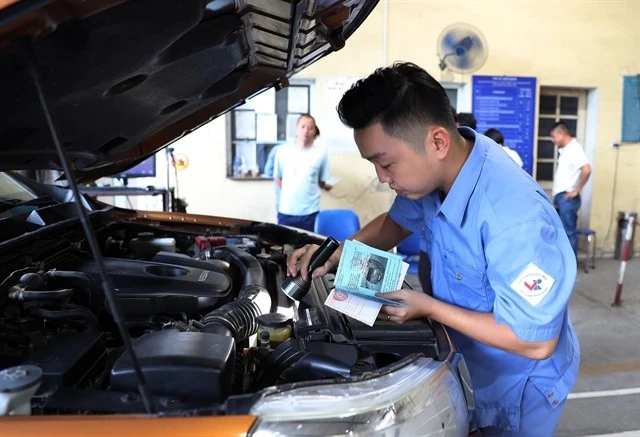
An car is inspected at a vehicle inspection centre in Hanoi. (Photo: VNA)

Hanoi (VNS/VNA) - From the start of this year, vehicle inspection centres can be established at bus stations and rest stops, under new regulations to streamline services.

The government has issued Decree No.166/2024/ND-CP to revise the rules governing the operation and establishment of vehicle inspection centres.

This decree simplifies business requirements while addressing industry challenges, ensuring transparency and promoting convenience. It builds upon previous regulations and introduces updates in alignment with Vietnam's Road Traffic Safety Law.

A key highlight of the decree is that it allows inspection centres to share premises with bus stations or rest stops without adhering to stringent space requirements. However, these centres must comply with national technical standards for infrastructure and equipment.

The decree also expands entry-level qualifications for inspectors to include bachelor's or engineering degrees in relevant technical fields.

Inspectors are now classified into three tiers -- Level I, II, and III -- each with distinct responsibilities. Notably, the promotion period from Level II to Level I has been extended to five years from the previous three.

Leadership standards for inspection centres have also been revised. Leaders must now hold at least a Level II inspector certification, broadening eligibility criteria compared to earlier requirements.

The decree also introduces operational flexibility, requiring only a minimum number of inspectors for a centre to function rather than specifying a fixed ratio of inspectors to inspection lines.

Additionally, the authority to issue vehicle inspection certificates is extended to department heads of inspection centres, not just centre leaders as previously regulated.

New standards for motorcycle and motorbike emissions testing facilities are also introduced, designed to align with the 2020 Investment Law and the Road Traffic Safety Law.

For fixed emissions testing centres, a minimum area of 15 sq.m per testing device is required, and these centres can share space with repair shops. Mobile testing facilities are exempt from space requirements, provided the necessary equipment is permanently installed on a specialised vehicle.

Regarding personnel, emissions testing centres must employ at least one certified inspector and a skilled technician. Staff may take on multiple roles if they hold the appropriate professional certifications.

In a significant shift, provincial Departments of Transport will assume full responsibility for evaluating and certifying vehicle inspection centres. Previously, this task required collaboration with the Registry Department, which will now play a supporting role only when requested./.
source

See more

The story of Elza Le Floch, Celeste Perotteau-Giraud, and Wyatt Lelouche is published in the Nice Matin newspaper (Photo published by VNA)

Three young French volunteers embark on humanitarian journey to Vietnam

While many French students have just completed their secondary school examinations and are preparing for their summer break, Elza Le Floch, Celeste Perotteau-Giraud and Wyatt Lelouche have embarked on a different journey. On July 15, the three members of the Scouts and Guides of France group in Menton left Nice for Xuyen Moc in Ho Chi Minh City.

At a classroom for hearing-and-speech impaired children in Bac Ninh province. (Photo: VNA)

Legal assistance project nears finish line with 95% of goals met

Legal support policies only matter when citizens know they exist, can tap into them, and receive quality service. That’s especially true for the poor, the disabled, ethnic minorities, children, domestic violence victims, and those battered by disasters and disease outbreaks.

Efforts to safeguard religious values in digital age

Efforts to safeguard religious values in digital age

Digital transformation is changing not only how people work and communicate but also how they practice their faith. A Buddhist sermon can now attract tens of thousands of online viewers. A Protestant believer in a remote area can join a Bible study class via smartphone. Religious activities once closely tied to places of worship are increasingly taking place in cyberspace.

Delegates tour the facilities of the industrial innovation centre at Eastern International University in Binh Duong ward, Ho Chi Minh City (Photo: VNA)

Digital, AI competencies made mandatory for university graduates

Under Circular No. 54/2026/TT-BGDDT on higher education curricula, learning outcomes must be defined as measurable and assessable competencies, providing the basis for curriculum design, teaching, assessment, quality improvement, credit recognition and degree awarding.

Nguyen Thuy Hang, Director of the Writers Association Publishing House, is questioned at the security agency for investigation under the Hanoi Department of Public Security. (Photo published by VNA)

Publishers detained over alleged anti-State propanganda

The move was made as part of an expanded investigation into a criminal case involving Nguyen Thanh Nam, who is accused of “making, storing, distributing or spreading information, documents and items aimed at sabotaging the State of the Socialist Republic of Vietnam.”

Fishing boats at Quy Nhon Port of Gia Lai province (Photo: VNA)

Gia Lai digitises fishing fleet to strengthen fight against IUU fishing

Under Directive No. 16/CT-UBND, recently issued by the provincial People's Committee, combating IUU fishing has been identified as an urgent political priority requiring concentrated resources to address shortcomings in fishing fleet management, while holding agency heads and local leaders accountable for the results achieved.

The General Association of Vietnamese People in Laos, in coordination with Bang Long Pagoda, organises the “Mid-Autumn Festival Night” programme to celebrate the Mid-Autumn Festival. (Photo: VNA)

Vietnamese community organisation network completed across Laos

The official establishment of the Vietnamese Community Management Committee and the Vietnamese Association in Vientiane province on July 14 has completed the organisational network serving the Vietnamese community in all 18 provinces and centrally administered cities of Laos.

Party General Secretary and State President To Lam (centre, standing, first row) poses for a group photo with staff and invalids and sick soldiers at the Thuan Thanh Invalids Nursing Centre. (Photo: VNA)

Top leader calls for better care for invalids, revolutionary contributors

Party General Secretary and State President To Lam on July 15 affirmed that caring for revolutionary contributors is both a political responsibility and a moral obligation, calling for more comprehensive and timely policies to ensure that those who sacrificed for the nation receive the care and respect they deserve.

A sailboat carrying tourists cruises in the waters off Phu Quoc, An Giang province. (Photo: VNA)

Phu Quoc tightens inland waterway safety, traffic management

Operators of inland ports and terminals must carry out regular inspections, maintenance and repairs to ensure facilities remain safe and operational. They are also required to work with competent authorities and the Inland Waterway Port Authority to verify that vessels operating at ports and terminals meet all safety requirements.