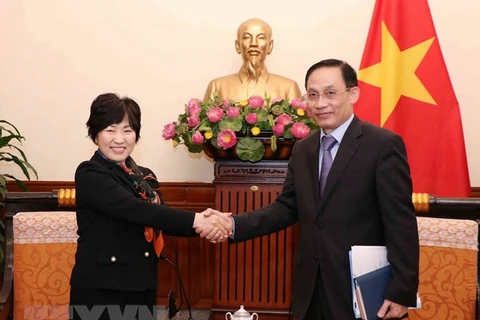
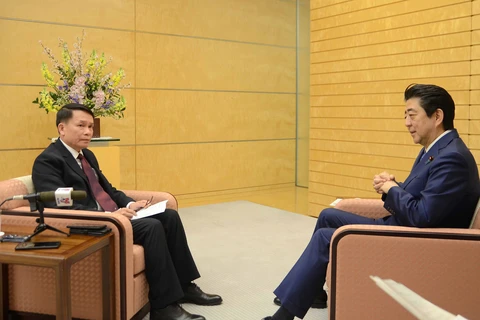
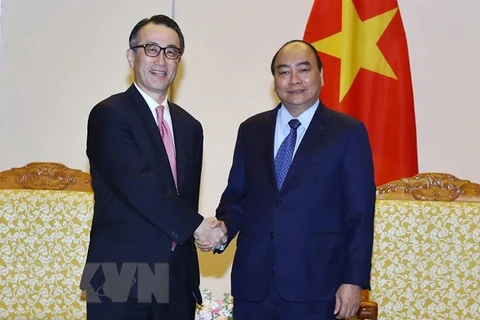
At the event (Photo: vccinews.vn)
 Hanoi (VNA) – An event to review economic cooperation between Vietnam and Japan over the years and towards effective development in the future was held by the Vietnam Chamber of Commerce and Industry (VCCI) on February 25.
The Vietnam-Japan economic dialogue is part of a working visit to Vietnam by a Japanese business delegation led by Yoichi Kobayashi, Chairman of the Japan-Mekong Business Cooperation Committee, from February 24-27.
The dialogue offered a chance for businesses from the two countries to meet, exchange information, and seek future partners; while exploring the potential for bilateral economic, trade, and investment cooperation.
Opening the event, VCCI Chairman Vu Tien Loc stressed the significant contributions of multifaceted cooperation between the two countries towards Vietnam’s socio-economic development over the years.
Potential for cooperation will be accelerated further in some fields, such as high-tech agriculture, the supporting industry, tourism, and science-technology, he added.
Japan is currently Vietnam’s second largest foreign investor, third major partner in tourism, and fourth leading trade partner, while two-way trade values hit nearly 40 billion USD in 2018.
Meanwhile, Vietnam is among countries with huge potential for attracting foreign investment and there are many chances for the supporting technology development in the country for Japanese small- and medium-sized enterprises, Loc said.
In the previous year, Vietnam exported various products to Japan, including garment-textile, devices and accessories, aquatic products, and timber and wooden products. The country imported from Japan machinery and devices, tools and accessories, computers, electronic products and spare parts, and iron and steel, among others.
For his part, Kobayashi said that exchanges and dialogues have helped to strengthen the Japan-Vietnam friendship, adding that with a population of nearly 100 million people, Vietnam is becoming an attractive consumer market for foreign investors, including those from Japan.
Director of Japan Airlines Shinichiro Shimizu said that as the Comprehensive and Progressive Agreement for Trans-Pacific Partnership (CPTPP) has come into force, the Vietnam-Japan relations look likely to be enhanced in the time to come.
He said that Japanese firms expect to tighten cooperation and share experiences with Vietnamese counterparts to support each other in raising business efficiency. The two sides also need to pay attention to and address problems during the implementation of the CPTPP, especially in logistics, he noted. –VNA
The Vietnam-Japan economic dialogue is part of a working visit to Vietnam by a Japanese business delegation led by Yoichi Kobayashi, Chairman of the Japan-Mekong Business Cooperation Committee, from February 24-27.
The dialogue offered a chance for businesses from the two countries to meet, exchange information, and seek future partners; while exploring the potential for bilateral economic, trade, and investment cooperation.
Opening the event, VCCI Chairman Vu Tien Loc stressed the significant contributions of multifaceted cooperation between the two countries towards Vietnam’s socio-economic development over the years.
Potential for cooperation will be accelerated further in some fields, such as high-tech agriculture, the supporting industry, tourism, and science-technology, he added.
Japan is currently Vietnam’s second largest foreign investor, third major partner in tourism, and fourth leading trade partner, while two-way trade values hit nearly 40 billion USD in 2018.
Meanwhile, Vietnam is among countries with huge potential for attracting foreign investment and there are many chances for the supporting technology development in the country for Japanese small- and medium-sized enterprises, Loc said.
In the previous year, Vietnam exported various products to Japan, including garment-textile, devices and accessories, aquatic products, and timber and wooden products. The country imported from Japan machinery and devices, tools and accessories, computers, electronic products and spare parts, and iron and steel, among others.
For his part, Kobayashi said that exchanges and dialogues have helped to strengthen the Japan-Vietnam friendship, adding that with a population of nearly 100 million people, Vietnam is becoming an attractive consumer market for foreign investors, including those from Japan.
Director of Japan Airlines Shinichiro Shimizu said that as the Comprehensive and Progressive Agreement for Trans-Pacific Partnership (CPTPP) has come into force, the Vietnam-Japan relations look likely to be enhanced in the time to come.
He said that Japanese firms expect to tighten cooperation and share experiences with Vietnamese counterparts to support each other in raising business efficiency. The two sides also need to pay attention to and address problems during the implementation of the CPTPP, especially in logistics, he noted. –VNA
VNA