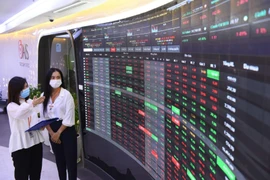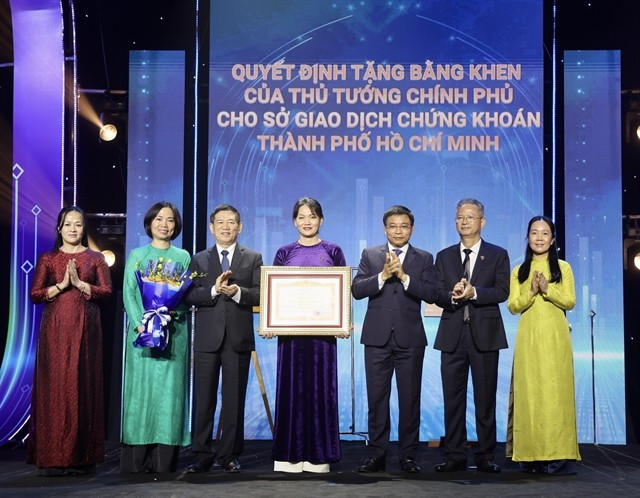
Hanoi (VNS/VNA) - The Ho Chi Minh City Stock Exchange (HoSE) celebrates its 25th anniversary today, commemorating a journey that transformed Vietnam’s growing capital market into a vital engine for the national economy.
From modest beginnings, with two listed stocks and a trading value of just 70.4 million VND (2,688 USD), HoSE has emerged as the nation’s largest exchange by market capitalisation and liquidity.
Since its inaugural trading session on July 28, 2000, HoSE has witnessed phenomenal growth. The number of listed companies has expanded from two to 391 stocks as of May, alongside 21 listed fund certificates and 192 covered warrants.
This growth signifies not just quantitative expansion, but a qualitative leap in transparency, governance and investor confidence.
The number of securities companies has grown from six in 2000 to 78 in 2025. These firms have significantly strengthened their financial capacity, with 45 boasting charter capital above 1 trillion VND.
Major players like SSI Securities Corporation (SSI), Techcom Securities (TCBS) and VNDirect Securities Company lead the pack with charter capital of 19.64 trillion VND, 19.6 trillion VND and 15.2 trillion VND, respectively. Cumulatively, 61 firms reported 55.7 trillion VND in profits after tax as of 2024.
Investor engagement has also surged. The number of trading accounts has grown exponentially from 2,997 at the end of 2000 to over 10 million by May, a 3,360-fold increase.
HoSE-listed firms span diverse sectors, with the top four, finance, real estate, consumer staples and industrial, accounting for over 75% of total market capitalisation. The finance sector alone contributes 44.5%. Many of these enterprises have turned to the bourse not only to raise capital, but also to signal credibility and attract strategic investors.
Between 2005 and 2025, the exchange hosted 584 auctions, generating more than 240 trillion VND from the sale of over 4.8 billion shares and 130 million rights.
Performance has been promising
Between 2015 and 2024, listed companies on HoSE consistently improved revenues and profitability, demonstrating sound post-listing governance and strategic alignment. Since earlier this year, all listed companies have complied with mandatory English-language disclosures, broadening the reach for foreign investors.
The asset management industry has mirrored HoSE’s expansion. From a handful of firms in the early days, Vietnam now hosts 43 licensed fund managers overseeing 123 investment funds with assets under management (AUM) exceeding 750 trillion VND, more than seven times the 2014 figure.
Exchange-traded funds (ETFs), a standout product line, have become increasingly popular. HoSE currently lists 17 ETFs tracking indices, including VN30, VN100, VNFIN Select and VNDiamond. These funds represent over one billion units with net asset values approaching 25 trillion VND, quadrupling the size in 2019.
ETFs are fuelling both primary and secondary market liquidity. From 2014 to May 2025, over 3.5 billion ETF certificates were issued and 2.6 billion redeemed via creation/redemption mechanisms. In 2022 alone, ETF trading reached 1.82 billion units and 39.5 trillion VND in value, both record highs.
Still, total AUM represents just 6.5% of Vietnam’s 2024 GDP, compared to 21% in Thailand and 52% in Malaysia, indicating substantial room for growth.
Speaking at the anniversary ceremony in HCM City, Minister of Finance Nguyen Van Thang emphasised the market’s vital role in the nation’s economic fabric.
From just two companies and 0.2% of GDP at inception, our capital markets now account for nearly 100% of GDP, the minister said, adding that this is a testament to the reform-minded vision of the Party and State.
The Vietnamese capital market has weathered global headwinds, trade tensions, capital flight, COVID-19 and system overloads, with resilience and policy responsiveness. Through Government intervention and regulatory vigilance, HoSE has maintained stability, liquidity and investor trust.
Future-focused exchange
To meet rising demand and technological expectations, HoSE has modernised its infrastructure. It launched its Exchange Tower in 2014, a backup data centre in 2016 and, most recently, a new information technology (IT) system this May.
The upgrade enables enhanced processing, scalability and the launch of new structured products.
Transparency and compliance remain cornerstones. HoSE continues to tighten oversight, reducing disclosure violations by nearly 80% over the last decade. It has also bolstered English-language disclosures and encouraged investor relations efforts among listed firms.
The development of a robust index ecosystem has further anchored the market. The VN-Index, which started at 100 points in 2000, reached a new record level of 1,557.42 points on July 28.
Meanwhile, market infrastructure has advanced, with continuous order-matching, broader trading hours, odd-lot transactions and market orders enhancing liquidity.
As a result, average daily trading volume has surged to 860 million securities and 19 trillion VND, compared to just 55,000 units and 1.4 billion VND in 2000.
Vietnam’s stock market may soon be upgraded from frontier to emerging market status, a move expected to attract significant foreign inflows. HoSE’s ongoing collaboration with global exchanges, such as the New York Stock Exchange (NYSE), London Stock Exchange (LSE) and Korea Stock Exchange (KRX), positions it well to integrate further into the global financial system.
HoSE is a founding member of the ASEAN Exchanges Initiative and actively participates in international bodies like the World Federation of Exchanges and the Asian and Oceanian Stock Exchanges Federation. These ties not only elevate its global standing, but also support Vietnam’s ambition to become a regional financial centre.
"With 25 years of solid foundation and the collective resolve of all stakeholders, I am confident Vietnam’s capital market will soon attain emerging market status — and continue to grow sustainably, transparently and inclusively," Thang said./.
VNA