Hanoi leads nation in apartment price growth

60% of apartments launched in the first half of 2025 were priced above 80 million VND per square metre. Since the third quarter of 2024, no new developments have been recorded with prices below 60 million VND per square metre.

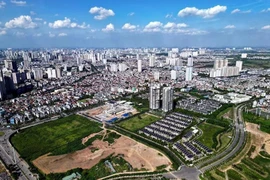
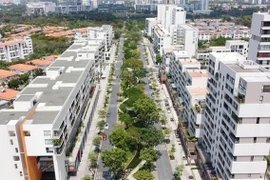
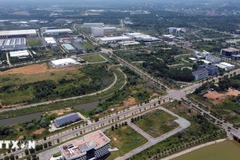
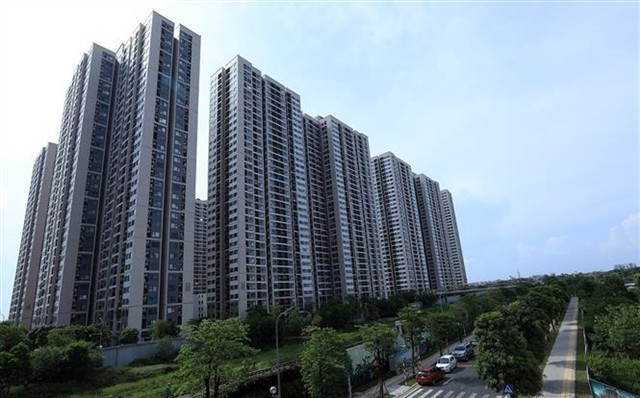
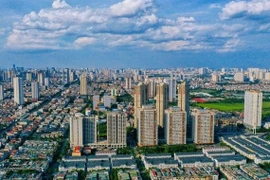
A residential apartment project in Hanoi (Photo: VNA)

Hanoi (VNS/VNA) - Despite a strong recovery in Hanoi’s apartment market over the past year, a growing imbalance between supply and demand is becoming increasingly apparent, as affordable housing has almost vanished and prices continue to climb beyond the reach of most urban residents, especially the younger population.

According to figures from the Vietnam Association of Real Estate Brokers (VARS), the supply of apartments in Hanoi saw a steep decline between 2018 and 2023, dropping from over 20,000 units in 2018 to just around 10,000 units in 2023.

This reduction was accompanied by the near-complete disappearance of the affordable housing segment, priced below 25 million VND (960 USD) per square metre, which made up 35% of total supply in 2019 but saw no new developments launched in 2023.

In 2024, supply showed signs of recovery, with approximately 30,000 new apartments brought to market, the highest figure in five years. During the first half of 2025, over 10,000 additional units were introduced.

Nonetheless, there remains a significant mismatch between pricing and actual demand. VARS noted that 60% of apartments launched in the first half of 2025 were priced above 80 million VND per square metre. Since the third quarter of 2024, no new developments have been recorded with prices below 60 million VND per square metre.

Even in Hanoi’s suburban districts, starting prices now begin at 55 million VND per square metre.

“Overall, the supply of affordable commercial apartments is becoming increasingly scarce in Hanoi, and even the mid-range segment is shrinking and could vanish in the near future,” warned VARS Chairman Nguyen Van Dinh.

He stressed that even high-end apartments priced below 60 million VND per square metre are becoming rare, pushing homeownership further out of reach for middle-income earners.

In Q2 2025, Hanoi continued to lead the nation in apartment price growth, with the average selling price reaching 75.5 million VND per square metre, up 7.7% quarter-on-quarter and nearly 90% higher than in 2019 (the sharpest rise came in the last 1–2 years).

Developers have persistently introduced new projects at higher price levels and adjusted up prices of unsold inventory, further driving up prices on the secondary market.

However, secondary market liquidity remains low. Transactions are mostly concentrated in completed mega-urban projects or luxury apartments in central areas priced around 50 million VND per square metre. At current price levels, not only low-income but also upper-middle-income buyers are struggling to access housing.

Tran Van Binh, General Secretary of VARS, said: “Many young people, even those earning 40–50 million VND per month, are hesitant to purchase property without financial support from their families. The pressure of large mortgage repayments, especially when floating interest rates surge after initial incentives, deters many.”

Binh added that today’s youth increasingly prioritise experiences and flexible spending over committing to long-term debt simply to own a small apartment. This mindset could lead some to financial disorientation and a 'live for the moment' lifestyle, spending on luxury goods or short-term pleasures rather than saving for a home, a trend already seen in the Republic of Korea.

"Others may choose to 'lie flat', giving up on homeownership altogether and losing motivation to strive, similar to what is unfolding in China.

In the short term, VARS forecasts that apartment prices in Hanoi will continue to rise due to high input costs and investors’ strong profit expectations. Many investors are under little financial pressure and have no incentive to lower prices. On the contrary, profit expectations are rising amid low interest rates, abundant cheap capital, and accelerated public investment policies./.

VNA
See more

Lien Khuong International Airport in the central province of Lam Dong (Photo: VNA)

Lien Khuong Airport expected to reopen in August

The project is invested by ACV, with a total investment of over 1 trillion VND (38 million USD), including the repair of the entire runway, taxiways, safety strips, and technical infrastructure and equipment to ensure flight operations.

Representatives of Ho Chi Minh City's tax agency address concerns and clarify tax-related issues raised by the FDI business community. (Photo: VNA)

Ho Chi Minh City moves to ease tax hurdles for FDI firms

The Ho Chi Minh City tax agency said it will maintain regular dialogue with businesses, push ahead with administrative reform and digital transformation, and identify implementation bottlenecks to recommend policy adjustments, facilitating investment and business activities for FDI enterprises.

A workshop on the Halal market is held in Ho Chi Minh City on June 16, 2026. (Photo: VNA)

Growing Halal market offers opportunities for Vietnamese businesses

The Halal market is becoming a promising avenue for businesses in Ho Chi Minh City. With its well-developed manufacturing, trade and service ecosystem and dynamic business community, the city is well positioned to strengthen its role in regional and global Halal supply chains.

Wistron Infocomm Vietnam Co., Ltd, an FDI enterprise, has invested in Dong Van III Industrial Park of Ninh Binh province since 2021, creating jobs for more than 12,800 workers. (Photo: VNA)

Vietnam seeks to position itself as leading destination for foreign investment

A significant shift in the recently issued Resolution 10 is the move from a strategy of attracting “more capital” towards attracting “higher-quality FDI”. The objective is no longer limited to investment volume but extends to absorbing advanced technologies, increasing domestic value creation, strengthening innovation capacity and accelerating modernisation in the economy.

Enterprises must disclose to investors the issuance plan, legal and investment risks and the rights and obligations of issuers and bondholders. (Photo: VNA)

Vietnam tightens rules on corporate bond issuance

Under Decree No 200/2026/ND-CP, enterprises issuing bonds will continue to operate under the principle of self-borrowing, self-repayment and self-responsibility, meaning issuers are fully accountable for the efficiency of capital use, debt repayment capacity and any disputes arising from bond issuance, use of funds, and payment of principal and interest.

A performance on The Huc bridge of the temple as part of a nighttime tourism programme to discover the Ngoc Son temple on Hoan Kiem Lake, downtown Hanoi. (Photo: VNA)

Hanoi adopts framework to boost night-time economy development

The resolution encourages a wide range of cultural, artistic and tourism activities, including performances, exhibitions, film screenings, presentations of traditional and intangible cultural heritage, and other programmes held in public spaces, pedestrian streets, heritage sites, theatres, cinemas and cultural venues.

A cargo port in Thiruvananthapuram city, India (Photo: ANI/VNA)

Ample room remains for Vietnam–India logistics cooperation

The GTTCI expert noted that alongside logistics and integrated warehousing, e-commerce is expected to be a particularly high-growth sector in the coming years. He described it as a multi-billion-dollar market with significant untapped opportunities for cooperation between Vietnam and India.

The meeting between Minister of Finance Ngo Van Tuan and Ambassador Julien Guerrier, head of the EU Delegation to Vietnam, on June 15. (Photo: thoibaotaichinhvietnam.vn)

Vietnam, EU enhance cooperation in green finance

Minister of Finance Ngo Van Tuan called on the EU to help facilitate Vietnamese firms' access to green finance, expand technical and financial assistance for green transition, and enhance cooperation in strategic technologies, innovation, digital finance and high-tech human resources development.

An overview of the working session between Deputy Finance Minister Tran Quoc Phuong and Kim Dongil, Director of ADB representing the Republic of Korea, Papua New Guinea, Sri Lanka, Taipei (China), Uzbekistan, Vanuatu and Vietnam. (Photo: Ministry of Finance)

Vietnam, ADB to advance strategic projects with strong economic impact

ADB has identified a pipeline of 27 projects for Vietnam through 2029, with total planned financing of approximately 4.6 billion USD. The projects focus on sectors that are among Vietnam’s priorities, including infrastructure, energy, urban development, agriculture and public sector management.

Illustrative photo (Photo: VNA)

Exports gain momentum from high-tech growth drivers

According to the Ministry of Industry and Trade, Vietnam’s exports reached 215.66 billion USD in the first five months of 2026, up 19.5% year-on-year. Twenty-six export items generated more than 1 billion USD in revenue each, including seven with turnover exceeding 10 billion USD.