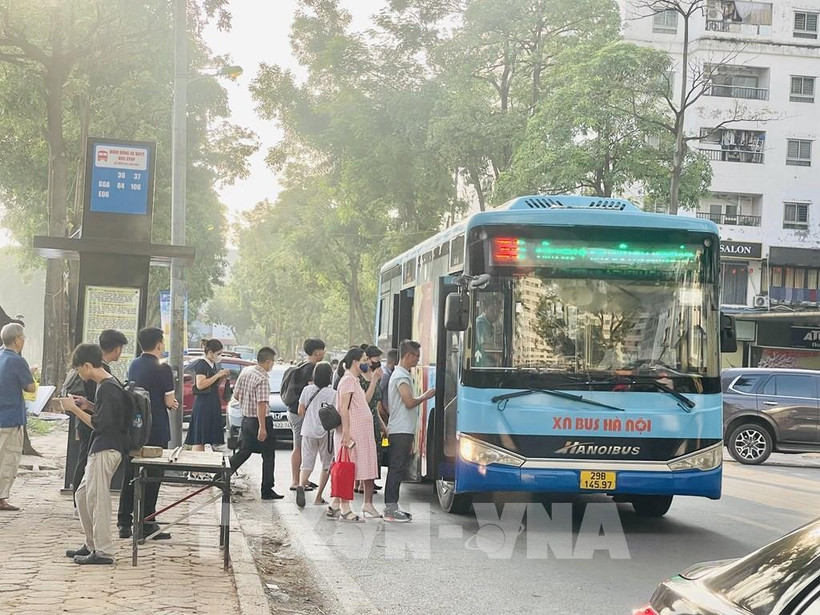
Hanoi prioritises charging infrastructure to drive green transport

Hanoi is advancing green transportation as part of its sustainability goals but faces challenges like limited charging infrastructure, inconsistent regulations, and high electric vehicle costs.

Hanoi is stepping up efforts to transition toward green transport. (Photo: VNA)

Hanoi (VNA) – As part of its broader sustainability goals, Hanoi is stepping up efforts to transition toward green transportation. While initial results have been encouraging, the city is still grappling with significant challenges, including underdeveloped charging infrastructure, a lack of standardised regulations, and high costs associated with electric vehicles.

One of the key obstacles is the absence of uniform standards for charging stations and connectors, making it difficult for different EV brands to share infrastructure.

According to Dao Viet Long, Deputy Director of the Hanoi Department of Construction, the city also lacks a comprehensive master plan for both the power grid and charging network, particularly in the urban core. Furthermore, private investment in charging stations is hindered by the lack of a clear legal framework for pricing and management.

Currently, V-Green Global Charging Station Development JSC has submitted a report on the installation of EV charging infrastructure in Hanoi. The company has rolled out approximately 1,000 stations, including 57 public high-capacity chargers, 259 mixed AC/DC chargers, and 684 private AC units.

Infrastructure for electric buses remains limited. Only 113 chargers have been installed across 16 routes, serving five out of eleven operators. These chargers are incompatible with Vinbus’s network, which uses different specifications. The pace of station development has not kept up with the increasing number of EVs, especially at key transfer points, bus depots, and densely populated residential areas.

Securing space for public charging stations in inner-city areas is proving to be a challenge. There are a few vacant lots available for integrated charging and parking facilities.

Meanwhile, the supply chain for EV maintenance remains fragmented, and the availability of spare parts, particularly batteries, is limited and largely dependent on imports.

In response to these challenges, Hanoi authorities are working to accelerate infrastructure development.

Vice Chairman of the Hanoi People’s Committee Nguyen Manh Quyen has directed the Department of Construction to review all relevant standards and regulations concerning charging infrastructure.

Enterprises that plan to build stations must coordinate with the department to ensure compliance and inclusion in the city’s official plans.

The city is also encouraging public-private partnerships and looking to raise community awareness about the transition to green transport.

Authorities plan to streamline procedures for permits and land use, including allowing temporary use of public land and technical corridors to build charging stations.Hanoi has identified four initial locations along Ring Road No.1 for combined parking and charging stations, in preparation for the planned phase-out of petrol-powered motorbikes in the area beginning July 2026.

These sites include a vacant stretch along De La Thanh Street, a lot near the Russian Embassy at the Kim Ma–Cau Giay intersection, sidewalks along Tran Khat Chan street from Bach Mai to Lac Nghiep, and an open area in front of the Vietnam Maritime Corporation headquarters at the Xa Dan–Giai Phong junction.The city is finalising a draft resolution to promote clean energy use, set to be submitted to the Hanoi People’s Council in this September. The proposal outlines several support policies.

By the end of 2026, at least 10% of parking spots in existing buildings must be equipped with chargers, while new developments must meet a 30% threshold. The city also aims to prioritise sidewalk charging stations and encourage hydrogen and other clean-fuel options.

To stimulate investment, Hanoi will offer financial incentives. These include subsidising 70% of interest on bank loans for charging station projects during the first five years, and covering 50% of land clearance costs and 100% of land rental fees for parking areas that install chargers at 30% of available spaces. Investors will also receive free technical support, including grid connection surveys and promotional assistance.

Private companies investing in clean transport infrastructure through public-private partnerships will be granted priority access to land and be exempt from rental fees at designated sites until 2033.

Additionally, Hanoi has committed to expanding technical and transportation infrastructure to ensure seamless integration with these green projects.

As public consultation on the draft resolution continues, the city remains committed to building a unified, future-ready transport ecosystem that supports Vietnam’s broader clean energy ambitions./.
VNA

See more

Delegates at the SEAN Future Forum NextGen Workshop 2026 held in Jakarta, Indonesia on March 9 (Photo: VNA)

Vietnam contributes youth perspectives to AFF NextGen initiative

The ambassador expressed confidence that fresh perspectives, innovative thinking and lessons drawn from the workshop will be proposed to AFF 2026, representing the voice of the younger generation in shaping ASEAN’s future in line with their aspirations.

A young volunteer donates blood during the 2026 Red Sunday programme. (Photo: VNA)

Nearly 5,000 people join blood donation campaign in Ho Chi Minh City

According to health authorities, Vietnam collected nearly 1.75 million units of blood in 2025, with 98% from volunteer donors, equivalent to around 1.75% of the population participating in blood donation. Large-scale campaigns such as Red Sunday have played a key role in achieving these results.

More than 30 kilogrammes of various drugs trafficked from Cambodia to HCM City were seized in a police operation in March 2025. (Photo: VNA)

Ho Chi Minh City aims to become drug free by 2030

Every commune, ward or residential area in Ho Chi Minh City is expected to meet official drug-free standards by the end of 2029, while schools, hospitals, government offices, businesses and social organisations across the city are to remain free of drug activity.

Military forces take a resident from a flooded area. Photo: VNA

Da Nang, Oxfam join hands to support flood victims

In the coming time, the Da Nang Red Cross Society will continue to coordinate with Oxfam to implement support activities in Nong Son commune, helping residents overcome difficulties and stabilise their livelihoods.

Training on response to reservoir incidents (Photo: VNA)

Central Civil Defence Fund established to bolster disaster response

The Central Civil Defence Fund is authorised to receive, manage and use voluntary contributions from domestic and foreign entities and individuals, plus transfers from provincial civil defence funds in line with the PM’s decisions and allocations from relevant state financial sources outside the state budget, all earmarked for incident and disaster response and recovery efforts.

Vietnamese women shine in the traditional Ao dai (Photo: VNA)

March shines with elegance of “Ao dai”

In early March, scenes of women in flowing Ao dai taking spring photos by lakes, parks, offices, temples and historical sites have become a familiar sight on the streets of Hanoi. Social media is also filled with images and stories surrounding the elegant attire, which has become a symbolic signal of the season dedicated to honouring women.

Hanoi voters learn about candidates’ biographies and action programmes. (Photo: VNA)

Hanoi thoroughly prepares for NA, People’s Council election

According to the municipal Election Committee, the capital city has established election committees in 126 communes and wards. In addition, 11 electoral boards for National Assembly deputies, 31 electoral boards for the city-level People’s Council, 831 commune-level electoral boards and more than 4,000 polling teams have been set up to serve the election process.

Artisan Vu Van Vinh from Chuyen My commune introduces to visitors a set of mother of pearl inlaid lacquer furniture including a platform bed, tea cabinet, and lacquered horizontal boards and parallel sentences made by his family, worth more than 3 billion VND. (Photo: VNA)

Four Hanoi craft villages join global creative crafts network

The recognition is not only a source of pride for the capital but also creates opportunities to promote these craft villages globally, strengthen international connections, and support their sustainable development in the process of global integration.

Vietnamese women affirm growing role in national economy

Vietnamese women affirm growing role in national economy

Vietnamese women have long been an indispensable force in the country’s socio-economic development. Today, they are present across a wide spectrum of economic activities, from production, trade and small-scale services to innovative start-ups, collective economic development, the digital economy, green growth, the circular economy and financial inclusion.

Voters study information of candidates to the 16th National Assembly and People’s Councils at all levels in the 2026-2031 tenure. (Photo published by VNA)

K’Ho ethnic minority group in Lam Dong province looks forward to Election Day

Lac Duong commune is a remote locality largely inhabited by the K’Ho ethnic minority in Lam Dong. The commune has 15 villages with more than 14,000 residents in 3,119 households and 8,799 registered voters. Given that residents live scattered along National Highway 27C and that the area’s mountainous terrain makes travel difficult, local authorities have prepared plans to organise the election smoothly.