Hanoi (VNA) – As Hanoi accelerates its transition to green transport, the city is placing growing emphasis on expanding charging infrastructure, which remains underdeveloped. The shift also faces challenges including inconsistent policy support, limited investor incentives, and high costs for electric vehicles.
Lack of common standards
One of the key bottlenecks lies in the lack of a unified standard for electric vehicle (EV) charging stations.
According to Deputy Director of the Hanoi Department of Construction Dao Viet Long the absence of standardised charging protocols across vehicle brands makes shared charging infrastructure difficult. A comprehensive plan for power grid integration and public charging networks, especially in downtown areas, has yet to be developed. In addition, the legal framework for managing privately invested charging stations and setting service prices remains incomplete.
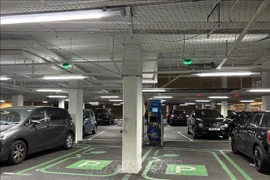
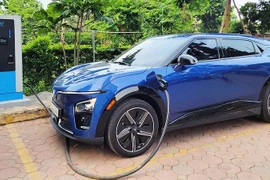
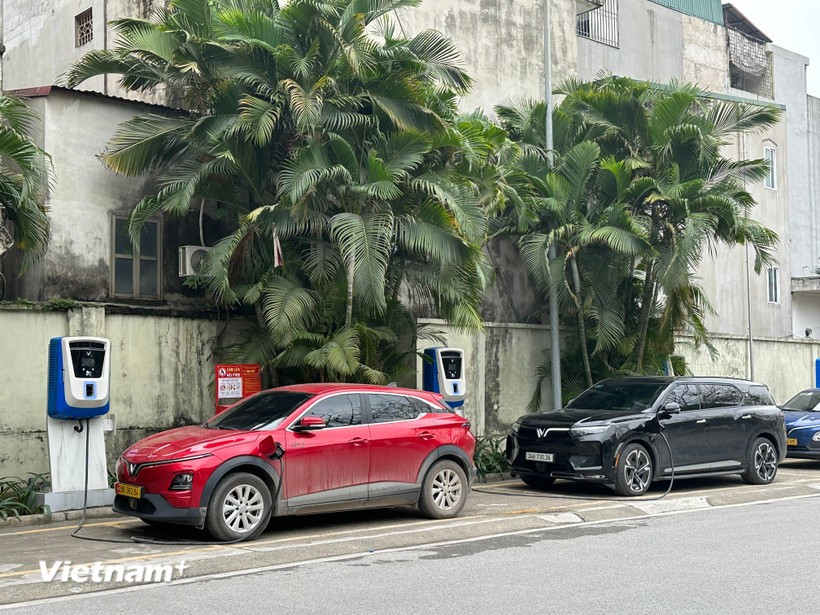
Currently, only V-Green Global Charging Station Development JSC has reported its network, comprising 1,000 stations in Hanoi, including 57 high-capacity public chargers, 259 mixed AC/DC units, and 684 personal AC chargers.
Charging infrastructure for electric buses is also falling behind. Only 113 chargers across 16 routes have been installed at depots operated by five out of 11 bus operators. Vehicles are not yet able to share chargers installed by Vinbus for other types of EVs. Moreover, infrastructure expansion is not keeping pace with the city’s growing EV fleet, especially at key transit points, depots and densely populated residential areas.
In some downtown areas, limited land availability makes it difficult to allocate space for charging stations or parking areas equipped with EV chargers. The network for maintenance, servicing, and spare parts — especially batteries — is also underdeveloped and largely reliant on imports.
In response, the Hanoi People’s Committee, in coordination with relevant departments, is rolling out practical solutions tailored to local conditions. These include revising policy frameworks, promoting social investment, enhancing inter-sectoral collaboration, and raising public awareness to meet the targets set under the Prime Minister’s Directive 20/CT-TTg.
Vice Chairman of the Hanoi People's Committee Nguyen Manh Quyen has tasked the Department of Construction with reviewing all regulations and standards related to EV charging stations. Businesses must coordinate with the department to ensure only qualified stations are approved and incorporated into the city’s planning.
He stressed that charging infrastructure must be included in all urban development projects and deployed uniformly citywide to support Hanoi’s green transport goals.Focus on strategic locations
Experts recommend that Hanoi develop a master plan for charging station networks, prioritising high-density residential areas, transport terminals, bus stations, shopping centres, and major traffic corridors. Interdisciplinary surveys should be conducted to identify suitable sites for pilot charging stations that meet technical and connectivity standards.
To promote private investment, the city is advised to allow temporary or flexible use of public land, road reserves, and utility corridors for charging stations. Simplified procedures for permits and land-use conversions should also be introduced.
Currently, Hanoi Parking Company, in coordination with relevant agencies, has surveyed potential sites for combined parking and EV charging along Ring Road 1, ahead of the city's planned ban on petrol motorbikes in the area from July 2026. Four initial locations have been identified as suitable: a vacant lot along De La Thanh Street (No. 621–768), a site near the Russian Embassy roundabout (Kim Ma – Cau Giay), a 500-metre stretch on Tran Khat Chan Street, and a vacant area in front of the Vietnam Maritime Corporation at the Xa Dan – Giai Phong junction.
Under a draft resolution on clean energy transition policies, Hanoi has proposed a range of measures to develop supporting infrastructure.
By the end of 2026, at least 10% of parking spaces in existing buildings and 30% in new projects must have EV chargers. The city also encourages pavement-based charging stations and investment in hydrogen and other clean fuel systems.
To support this, Hanoi will subsidise 70% of interest on bank loans for clean energy infrastructure projects over five years. Projects with at least 30% of parking spaces equipped with chargers will receive 50% land clearance support and five years of free land rent. The city also offers free grid connection surveys, design, and promotional support.
Investors developing clean transport infrastructure under PPP schemes will receive priority land access and full land rent exemptions at designated sites through 2033.
The draft resolution is currently under public consultation and expected to be submitted to the city People’s Council in September 2025./.