Hanoi (VNA) - The New Zealand Herald of New Zealand on August 4 published an article by Indian writer Ankita Mahabir, showing her deep impression of Vietnam’s Cham culture.
From weaving villages to sacred blessings, Mahabir recounted five immersive encounters, which she said that they offer a rare glimpse into Vietnam’s living Cham culture.
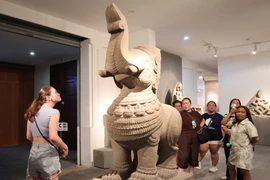
The writer said she took a journey to the Cham Museum — the modest building in Phan Rang –Thap Cham, noting that the museum might not boast size but it brims with pride for the local community, featuring carefully preserved sandstone sculptures, portraits, and rare artifacts.
What made this visit special wasn’t just the collection, but the cultural context, the layered symbology, the meaning behind the rituals and how Cham identity continues to evolve today in modern Vietnam, she said.
Those seeking a deeper understanding of Cham culture will find this museum to be a great starting point, she added. At My Nghiep brocade weaving village, Mahabir said she was captivated by age-old geometric motifs emerged thread by thread, noting that each pattern tells a story of harvests, ancient deities and cosmic beliefs.
While visiting Bau Truc pottery village—one of the oldest in Southeast Asia, the Indian writer had the chance to rotate the clay on a wheel, she was fascinated by how Cham women skillfully shape terracotta entirely by hand and circle with intent, and use deliberate body movements as part of the shaping process.
Mahabir also spent her time on walking through time at Po Klong Garai Temple, which was built in the 13th century to honour King Po Klong Garai. The temple complex is among the best-preserved Cham monuments.
The red sandstone towers, linga-yoni shrines, and carved reliefs give glimpses of a time when the Champa Kingdom thrived, she said, adding that ceremonies are still held here during Cham festivals like Kate, drawing worshippers in traditional dress, bearing offerings, and ancestral prayers.
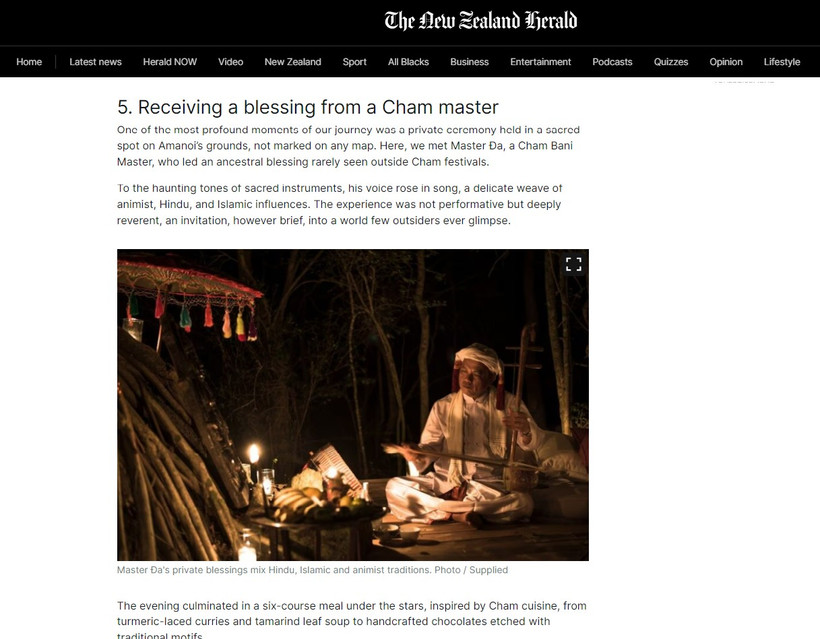
One of the most profound moments of her journey was a private ceremony held in a sacred spot on Amanoi’s grounds, not marked on any map, she said, noting that she met Master Da, a Cham Bani Master, who led an ancestral blessing rarely seen outside Cham festivals.
“To the haunting tones of sacred instruments, his voice rose in song, a delicate weave of animist, Hindu, and Islamic influences. The experience was not performative but deeply reverent, an invitation, however brief, into a world few outsiders ever glimpse,” the article said.
In addition to admiring stunning landscapes and experiencing Vietnam’s vibrant Cham culture, the Indian writer was especially impressed by Cham cuisine, turmeric-laced curries and tamarind leaf soup to handcrafted chocolates etched with traditional motifs.
"Beyond the Cham encounters, the region offers other unique sights. Travellers can explore the nearby fishing village of Vinh Hy, wander through the Ninh Thuan Stone Park or go trekking in Nui Chua National Park. Guests at Amanoi can also do a rewarding climb to Goga Peak, which we did with our toddler quite easily," according to the article.
“To experience the Cham community through Amanoi is to be reminded that luxury is not always opulence. Sometimes, it’s about access. Access to silence. To ceremony. To connection. These were not “activities” checked off a list but meaningful encounters with a people whose culture continues to shape the soul of southern Vietnam – quietly, beautifully, enduringly,” the writer said./.
Khanh Hoa’s Cham temples: A millennium of history draws tourists
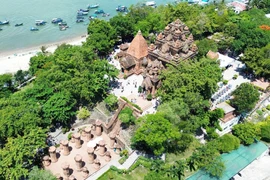
Dubbed the “land of ancient towers”, Khanh Hoa boasts a rich Cham legacy through architectural masterpieces like the Po Nagar, Hoa Lai, Po Klong Garai, and Po Rome towers.