Indonesia's programme to develop visionary leaders unveiled

This programme is designed to equip prospective senior leaders with strategic leadership mindset, geopolitical and geostrategic vision, and the capacity to formulate policies and govern the country amid a dynamic domestic and international environment.

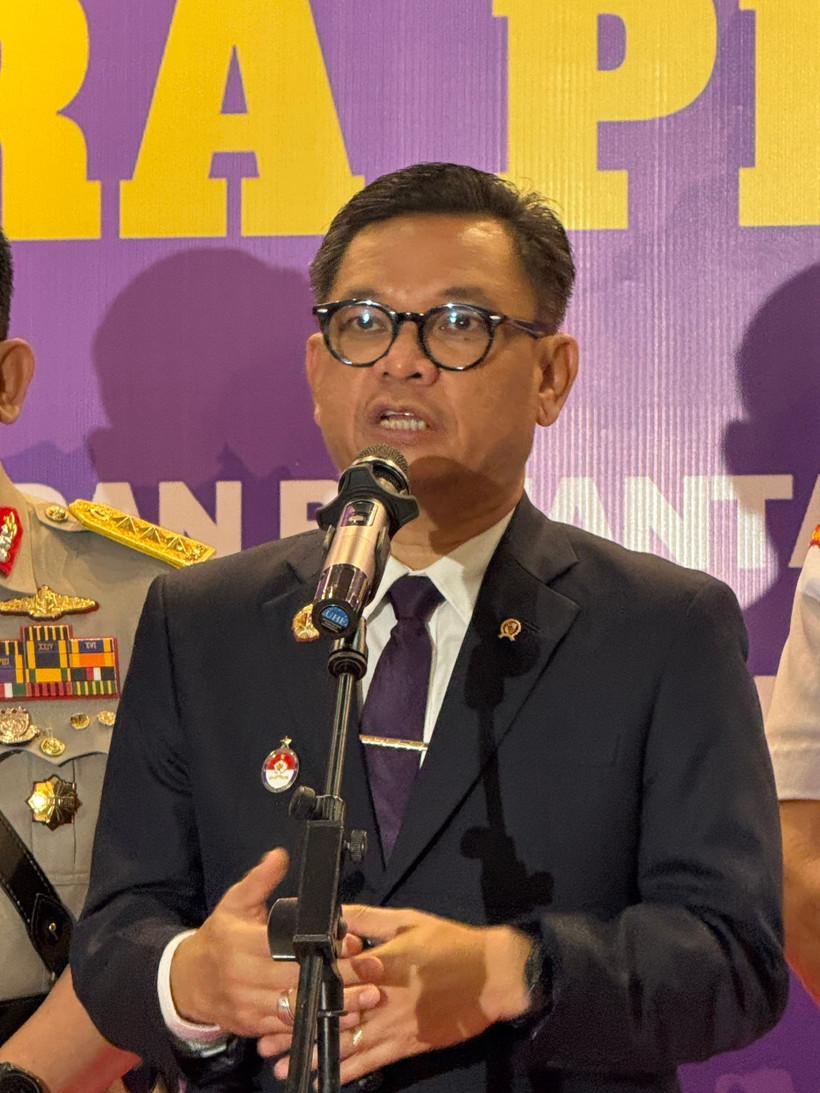
Governor of National Resilience Institute (Lemhannas RI) of Indonesia Dr. Ace Hasan Syadzily (Photo: VNA)

Jakarta (VNA) – The National Resilience Institute (Lemhannas RI) of Indonesia on January 13 held the opening ceremony for the National Leadership Preparation and Strengthening Education (P4N), bringing together 110 individuals, who are expected to be prospective leaders in the country’s diverse sectors in the future.

Addressing the event, Governor of Lemhannas RI Dr. Ace Hasan Syadzily stressed that the P4N programme is crucial in developing visionary leaders who adapt to changing times.

This programme is designed to equip prospective senior leaders with strategic leadership mindset, geopolitical and geostrategic vision, and the capacity to formulate policies and govern the country amid a dynamic domestic and international environment, he said.

Talking with the Vietnam News Agency (VNA)'s resident correspondent in Jakarta, Syadzily highlighted the strategic challenges Indonesia is currently facing, including poverty, unemployment, vulnerabilities in energy and food security, uneven digital transformation, the need to improve human resource quality, political polarisation, difficulties in consolidating democracy, the impacts of international geopolitical dynamics, as well as environmental crises and threats from climate change.

He said that these challenges cannot be addressed through isolated approaches, they require a resilient and flexible national leadership team, capable of coordinating across sectors, enhancing regional resilience, and fostering collaboration among all components of the national system. He emphasised that an integrated, holistic, and representative mindset is a prerequisite for future leaders, especially as Indonesia works toward realising its “Golden Indonesia 2045 Vision.”

The training programme aims to cultivate a national leadership team with a solid foundation of values, a deep understanding of strategic policies, and the ability to coordinate effectively, meeting the requirements of national development in the coming period.

Syadzily stated that, for Indonesia, national leadership requires a combination of core qualities, the most important being a foundation of national values based on four principles - a global geopolitical vision; deep understanding of strategic programmes and policies; the ability to formulate policies aligned with national interests and government perspectives; and the capacity to coordinate and cooperate effectively to realise the country’s development goals./.
VNA

See more

Indonesia’s meat industry faces widespread job loss risks (Photo:en.infosawit.com)

Indonesia’s meat industry faces risk of mass layoffs

The Indonesian Meat Entrepreneurs and Processors Association (APPDI) said the total beef import quota for private companies this year has been cut to 30,000 tonnes, down sharply from 180,000 tonnes in 2025. The figure accounts for only a small fraction of Indonesia’s overall import plan of 297,000 tonnes of beef and buffalo meat for 2026.

Vietnamese Minister of National Defence General Phan Van Giang (left) and Lao Minister of National Defence Senior Lieutenant General Khamlieng Outhakaysone (Photo: VNA)

Laos focuses on building comprehensive all-people national defence posture

Reporting on defence and security work over the past five years, he noted that despite numerous challenges, Laos has recorded significant achievements under the direct, comprehensive and resolute leadership of the LPRP, the guidance of the Central Commission for Defence–Security, the solidarity and efforts of administrations at all levels, sectors, local authorities and the Lao people, along with cooperation from strategic partners.

Indonesian Energy and Mineral Resources Minister Bahlil Lahadalia at a press conference in Jakarta on January 8, 2026 (Photo: ANTARA)

Indonesia to reshape coal policy in 2026

From January to September 2025, Indonesia’s coal production fell 15% year-on-year to 509 million tonnes, while exports declined 4.7% to about 285 million tonnes. Shipments to China and India dropped by 16% and 12%, respectively.

Floodwaters cover roads and residential areas in Jakarta following heavy rainfall on January 12, 2025. (Photo: www.jakartadaily.id)

Indonesia: Jakarta inundated after heavy rains

The Jakarta Disaster Mitigation Agency, known locally as Badan Penanggulangan Bencana Daerah or BPBD Jakarta, recorded flooding in eight neighborhood units, or rukun tetangga, in South Jakarta and two in North Jakarta as of 10:00 am local time, with water levels ranging from 20 cm to 95 cm.

Fire destroys one of the 11 PTT petrol stations that were attacked across three southern border provinces on January 11 (Photo: bangkokpost.com)

Thailand imposes curfew in southern province

The Thai military confirmed that multiple petrol stations in Thailand's southern border provinces were hit by arson attacks and explosions on late January 11, leaving one police officer injured, with five petrol stations in Narathiwat among the targeted sites.

A photo of Lirang Island in the newly designated marine conservation area by the Ministry of Marine Affairs and Fisheries in the waters of West Wetar (Photo: antaranews.com)

Indonesia establishes new marine protected area

This area forms part of a vast ecosystem and serves as an important migratory corridor for many large marine species. The move aims to safeguard high-value biodiversity while ensuring the long-term sustainability of local coastal livelihoods.

Semiconductor wire production at an industrial park in former Hoa Binh province (now Phu Tho province). (Photo: VNA)

Vietnam’s GDP growth impressive amid global headwinds: Chinese media

It said with these results, the Vietnamese Government still has ample room to adjust monetary policy, unleash market vitality, and push ahead with institutional reforms. This, the paper noted, could enable Vietnam to achieve double-digit economic growth during the 2026-2030 period.