Intellectuals advise on formulation of national development goals, strategic decisions

Researchers from the VNU-Hanoi emphasised that the Party and the State should study and select a model in which the State creates and guides development to leverage institutional advantages and build the most effective governance and administrative system.

The draft documents to be submitted to the 14th National Party Congress place a strong emphasis on the role of education – training, science – technology, innovation, and human development as key drivers to enhance competitiveness and promote sustainable development. (Photo: VNA)

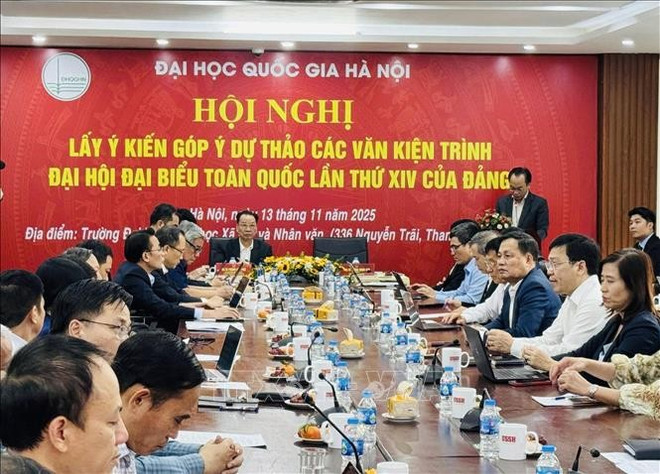
Hanoi (VNA) – The Vietnam National University, Hanoi (VNU-Hanoi) held a conference on November 13 to gather feedback on the draft documents to be submitted to the 14th National Party Congress, demonstrating its intellectual community's sense of responsibility, intellect, and dedication to the formulation of the country’s vision, objectives, and strategic decisions for development in the new period.

Stressing the significance of the coming congress, President of the VNU-Hanoi Hoang Minh Son said that the draft documents place a strong emphasis on the role of education – training, science – technology, innovation, and human development as key drivers to enhance competitiveness and promote sustainable development. These are also the areas which the university must pioneer and has distinct advantages to make strong and practical contributions to.

Notably, the draft Political Report identifies education and training as a strategic breakthrough and a foundation for raising public knowledge, training human resources, nurturing talents, and developing high-quality manpower, particularly highly skilled professionals for science – technology, innovation, digital transformation, and green transformation, Son stated.

This underscores the need to continue fundamentally and comprehensively reforming education and training to make breakthroughs in the field, build an open, modern, and integrated education system, promote university autonomy, reform governance models, and closely link higher education with the labour market demand and the development needs of localities and the country as a whole, he added.
intellectuals-2.jpg
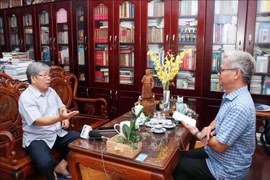
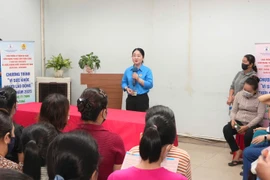
An overview of the conference of the Vietnam National University, Hanoi (Photo: VNA)

At the conference, scientists and experts discussed several key contents of the draft documents, particularly issues related to development vision, new growth drivers, the development of education – training, science – technology, as well as high-quality human resources, and the role of the Vietnamese culture and people in the country’s sustainable development.

Tran Quoc Binh, Vice Rector of the University of Science under the VNU-Hanoi, said that to develop high-quality human resources that meet the country’s development needs in the new era, strategies are especially important for building a modern national education system on par with regional and global standards. In addition, it is necessary to comprehensively improve mechanisms and policies for training, utilisation, remuneration, recognition, and forming a creative working environment for experts, especially top-tier ones with significant contributions to the country.

Chu Duc Trinh, Rector of the University of Technology under the VNU-Hanoi, stated that Vietnam will have limited room for national development if it does not rely on science and technology – a lesson learned by many countries around the world.

To confidently advance to the new era, he proposed the country further participate in higher value-added stages of the industrial chain and build an industrial system that becomes the centre of the development ecosystem, he added.

Regarding institutional issues, researchers from the VNU-Hanoi's Institute of Vietnamese Studies and Development Science emphasised that the Party and the State should study and select a model in which the State creates and guides development to leverage institutional advantages and build the most effective governance and administrative system.

The two core factors ensuring the success of this state model are achieving successful digital transformation, which provides a cornerstone for a modern national governance system; and training and developing a new generation of leadership and management personnel whose core competency is innovation capacity and development leadership./.
VNA

See more

Minister of Agriculture and Environment Trinh Viet Hung presents the Government’s proposals on the amendments to the 2024 Land Law. (Photo: VNA)

Amendments to Land Law aim to achieve three key goals

The Government has identified three major objectives: promptly institutionalising Party policies on land, private-sector development and national digital transformation; addressing urgent practical obstacles to unlock resources and support the goal of double-digit economic growth; and building a modern, streamlined and effective land management system through stronger decentralisation and administrative reform.

Minister of Finance Ngo Van Tuan speaks at the session (Photo: VNA)

NA considers consolidated law to streamline public finance management

Consolidating the Law on State Budget 2025 and the Law on Public Investment 2024 (amended and supplemented in 2025) is necessary to establish a consistent public finance management mechanism; minimise procedures, time and compliance costs; and improve the mobilisation, management and use of State budget resources to support growth.

President Ho Chi Minh's Mausoleum attracts a large number of visitors (Photo: VNA)

📝OP-ED: A century of aspirations, a rising Vietnam

Today, Vietnam's mission is to open the doors wider to development, move the country forward and join the ranks of major powers through its own strength. This is also the most practical way to carry forward the spirit of the historic autumn of 1945.

The 16th National Assembly begins the second phase of its first extraordinary session on August 19. (Photo: VNA)

NA begins second phase of first extraordinary session, focusing on land, housing policies

The 16th National Assembly began the second phase of its first extraordinary session on August 19, hearing presentations on policy orientations for drafting the Law on State Budget (consolidated); amending the 2024 Land Law, the 2023 Housing Law, and the Law on Real Estate Business; and the integration of four national target programmes into a single one.

Member of the Communist Party of Vietnam Central Committee and Deputy Foreign Minister Nguyen Manh Cuong (R) meets with Roman Roun, Chairman of the Communist Party of Bohemia and Moravia (KSCM) in Hanoi on August 18. (Source: Baoquocte.vn)

Vietnam, Czech Republic step up effective implementation of Strategic Partnership

The two sides expressed their delight at the positive and substantive development of traditional friendship and multifaceted cooperation between Vietnam and the Czech Republic, and welcomed the elevation of bilateral ties to a Strategic Partnership in January 2025, which has created a new framework and impetus for deeper, more effective and sustainable cooperation.

Politburo member and Minister of Foreign Affairs Le Hoai Trung (R) receives visiting Chairman of the Communist Party of Bohemia and Moravia (KSCM) Roman Roun in Hanoi on August 18 (Photo: VNA)

Vietnam, Czech Republic seek to deepen multifaceted cooperation

Politburo member and Minister of Foreign Affairs Le Hoai Trung affirmed that the Party, State and people of Vietnam have always cherished the valuable support extended by the Communist Party and people of former Czechoslovakia, as well as by the KSCM and Czech people today.

Minister of Foreign Affairs Le Hoai Trung speaks at the event. (Photo: VNA)

Vietnam-India cooperation grows more practical, future-oriented

Vietnam-India relations, founded by President Ho Chi Minh and Indian leaders and nurtured by generations of the two countries, have developed into a special and enduring friendship. Bilateral cooperation has delivered significant and practical benefits, with two-way trade doubling over the past decade, while defence and security cooperation has become increasingly substantive and effective, reflecting high levels of strategic trust.

Prime Minister Le Minh Hung speaks at the Government's August law-building session on August 18. (Photo: VNA)

Draft laws must support management reform, stronger decentralisation: PM

Participants looked into 11 draft laws and one draft resolution, including laws amending and supplementing several articles of laws on non-agricultural land use tax and corporate income tax; natural resources tax; securities; accounting and independent auditing; the Labour Code; and laws on archives, gender equality, Red Cross activities and employment.

General Secretary of the Communist Party of Vietnam and President To Lam, who is also Secretary of the Central Military Commission, visits Infantry Division 308 of Army Corps 12 under the Ministry of National Defence in Hanoi on August 18 (Photo: VNA)

Top leader visits Infantry Division 308

General Secretary and President To Lam urged the division to preserve its proud tradition and turn it into determination and action, underscoring the need for it to uphold the “vanguard” spirit, especially in building a revolutionary, regular, elite and modern army; training and maintaining combat readiness; advancing science, technology, innovation and digital transformation; observing discipline and law; mastering modern weapons and equipment; and fulfilling its three functions as a combat, working and production force.