Land valuation must align with law, international practice: Deputy PM

Chairing a hybrid meeting to discuss draft decrees guiding the implementation of National Assembly Resolution No. 254/2025/QH15 on mechanisms and policies to address difficulties and obstacles in enforcing the Land Law, the Deputy PM emphasised that the draft decrees must strictly adhere to Resolution No. 254/2025/QH15, serving only as implementation guidelines without expanding authority beyond what the Resolution permits.

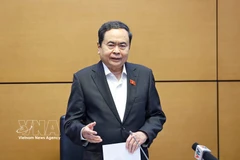
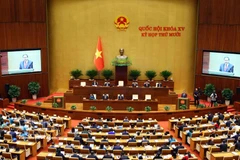
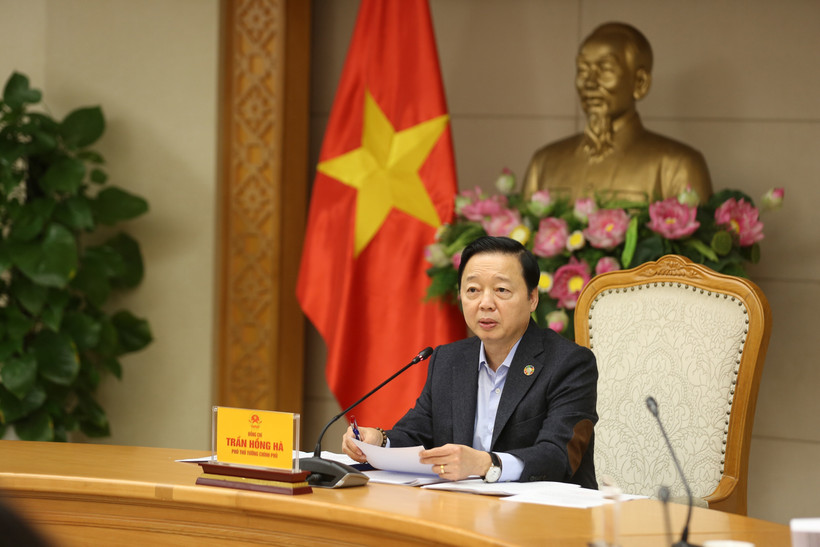
Deputy Prime Minister Tran Hong Ha speaks at the hybrid meeting to discuss draft decrees guiding the implementation of National Assembly Resolution No. 254/2025/QH15 on mechanisms and policies to address difficulties and obstacles in enforcing the Land Law. (Photo: VNA)

Hanoi (VNA) - The selection of land valuation methods must comply with those recognised by law and international practice, be suited to the specific conditions of each plot, and ensure objectivity, transparency, and consistency with actual market conditions, according to Deputy Prime Minister Tran Hong Ha.

Chairing a hybrid meeting to discuss draft decrees guiding the implementation of National Assembly Resolution No. 254/2025/QH15 on mechanisms and policies to address difficulties and obstacles in enforcing the Land Law, the Deputy PM emphasised that the draft decrees must strictly adhere to Resolution No. 254/2025/QH15, serving only as implementation guidelines without expanding authority beyond what the Resolution permits. He stressed the need for clarity, transparency and feasibility, noting that revising policies already agreed upon as shortcomings should avoid creating new complications or increasing implementation complexity.

He underlined that any new regulations must clearly define the responsibilities and jurisdiction of each agency, avoiding vague provisions. Issues that fall outside the scope of the Resolution or are not truly necessary should not be included. With regard to Build–Transfer (BT) projects, he reaffirmed the principle of non-retroactivity, with new mechanisms to apply only to cases arising from July 1, 2025, in order to address practical difficulties without creating legal risks.
tran-hong-ha-2.jpg
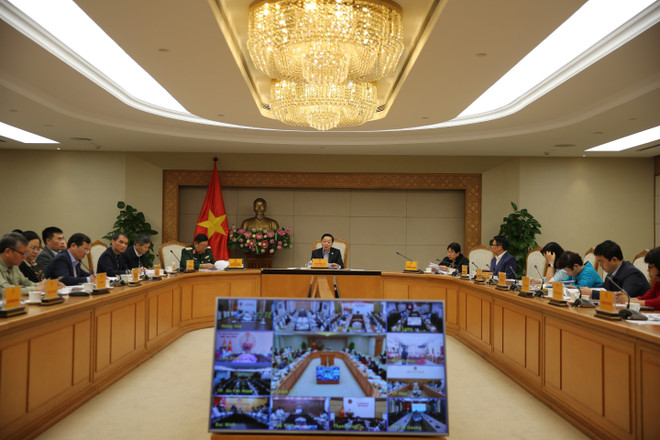
Deputy Prime Minister Tran Hong Ha speaks at the hybrid meeting to discuss draft decrees guiding the implementation of National Assembly Resolution No. 254/2025/QH15 on mechanisms and policies to address difficulties and obstacles in enforcing the Land Law. (Photo: VNA)

BT contracts, he stated, are the highest legal basis for land recovery and allocation for investor payment. All matters related to land allocation, valuation, land-use payment and price determination timing must be based directly on signed contracts. Adding administrative documents without clear legal value could lead to disputes; therefore, all essential provisions must be clearly stipulated in the contracts themselves.

On policy validity, Ha requested careful handling of transitional and retrospective issues to avoid negative impacts on ongoing projects. Cases in which land prices have already been determined should continue to follow existing regulations to ensure stability.

Regarding land valuation, the Deputy Prime Minister called for prudence in applying land price lists and adjustment coefficients. Where market data remain insufficient, specific land pricing in accordance with the Land Law must be applied.

He also stressed protecting lawful resettlement rights and ensuring fair compensation, especially for land used stably before July 1, 2014. Finally, he reaffirmed that the allocation and leasing of State-managed land must strictly comply with auction and bidding regulations, ensuring consistency and legal integrity./.

VNA

See more

The appointment decision handover ceremony is held in Hanoi on March 12. (Photo: VNA)

PM appoints new leader for Vietnam’s top science academy

PM Pham Minh Chinh asked the VAST to continue to serve as the Party and State’s strategic advisory body on science – technology in key areas such as artificial intelligence, energy, marine economy, water security, and aerospace, alongside building a national sci-tech database.

Do Thanh Hai (right), Deputy Director-General of the East Sea Institute under the Diplomatic Academy of Vietnam, speaks at the dialogue. (Photo: VNA)

Vietnam, India promote maritime security cooperation through blue economy development

Through four rounds of bilateral “Track 1” Maritime Security Dialogue, the two sides have outlined priority areas of cooperation, including marine scientific research, blue economy development, humanitarian assistance and disaster relief, naval and coast guard cooperation, maritime law enforcement, capacity building, and maritime connectivity.

Ha Thi Nga (right), Vice President and General Secretary of the Vietnam Fatherland Front, meets with V.G. Kalganov, Deputy Chairman of the External Relations Committee of Saint Petersburg, in Hanoi on March 12. (Photo: mattran.org.vn)

Vietnam, Saint Petersburg step up people-to-people exchanges

The VFF will continue strengthening bilateral ties and promoting cooperation activities, while seeking closer coordination and support from Saint Petersburg to expand people-to-people exchanges in the coming period, VFF Vice President and General Secretary Ha Thi Nga has said.

National Assembly (NA) Chairman Tran Thanh Man speaks at the meeting. (Photo: VNA)

Top legislator asked for thorough preparations for NA, People’s Council election

With only three days left before voters head to the polls on March 15, the top legislator described the election as a particularly important political event and a major national occasion that demonstrates the people’s right to exercise their democratic power by directly choosing qualified representatives to the NA and People’s Councils at all levels.

Ship 17 of Brigade 171 under Naval Region 2 of the Vietnam People’s Navy. (Photo: VNA)

Navy ship completes Milan 2026 multinational exercise in India

Over a journey covering more than 5,000 nautical miles, the ship’s officers and crew combined operational participation with extended sea training aimed at enhancing command coordination capabilities, combat readiness, mastery of weapons and technical equipment, and overall physical endurance.

An overview of the 10th session of the 15th National Assembly which opens on October 20, 2025. (Illustrative photo: VNA)

France-based expert suggests elevating parliamentary diplomacy to support national development

Inter-parliamentary cooperation should be closely aligned with the country’s development priorities, including institutional reform, trade and investment, digital transformation, green transition, energy security, high-quality human resources development and the implementation of international commitments, said Le Van Tranh, a Vietnamese doctoral researcher in law at Paris Panthéon-Assas University in France.

Residents visit polling stations in their wards to review the list of candidates for deputies to the 16th National Assembly and members of People’s Councils at all levels for the 2026–2031 term. (Photo: VNA)

📝OP-ED: Resolutely removing discordant voices ahead of national election day

When March 15 arrives, one will see elderly voters approaching a hundred years old making their way to the polls, young voters casting their ballots with enthusiasm, and multi-generational families going together to fulfil their civic duty. Together, these moments will create a vibrant atmosphere, resembling a national celebration.

Le Thuong, Chairwoman of the Vietnamese Association in the Kansai region, Japan. (Photo: VNA)

OV in Japan place high expectations on NA, People’s Council election

Le Thuong, Chairwoman of the Vietnamese Association in the Kansai region, said overseas Vietnamese are closely following the upcoming election, viewing it as an important opportunity to strengthen the effectiveness of governance and ensure that development policies meet the country’s evolving needs.