Lawmakers urge stronger incentives to boost railway sector

Highlighting the transformative potential of the draft law in revitalising Vietnam’s railway industry, Hoang Van Cuong, a deputy of Hanoi, expressed his support for Article 39, which empowers the Prime Minister to issue a list of railway-related goods and services to be assigned or ordered from domestic enterprises for production.

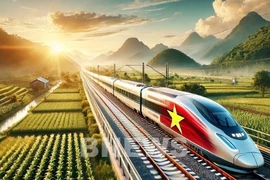
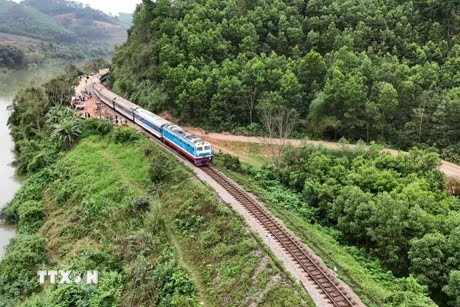
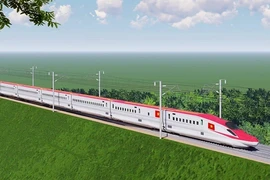
Illustrative image (Photo: VNA)

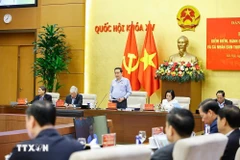
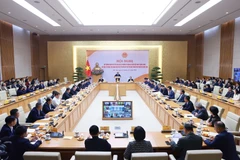
Hanoi (VNA) – The 15th National Assembly (NA) deliberated the draft revised Railway Law at its 9th session on June 18, with the majority of lawmakers stressing that the law is essential to institutionalise the Party’s guidelines and the State's policies, while providing a legal foundation and driving force for the development of the railway sector.

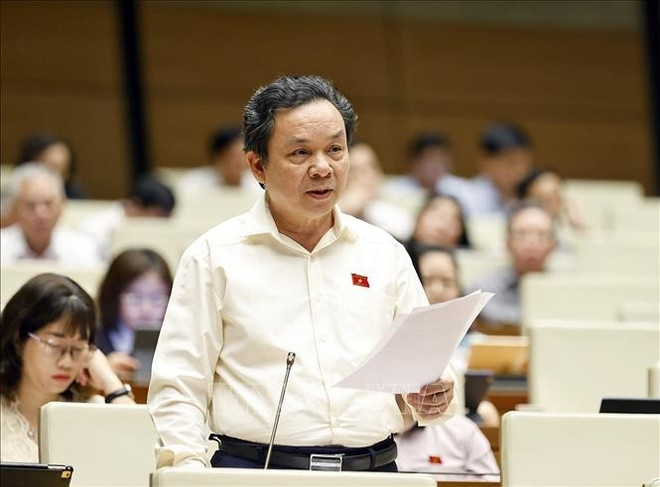
Highlighting the transformative potential of the draft law in revitalising Vietnam’s railway industry, Hoang Van Cuong, a deputy of Hanoi, expressed his support for Article 39, which empowers the Prime Minister to issue a list of railway-related goods and services to be assigned or ordered from domestic enterprises for production.

Cuong stressed that to give businesses the confidence to manufacture, the domestic market must be guaranteed for these products instead of importing them from foreign markets. He suggested that the law should clearly prohibit the import of goods or components listed for domestic production.
duong-sat-1.jpg
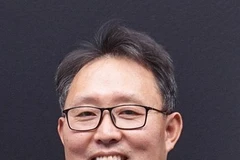
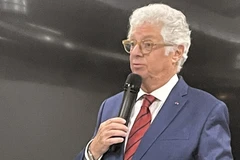
Deputy Hoang Van Cuong from Hanoi. (Photo: VNA)

Hoang Minh Hieu, a deputy from Nghe An province, underlined the critical importance of regulating railway infrastructure business operations as Vietnam is modernising its railway system. He said such provisions are essential for ensuring the transparent and efficient use of public assets, while attracting resources from both public and private sectors for infrastructure management, maintenance, and development.

Hieu noted that while the draft law dedicates significant space to railway construction, it pays insufficient attention to railway infrastructure business and transport operations. He proposed the drafting agency review existing regulations and draw on international legal experience to refine the bill.

Sharing insights from a recent visit to the Cat Linh–Ha Dong urban railway line, Tran Dinh Gia, a deputy of Ha Tinh province, advocated for adding "personal parking lots" to the definition of “technical infrastructure works for connection” under the law. He proposed the definition should also encompass electricity supply systems, drainage, road access to stations, transfer points between rail and road, and other relevant infrastructure. Gia also called for fare subsidies to support urban passenger rail transport.

Deputy Pham Van Hoa of Dong Thap province voiced support for offering strong preferential policies to attract investment into the capital-intensive railway sector. However, he cautioned against provisions allowing the Government to guarantee 100% of investor credit, suggesting instead low-interest or subsidised loans as a more balanced approach.

Regarding transit-oriented development (TOD), Hoa acknowledged it as a sound policy direction but stressed the need to clearly define investor entitlements to encourage greater participation of the private sector./.
VNA

See more

Vietnamese Ambassador to the RoK Vu Ho speaks at the event. (Photo: VNA)

President Ho Chi Minh honoured in RoK on 136th birth anniversary

With Vietnam–Korea ties expanding across multiple fields, he noted that honouring President Ho Chi Minh in the RoK carries significance beyond the overseas Vietnamese. It offers a chance to raise mutual understanding, empathy, and bonds between the Vietnamese and Korean people built on shared values of peace, cooperation, and development.

President Ho Chi Minh works at the Presidential Palace in Hanoi. (File photo: VNA)

Ho Chi Minh Thought guides development path: Top leader

In an article written on the occasion of President Ho Chi Minh’s 136th birth anniversary (May 19, 1890 – 2026), the top Vietnamese leader affirmed that “Ho Chi Minh Thought serves as a guiding light along our development path.”

Vietnamese Ambassador to Venezuela Vu Trung My speaks at the event (Photo: VNA)

President Ho Chi Minh’s enduring legacy highlighted at Venezuela commemoration

Vice President of the United Socialist Party of Venezuela (PSUV) Jesús Faria expressed deep admiration for President Ho Chi Minh and Vietnam’s indomitable struggle for national independence. He described President Ho Chi Minh as an immortal symbol of 20th-century national liberation movements, whose legacy continues to inspire leftist parties, progressive movements, and peoples across Latin America, including Venezuela.

Standing Vice Chairman of the municipal People’s Committee Nguyen Loc Ha (R) and EU Ambassador to Vietnam Julien Guerrier. (Photo: VNA)

Ho Chi Minh City, EU boast ample room for sustainable development cooperation

Since the establishment of their diplomatic ties in 1990, Vietnam and the EU have deepened the bilateral ties into one of the bloc’s most dynamic and in-depth partnerships with an ASEAN member, Ha noted, adding that the relationship entered a new chapter in January when the President of European Council’s visit upgraded it to a Comprehensive Strategic Partnership.

Deputy Minister of Foreign Affairs Nguyen Minh Hang speaks at a discussion session on reforming multilateral systems and global governance, held on May 15, 2026, as part of the expanded BRICS Foreign Ministers’ Meeting in India. (Photo: VNA)

Vietnam ready to strengthen BRICS connection with Asia-Pacific

Hang called on countries to act responsibly in accordance with international law and the UN Charter; respect the independence, sovereignty and territorial integrity of states; refrain from using or threatening to use force; and settle disputes peacefully through dialogue. She also underscored the importance of ensuring security, safety and freedom of navigation through straits in line with international law, including the 1982 United Nations Convention on the Law of the Sea (UNCLOS).

Vietnamese Minister of Foreign Affairs Le Hoai Trung (centre), DPRK Vice Minister Pak of Foreign Affairs Sang Gil (left), and Vietnamese Ambassador to the DPRK Le Ba Vinh cut the ribbon to open the exhibition. (Photo: VNA)

Photo exhibition highlights Vietnam–DPRK relations

Visitors at the exhibition were moved by historical photographs dating back nearly 70 years, including images of the founding leader of the DPRK Kim Il Sung personally welcoming President Ho Chi Minh and a CPV delegation at Pyongyang’s Sunan International Airport during their visit to the DPRK from July 8–12, 1957. In return, the DPRK leader paid an official visit to Vietnam from November 27 to December 3, 1958.

Illustrative image (Photo: VNA)

Deputy PM calls for substantive assessment of two-tier local administration operations

Chairing a meeting on the development of a scheme to review the first-year operations of the political system’s organisational apparatus and the two-tier local administration model, Tra emphasised that the review must comprehensively and objectively evaluate the nationwide implementation of administrative unit restructuring and the operation of the new local administration model.

Vietnamese Ambassador to Russia Dang Minh Khoi (right) and First Deputy Chairman of the Federation Council of Russia Andrey Yatskin at their meeting in Moscow on May 14. (Photo: VNA)

Key directions for Vietnam–Russia cooperation in 2026

Vietnamese Ambassador to Russia Dang Minh Khoi had a working session with a delegation from the Russian Federation Council led by First Deputy Chairman Andrey Yatskin, in Moscow on May 14, discussing the expansion of multifaceted cooperation in 2026.

Officials from Cao Bang province of Vietnam and Baise city in the Guangxi Zhuang Autonomous Region of China hold talks on May 15. (Photo: VNA)

Cao Bang, China’s Baise city eye to boost all-around cooperation

Cao Bang province of Vietnam and Baise city in the Guangxi Zhuang Autonomous Region of China are exploring a “red tourism” route linking Pac Bo and Meng Mo (China) to promote revolutionary tradition education and strengthen bilateral friendship. They are also stepping up cooperation in human resource development through training exchanges and efforts to improve workforce quality.

Atsaphangthong Siphandone (centre), Secretary of the Vientiane Party Committee and Chairman of the municipal People’s Council, speaks at the working session. (Photo: VNA)

Ho Chi Minh City, Vientiane strengthen cooperation for 2026–2030

Under the MoU, the two sides will strengthen cooperation in politics – diplomacy, security – defence, legal and judicial affairs, economic affairs, education, culture and society, cooperation among mass organisations and socio-political organisations, and development support.

Politburo member and Minister of Foreign Affairs Le Hoai Trung (left) meets with Jo Yong Won, Chairman of the Standing Committee of the Supreme People's Assembly (SPA) and Chairman of the SPA of the Democratic People's Republic of Korea, in Pyongyang on May 15. (Photo: VNA)

Vietnam wishes to unceasingly develop ties with DPRK: Foreign Minister

Jo Yong Won, Chairman of the Standing Committee of the Supreme People's Assembly (SPA) and Chairman of the SPA of the Democratic People's Republic of Korea (DPRK), expressed confidence that under the leadership of the CPV, headed by General Secretary and President Lam, Vietnam will successfully achieve the strategic goals set forth at the 14th National Party Congress.

New Hungarian Prime Minister Peter Magyar (front) at the swearing-in ceremony of the new Government in Budapest on May 12, 2026. (Photo: Xinhua/VNA)

Congratulations to newly-elected Hungarian leaders

Prime Minister Le Minh Hung and National Assembly Chairman Tran Thanh Man on May 15 sent messages of congratulations to Magyar Péter and Forsthoffer Ágnes on their election as Prime Minister and Speaker of the National Assembly of Hungary, respectively.